
I got this book from an oddities shop in El Paso. Tooth and Veil is more about gothy jewelry and decor than books so this was a lucky find, this duo of obscure tales from the 1800s. Instead of a teaser or summary, the back of this book has a warning that these stories are “products of their time” and have “social norms, prejudices, stereotypes, and attitudes of the era that do not represent today’s society or values.” The introduction is a fascinating little tale in itself about the joys and hardships of preserving old stories like this. This feels like the smallest of small publishing, an amazing little passion project.But enough about the publisher/reviver; on to the stories themselves.
The Human Vampire; or, the Elixir of Life is is credited to K. F. Hill, the pen name of Lucy A Baer. Almost nothing is known about her, which is a shame because this story is pretty fun.
This is the story of a man who discovers a way to prolong his life and youth. He uses this discovery, of course, to scam women out of money. He sweeps through Southern society using his youthful good looks and suave British accent to woo young heiresses. Once he’s blown through his current heiress’s money he conveniently “dies,” only to pop up somewhere else with his youth restored, ready to scam someone else. Unfortunately, Southern society is small enough that eventually one widowed heiress runs into another and a handful of people get suspicious. The ages don’t make any sense but the resemblance between their various husbands is just too great to be ignored.
The story follows both our villain, who goes by various names as he continually reinvents himself, and his victims as they try to investigate this elusive scam artist. Despite our buttoned up stereotype of the 1800s, I find their horror can be surprisingly graphic and tragic. As we follow our heroes’ investigations we uncover the villain’s horrifying experiments in pursuit of perfecting his elixir of life, and though he does come to a suitably tragic end, his latest wife and children are caught in the crossfire and their lives end tragically as well.
The Human Vampire is also, I think, the main reason for the warning on the back of the book. The late 1800s were a pretty racist time in American history and this book reflects that. The Irish characters are not put in a flattering light and are written in horrendous vernacular. The few black characters are treated more sympathetically, especially the black families who fall victim to the villains’ experiments, but there’s nothing like a modern understanding or nuance here. I’ve read a lot of stories from this era and found this less uncomfortable than most, but the old-timey attitudes might still grind your gears.
Still, I loved this story. It was exciting, the characters were fun to read, and the ending was surprising and dark and morally messy. It truly feels like a hidden gem and makes me hope we discover more of Lucy Baer’s lost work someday.
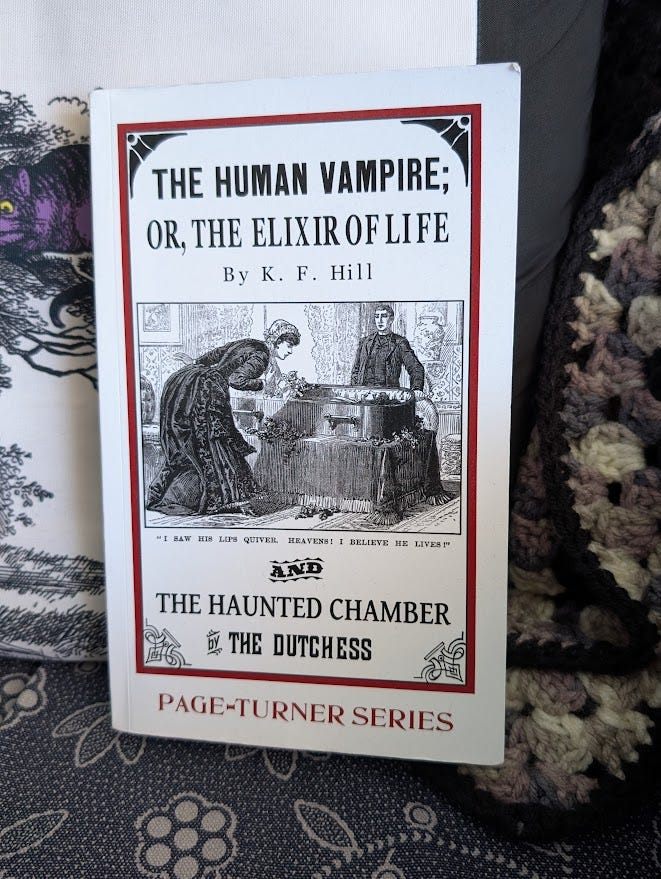
The second story, The Haunted Chamber, is a bit more known and available online. It’s written by Margaret Wolfe Hungerford under the pen name “The Duchess.” It’s a much more straightforward story of love and betrayal, written in a calm and knowing style that highlights the drama of the story, while also having a subtle sense of humor throughout.
Sir Adrian Dynecourt has come home to settle in his family’s castle and invited several friends to stay with him, including the lovely Miss Florence Delmaine and her chaperone, Mrs. Talbot. Unfortunately, Adrian’s jealous cousin Arthur also crashes the party. Social maneuvering and miscommunication turn to betrayal as Arthur tries to secure Miss Delmaine (and her sizable fortune) for himself. If he can somehow also get his cousin’s castle, his triumph will be complete.
This castle, like many, has been rebuilt and added to over the centuries. One tower of the original building still stands, though it’s mostly abandoned now in favor of newer more comfortable areas of the castle. Now it’s the subject of ghost stories and family lore and one very real chamber near the top that locks itself if you let the door close. I think you can imagine where Arthur is tempted to trap his cousin.
There aren’t many surprises in this story. The pleasure is in watching events play out to their inevitable end, and in the elegant feel of the writing. And there is pleasure in it. I enjoy a solid classic tale and this delivers.
Both of these tales, especially the nearly forgotten Human Vampire, brought home to me just how long pulp horror has been around. Stories like these from the 19th century are becoming quite rare as the paper they’re printed on literally disintigrates and it makes me wonder just how many spooky treasures are lost forever. Now that’s a truly horrifying thought. Let’s find them and read them while we still can.
 Darker Books