
Let’s talk about Algernon Blackwood. Specifically, let’s talk about this cute little modern collection I picked up by Pushkin Press of four Blackwood tales. I think I got it at Barnes & Noble, maybe in Amarillo. It’s a hardback with a lovely cover all done in black and white and red. I love the font they used. As I mentioned, this collection has four of Blackwood’s stories–Ancient Sorceries, The Listener, The Sea Fit, and his most famous story The Willows.
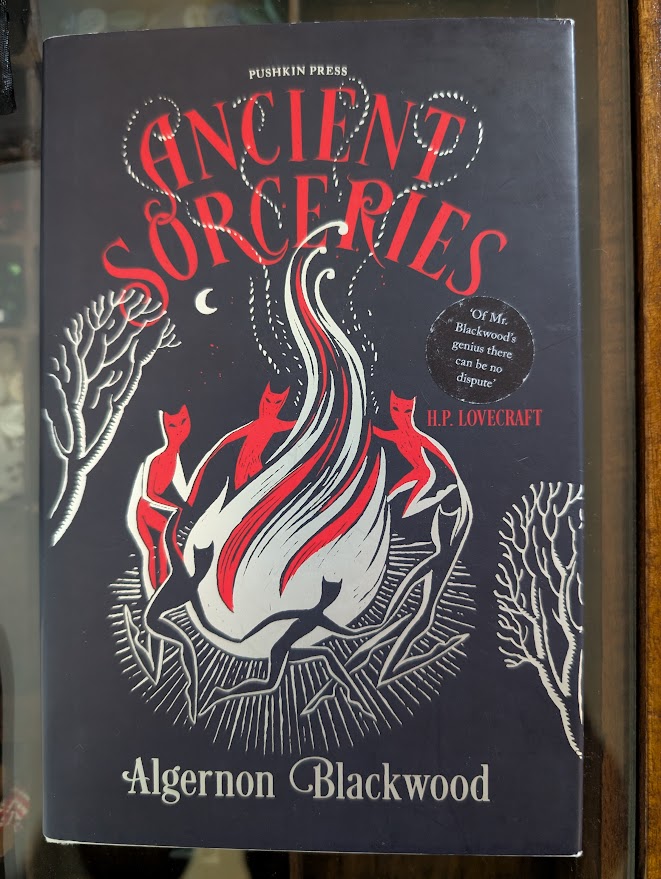
This book’s cover features an H. P. Lovecraft quote praising Blackwood. Lovecraft is arguably the more famous of the two, but Blackwood was a big influence on Lovecraft and honestly, Blackwood seems like a super cool person. Horror fans generally know by now that Lovecraft was kind of an unsuccessful shut-in during his life, and deeply racist even by the standards of his time. He wrote some amazing stories and his Cthulhu mythos has inspired some amazing fiction but he doesn’t seem like a guy most of us would enjoy knowing. Algernon Blackwood, on the other hand, travelled the world and had cool hobbies like ghost hunting and backpacking. He delved deeply into buddhism and occult societies and people said he was pleasant company. He also has an excellent name; Lovecraft was not cool enough to be buddies with a guy like this and, to be honest, I’m probably not cool enough either.
Blackwood wrote over a dozen novels and an untold number of short stories. I’ve only read a handful of his stories so far but I should probably dive deeper into his work. He’s a giant of weird fiction, writing not just horror and ghost stories but also many stories focused on awe and mysticism. These particular four inhabit a space that’s part horror and part cosmic awe.
The first story, Ancient Sorceries, follows Arthur Vezin, who visits a quaint little French town with mysterious goings-on. As he jumps off the train a fellow passenger shouts an urgent warning, but not knowing much French all Arthur can decipher is “because of the dreams and the cats.” It makes no sense until he falls deep into the mystery of this town and its witchy denizens. It’s quite a long story, verging on a novella, slow-paced and atmospheric. The whole town’s catlike quiet draws you in just as Arthur is drawn in. Well, he’s also drawn in by the innkeeper’s attractive and friendly daughter, who eventually insists that she knew him in a previous life . . .
The Listener is a ghost story. Much of the tension comes from wondering how much of the narrator’s problem is ghosts and how much is his delicate mental health. The tension and mystery build slowly up to some quite dramatic scenes near the end. There’s a dramatic reveal at the end I want to discuss so skip the rest of this paragraph if you want to be surprised. After a great build-up that this man is being truly persecuted by a malevolent ghost, the big reveal is that in life this ghost had leprosy. This explains a lot but I’m not sure this news has quite the punch these days that it once had. Finding this out was supposed to be horrifying, I think, but it mostly made me feel sad for this guy who died alone and friendless because of his disfiguring disease. Still, I suppose having leprosy doesn’t entitle your ghost to persecute others.
The next story, The Sea Fit, is a great example of Blackwood’s mixing of horror and awe. “Big Ericsson” is a sea captain with Norse blood in him, and sometimes when the sea and sky are just so, he feels the old gods calling him to join them in the storm. This is the story of one such perfect moment and by the end it’s hard to know whether to be horrified at nature’s attempt to claim Ericsson or to cheer on his glorious union with the sea. This story is quite short and simple compared to the others and quite satisfying.
The last story in this collection, The Willows, is probably Blackwood’s most famous. You’ll find it in anthologies of horror and weird tales and I think at some point I had to read it for school. This is my third time reading it, I think, and I enjoy it more each time. It’s much more about atmosphere and awe than surprise, so it keeps its power as you read it over and notice new details.
It’s a simple story about two men canoeing down the Danube River and running into something otherworldly. The first time I read this, I had to look up the Danube. I’d heard of it, I’m not totally ignorant of geography, but I’d always associated the Danube with all the cities it flows through. Once I read about the wetlands of the Danube Delta and looked up pictures of it, the isolation and otherworldly feel of the story made a lot more sense.
The otherworldly forces these men encounter are fascinating, seeming to exist on another plane while only pushing on the edges of our reality, causing an eerie hum and making the willow bushes seem to shift in odd ways. They also seem to cause an eerie amount of bad luck for our travelers, almost as if they’re trying to trap them on this tiny sandbar they’re camping on. Trap them, or maybe worse. Ordinary things, like missing food stores and a worn spot in the boat they could swear wasn’t there last night; it all takes on ominous overtones on this shifting island with its maddening hum.
It’s quite suspenseful watching these two men try to hide, escape, and understand these mysterious beings and what they want. It’s quite a good piece of cosmic horror and has a quiet realism that makes it all the more effective. Every time I read a Blackwood story I’m convinced I should read more of them. If you’re not familiar with Blackwood this is a great place to start, and if you are familiar please tell me what else of his I should read next. I would love to dive deeper into Blackwood’s awestruck world.
As always, you can and should follow my sister and me either here or on Substack. And as always, you can and should read all the books you can lay hands on.
 Darker Books