October has arrived! The dark nights are growing ever longer and the wind is starting to chill our spines, which makes this the perfect month to cozy up with ghost stories and weird tales. This year I’m devoting spooky month to tales with a supernatural bent, featuring folklore, ghosts, and the occasional monster.
I’ll start with a book I actually bought last October. I was all the way down in Tucson tending to some ghosts of my own when I walked into Antigone Books. This is a feminist and political bookstore and their horror section was tiny, even around Halloween, but I still found a couple of interesting titles and this was one of them.
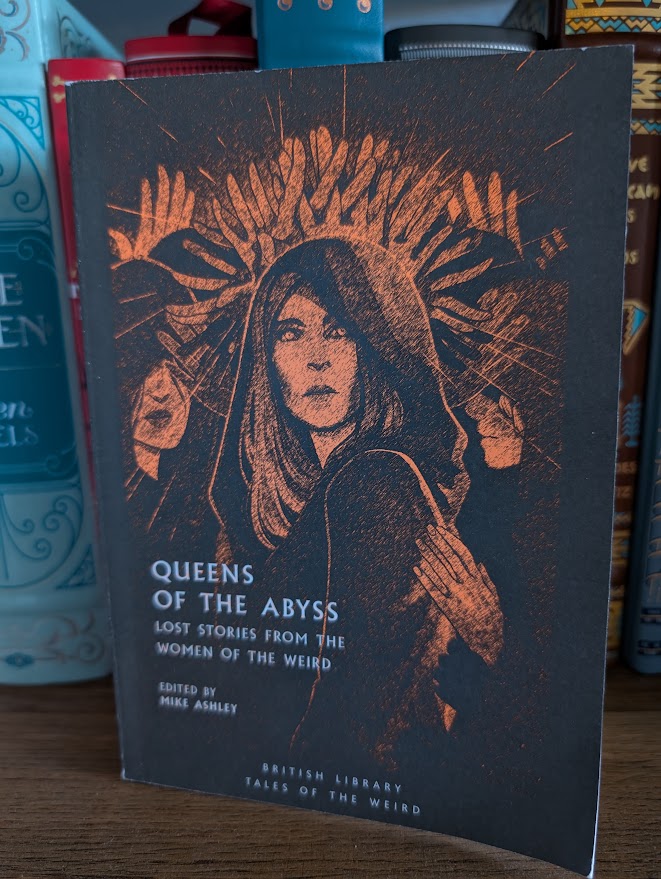
Queens of the Abyss is a collection focused on stories from the 1800s and early 1900s, featuring a number of women who are either less well known or better known for something besides weird tales. It features a few big names, like M. E. Braddon and Leonora Carrington, along with a host of writers largely forgotten by now. All we tend to remember about the ‘weird tales’ era of horror is H. P. Lovecraft and, if you’re lucky, Algernon Blackwood or M. R. James; I love books that get beyond the biggest names and this book really delivers on that.
The editor, Mike Ashley, gives a tiny introduction of each selected author and a couple of suggestions for further reading, which makes this a decent jumping off point for finding further weird tales if you’re interested. There’s a varied selection of ghosts, demons, and general weirdness included and I enjoyed the sampling. A few of my favorite stories were The Haunted Flat by Mary Belloc Lowndes, The Nature of the Evidence by May Sinclair, and The Bishop of Hell by Marjorie Bowen. If you’re looking to cozy up under a blanket or by the fire with a good book, you could do a lot worse than Queens of the Abyss.
What kind of dark is it? Ghosts and goblins and moderate gore
How good is it? 7/10 faerie tricks
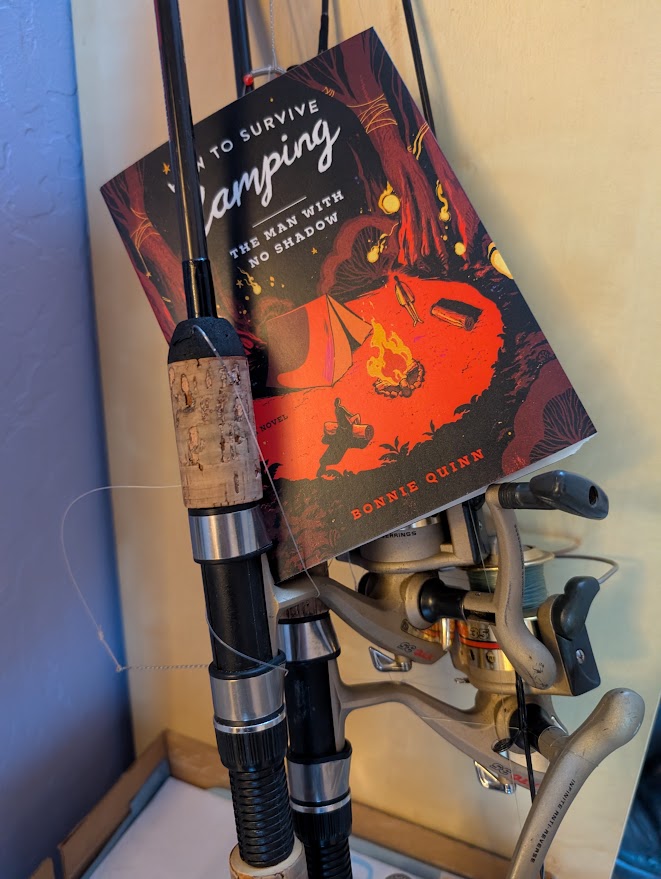
It starts with a list of rules, which had me worried. The list was funny, a good mix of sound camping tips (how to space your tents and avoid flooding) and rules for avoiding death at the hands of mysterious beings (apparently the children with no wagon are not to be trusted and the man with no shadow is bad news). The list promised a fun romp in the haunted woods but it also felt a bit gimmicky, so I worried that haunted romp would be thin on character development and lazily plotted, perhaps. I was delighted to find I was mostly wrong. This wasn’t a deep character study or anything but the story that grows from this goofy set of rules is pretty satisfying.
The woman who wrote the rules is Kate, who inherited this campground when her parents died. She was pretty young when they were taken from her, not quite finished with college, so she had a rough start running the place but it’s been several years now and she’s started to really get the hang of the job by now. Or so she thinks.
This piece of land has been in Kate’s family for a few generations now, which is a source of pride and stability but also the source of most of Kate’s problems. Her family has owned the land so long that it’s become Old with a capital ‘O’. The kind that attracts beings of myth and folklore like fairies and shulikun, along with beings that have power but no stories to their names. At least none Kate’s found in the many books on folklore that line her office walls. Kate’s campground is a huge source of income for the nearby town but it’s also understood that Kate’s job is to keep all those beings contained and controlled. Keep the town safe, keep the land in the family. A simple mandate but not always easy to carry out. Lately things have gotten extra difficult. Some of her land’s inhabitants have gotten restless and one in particular, the Man with no Shadow, seems to want a change of leadership.
I like Kate. She doesn’t seem like a very nice person, truth be told, but she’s tough and serious about her duties both mundane and supernatural. I found myself rooting for her as she fought both the Man with No Shadow and a whole lot of her ungrateful neighbors. I started to see her as tough but fair, willing to take each eldritch being on its own merits; if you’re a being (human or supernatural) willing to deal fairly with Kate, she’s willing to deal fairly with you. I found it refreshing to follow someone trying to really wrestle with and live along side the forces of darkness instead of the usual fleeing or fighting we usually get. Though Kate’s not afraid to kick ass when she needs to. The story was a good balance for me between tough kickassery and vulnerable humanity.
It’s also a perfect book for October, the spooky season of ghosts and goblins and darkening skies, because it’s all about learning to live with the things that go bump in the night. Quinn is a newer author and this is the first in what is now a growing series of stories about Kate and her campground. I plan to eventually pick up further installments of Kate’s adventures and if you want a cozy bit of autumn horror this would be a good choice.
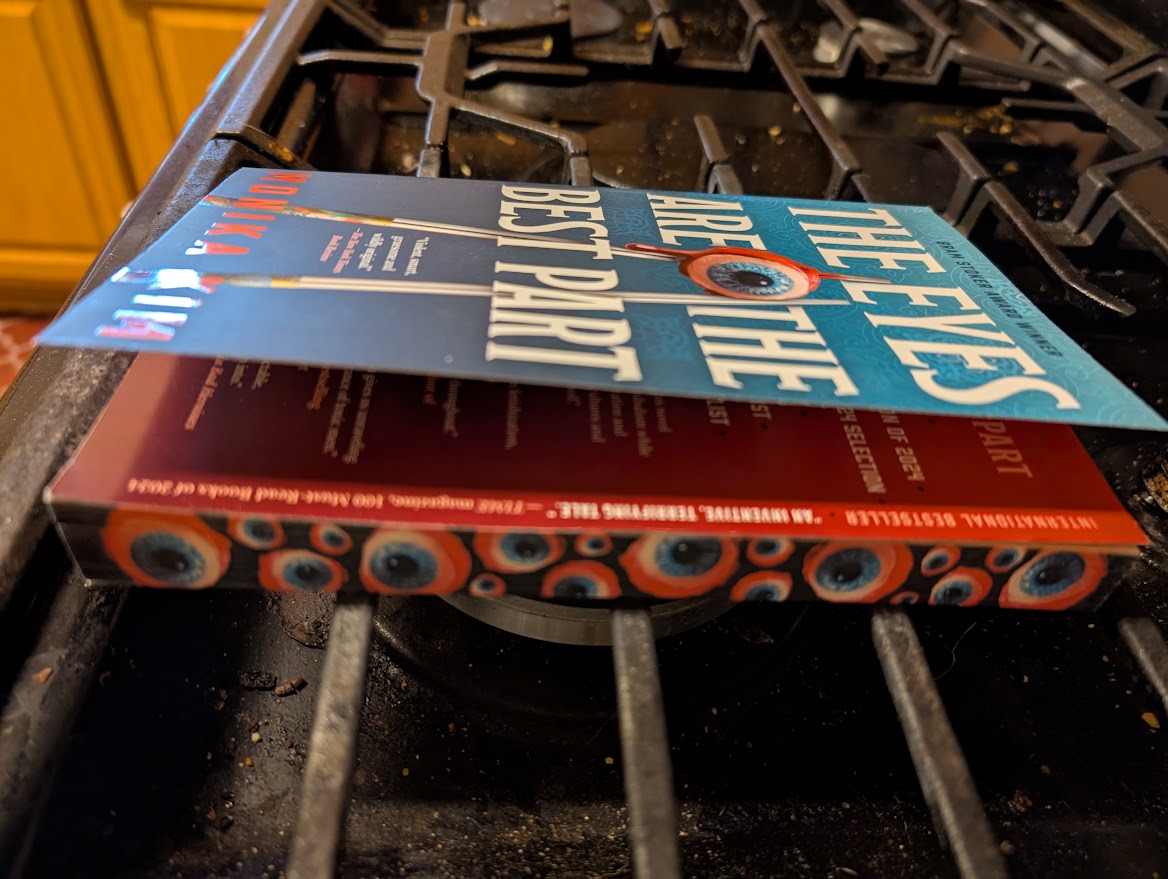
How dark is it? Not as dark as the eyeball theme promised
How good is it? 3/10 tasty tasty eyeballs
The beginning of this was promising. Ji-won’s dad runs off with another woman and her mom is paralyzed by it. Ji-won’s sister isn’t doing much better. Ji-won herself is starting college but instead of going to her dream school with all her friends, she’s stuck all by herself at the local college here in town. Things only go downhill from there as her mom starts dating George, who’s clearly a creep with a fetish for Asian ladies, and Ji-won herself develops a worrisome obsession with eyeballs. Specifically, she wants to eat eyeballs. Blue eyeballs. George’s blue eyeballs.
That’s creepy and interesting. We also find out early on that maybe Ji-won’s always been a bit unbalanced. Back when all her friends got into Berkeley and Ji-won didn’t, she went to great lengths to break up the friend group just because she was bitter and envious. When we learn that, Ji-won’s growing obsession and her quest to destroy George make a twisted sort of sense and Ji-won herself becomes intriguing.
Unfortunately, none of that promise pans out. The intriguing set-up quickly devolves into a weird revenge fantasy involving George and Ji-won’s new college friend Geoffrey, neither of whom have any redeeming qualities whatsoever. George is a cartoonishly gross fetishist with several Asian girlfriends who each think they’re the only one. He takes an actual “business trip” to Thailand that we all know is code for sex tourism. Geoffrey is an overblown parody of a ‘Nice Guy’ who wears feminist t-shirts and spouts feminist quotes while literally stalking Ji-won in a cartoonishly gross way. Yet, in spite of how clearly gross these guys are, they don’t actually do a lot. ‘Ji-won vs the Cardboard Cut-outs’ gets boring pretty fast; it’s hard to excited about her bringing down such useless villains. Of course, if I had gotten invested I would have been even more disappointed at the ending. Ji-won’s revenge ratchets up and up only to largely fizzle out in a fairly unsatisfying way.
The back of this book has a short interview with Monika Kim that says she wants to turn stereotypes about Asian women being passive sex objects on their heads. I get how this book is meant to do that but I’m not sure it actually does much toward that project. Ji-won’s mom and sister are utterly passive, with almost no personality beyond anxiety and spinelessness. Even at the end, when George is in the hospital after literally trying to kill Ji-won, her mom is sneaking off to see him, still hoping this creep will rescue her from her empty life. My best guess is that her utter infuriating helplessness is supposed to highlight Ji-won’s rage-fueled cleverness by contrast but it seems ham-handed and has a “Ji-won’s not like other Asian girls” feel that doesn’t sit well.
There could have been shades of ‘American Psycho’ here, where Ji-won gets away with multiple murders because no one believes a cute little Asian girl would do such grisly things. If that angle had been played up things might have got intriguing again, but that’s not really where Kim takes it.
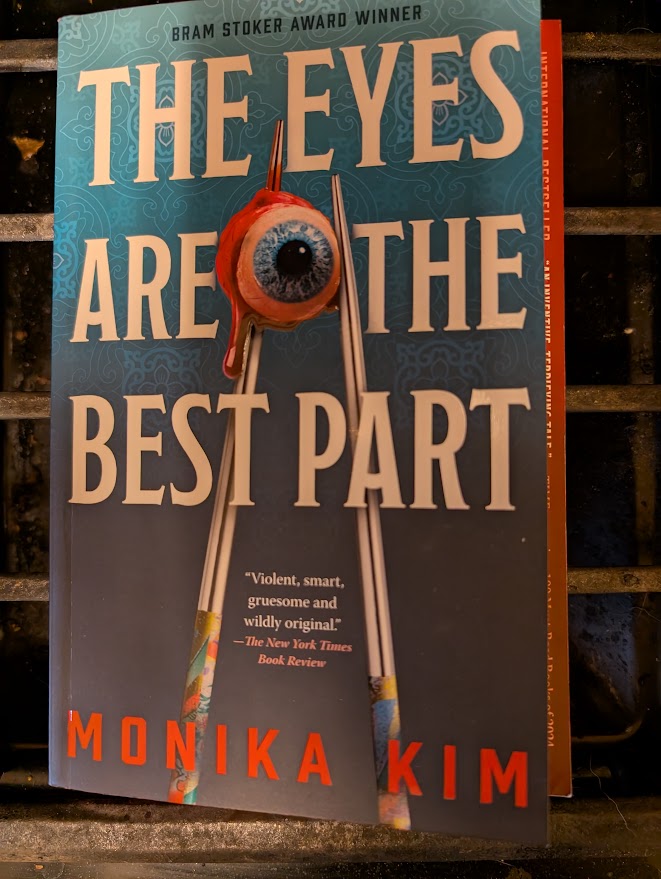
This was a quick read and the eyeball obsession was kind of interesting but by the end I was mostly just bored and annoyed. There was a lot of wasted potential here. The cover is cool, though, and the page edges have creepy eyeballs on them. So that’s something.
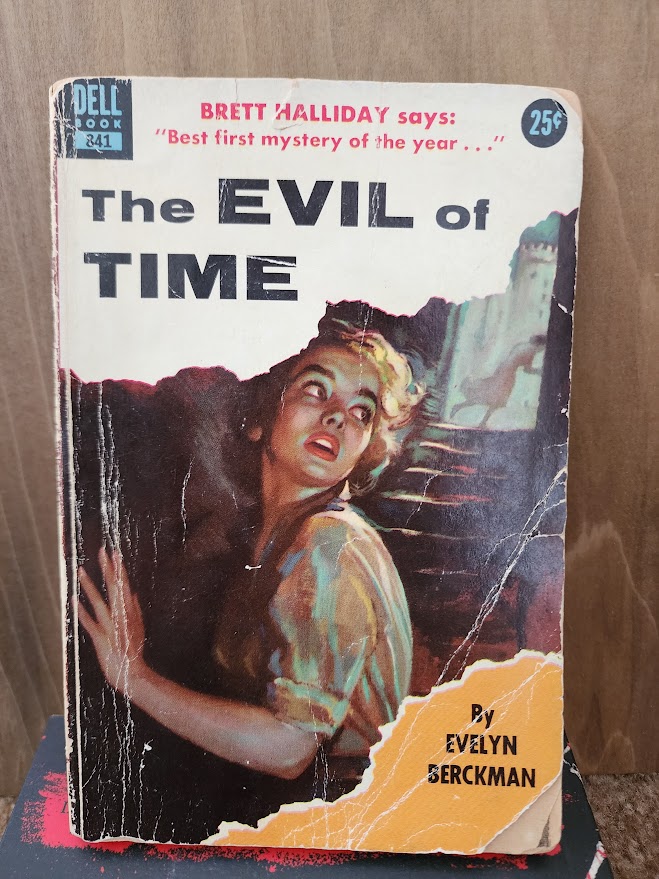
I picked up two Evelyn Berckman novels on the same day, because Brave Books in El Paso gave me free beer and offered me pulp fiction. I am a sucker for both. Even though I read The Evil of Time second, it appears to be Berckman’s first novel, written in 1954. This might explain why it was . . . pulpier? than the other novel I picked up, House of Terror (aka The Blind Villain). Hous of Terror was more subtle, centered on complex family relationships, and this one is a more straightforward mystery in a decrepit castle. I actually loved this book, though. It was suspenseful and the mystery was set up well. It actually gave me a “jump scare” moment, which I almost never have when reading.
The story is set in southern Germany in the aftermath of World War 2. We’re following a woman named Keith who works with the U.S. army hunting down and returning art stolen by the Nazis. Her bosses have been searching Drachensgrab, home of the mysterious Von Kaithur sisters. They’re pretty sure there’s a cache of stolen art there–a Greek tapestry, an obscure Rembrandt, a gold cup by Cellini, and a few other treasures. There are also rumors of money hidden somewhere around the place but the big boss, Colonel Ridge, and his crew have searched everywhere and found neither art nor money. Everyone’s been ordered to move on, but technically they have three days left to search and Keith’s supervisor asks her to go up and look around. Maybe one harmless looking expert in history will find something a pack of stompy soldiers missed.
The head of the house, Luise von Kaithur, is a rabid Nazi sympathizer who bitterly resents all these Americans in her home. There are also weird voices and footsteps in the castle at night. Oh, and one soldier “fell” down a flight of stairs and died. But other than that, what harm could there be in having another look around the place?
Still, Keith is eager for the chance to solve this puzzle and maybe show up the annoying and condescending Colonel Ridge. If she could find something big that Ridge missed, that would be worth the danger. I think everyone hopes Luise “I love Hitler” von Kaither will be less frosty towards a blonde woman in civilian dress; that could give Keith more freedom in her investigation.
This castle is one of the most effectively creepy castles I’ve ever read. It’s not even technically haunted but it’s scarier than many haunted houses I’ve read about. Something about postwar Germany as written by someone so close to the actual war gives the setting a feeling of lingering evil that really got to me but beyond that, Berckman’s writing is vivid and creative. Luise and her sister have a grand ancestral estate but pretty much no money so it’s literally falling apart. Keith can see gaping holes where plaster angels have fallen from the ceiling of her assigned bedroom, and when she pulls the covers off the bed she’s offered, rats scurry out. (She wisely elects to find another room to spend her nights in. One of the few with a decent bed and a lock on the door.) Some of her explorations take her to the attic, with odd domes in its floor (the tops of arched ceilings beneath) and centuries worth of junk piled up, and the old chapel on the grounds, whose organ pipes are filled with dead bats. She also explores the overgrown garden looking for a hidden grotto–grottoes were all the rage in the 1700s, the last time the estate was renovated. While she’s continually frustrated in her search for this elusive grotto, she does find proof that she’s not alone with the von Kaithur sisters. She spies a couple of old men creeping about the place on searches of their own.
She also briefly works with the fiercely masculine Captain Barth, almost working up a romance in the brief time they’re together. Just like the other Berckman novel I read, this story is driven by women and the romantic aspects are largely seen from Keith’s perspective. She’s a bit more stereotypical than Dana, the hero of The Blind Villain. Keith is getting older and worried her abrasive smarts will keep her from finding love, so she decides to deliberately tone it down around Captain Barth. She also needs a bit of rescuing by a big strong man at the story’s end.
True to what I love about Berckman, though, Keith is her own agent making her own decisions. At the last second, even while chastising herself for her contrariness, she sends Barth packing. In the end, she goes for Colonel Ridge, who in spite of his cold exterior, really comes through when she needs it. More than that, after he saves her life he shows a softer side and also freely gives her all the credit for solving the mystery. He has to earn her interest by respecting and admiring her as a person. Romantically speaking, it was a pretty progressive ending for an old pulp novel.
You might notice I’m purposely not telling you exactly how the mystery turns out, and that’s because you should really read this book if you can find a copy. It’s a quick read with an exciting payoff. It’s also fascinating and surprisingly spooky. This book, written by an American transplant to England, is very anti-Nazi but it doesn’t have that epic “good vs. evil” feel you get from more modern takes on World War II. It’s got a personal feel, with the German characters all having different feelings about the war and occupation and the Americans never quite sure who to trust. Luise von Kaithur, for example, is a rabid Nazi and everybody knows it but she wasn’t a soldier or even a financial supporter. She sucks but what can you do? Would she be pro-Nazi enough to push that soldier down the stairs? To hide neo-Nazis? Or will she just frown frostily at all the soldiers invading her home and do nothing? Who knows? The small town scale of the story was scary and thrilling but also added some humanity and nuance to the story.
After two novels, I’m already determined to track down more of Berckman’s work. I think she’s due for a revival.
How dark is it? Dark blue like the blueprints for a house
How good is it? 7/10 hidden rooms
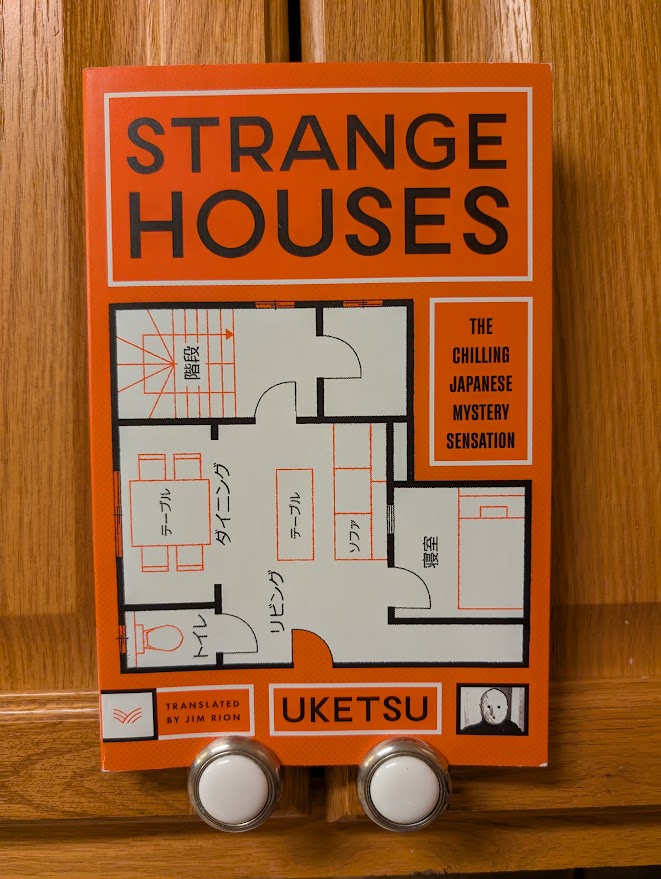
Strange Houses is the second book by Uketsu, a mystery-maker who is himself a mystery. I reviewed his first book, Strange Pictures, a while ago. Uketsu is a Japanese YouTuber who always appears in a freaky looking mask, which he also uses in his author photo for his books. (Also, I actually have no idea what Uketsu’s gender is, I’m just making a wild guess based on body shape. Sorry if I guessed wrong.)
But I digress. On to the book. The first one, Strange Pictures, was a series of separate but interconnected stories; Strange Houses is one long story told through a series of three houses. The writing style is extremely minimalist and straightforward, making it a lightning quick read. The writing style also gives the story a clinical feel, like we’re removed from the emotional impact of the mystery as it unfolds. I don’t think this simplicity is a fault in translation. As far as I can tell, this English translation is a good approximation of the extremely accessible style Uketsu aims for.
It’s not just the prose that’s straightforward and clinical, it’s the whole telling of the story. The narrator, a freelance writer, and his architect buddy Kurihara start looking at a very unusual floorplan and Kurihara decides it must be a murder house. Things snowball from there, Kurihara’s imagination running wild and the author going along for the ride. The thing is, it quickly becomes clear that Kurihara is pretty much spot on about his theories. The narrator, needing a quick piece for a magazine, writes a story about their murder house theory and ends up meeting someone who knows that house, which leads him to another strange floor plan, and so on. The floor plans are printed in the book so we can puzzle over them, which is fun.
The whole book is a bit like the end of a Sherlock Holmes novel, where he explains in intricate detail how the crime was done. It’s all very logical and bloodless, which is not for everyone. I appreciated the style, though, because the actual mystery they’re unraveling is beyond redonkulous. I won’t spoil all the details but it involves secret children being trained to murder houseguests, and that’s just the beginning of the madness. Normally, I’m all for diving into the emotional depth and moral complexity of a story but this one is so farfetched that it doesn’t bear thinking about. The very dryness of the narrative keeps all that just slightly in the shadows, like a horror movie that never quite shows you the monster. For me, it works better that way.
I’m starting to find Uketsu’s books easy reads, light little palate cleansers between more shocking or draining books. They’re still full of murder so I probably shouldn’t say this but I ended this book with a smile on my face, satisfied after a fun little romp through the murder houses. Which, now that I think about it, might be a major flaw in the books. I didn’t find either of them scary at all because none of the characters are fleshed out enough to relate to. For me, they’re fun quick puzzles but if you’re looking to immerse yourself emotionally this is not the author to take you there.
This review was first posted on our Substack in 2025. We reprint it here for your reading pleasure.
This book lured me in with Baba Yaga. I really don’t know that much Slavic folklore or mythology but I’m fascinated by what I do know about Baba Yaga. In fact, this is the second Baba Yaga themed book I’ve read in the last year. Well, I thought it would be. As it turns out, this book really isn’t about Baba Yaga at all and that was a let down but it was still a pretty good book.
Sonny is 13 years old. He has a shaky relationship with his mom. His father has just killed himself. Sonny sees the Grim Reaper smoking a cigarette in the corner of the hospital room where his father has just died.
Sonny’s mother moves them to Oregon to a trailer on someone else’s property. This is her way of getting them a fresh start but it doesn’t do anything to reset their relationship or improve their grim financial situation. The Grim Reaper reappears in Sonny’s life and eventually makes him an offer. Death is a person who serves as death for one thousand years. Death’s tenure is almost up, he was the man captured by Baba Yaga at the opening of the book. Death is offering Sonny a way out of his miserable life and griefstricken Sonny can’t think of any reason to refuse. The remainder of the book explores the terrifying initiation Sonny must endure to die to himself and become Death.
This is really a novel about grief. Sonny, his mother, his new friend Jess, and Jess’s father are all grieving deeply. Each of them is grieving alone. Fritz’s portrayal of grief is accurate and cutting. The horror of the novel paired with the deep mourning of its characters made me wonder if actually it was all just metaphorical or hallucinations. Maybe the character of the Grim Reaper was actually Sonny feeling suicidal himself. Maybe Jess’s mother’s terrifying contortions were the feelings of wrongness and terror a young girl feels when parenting her own dying mother. Probably not but the emotional state of the characters and the supernatural events match perfectly. Metaphor or not, it all resonates.
This was a short read but a good one. Although it felt YA at times, that seemed appropriate for a book about a middle school boy. Not all horror has to be ultra adult. Not all bad things happen to adults. In fact, life’s hardships come for all ages and “A Fig for All the Devils” explores the unique hell of adolescence colliding with grief.
This review first appeared on our Substack in 2025. The book Trex reviewed “last week” will actually be reprinted here next week.
Trex reviewed a book about grief last week, which reminded me that I also have a couple books about grief waiting to be reviewed. By coincidence, we’d converged on one of the classic themes in horror. To that end . . .
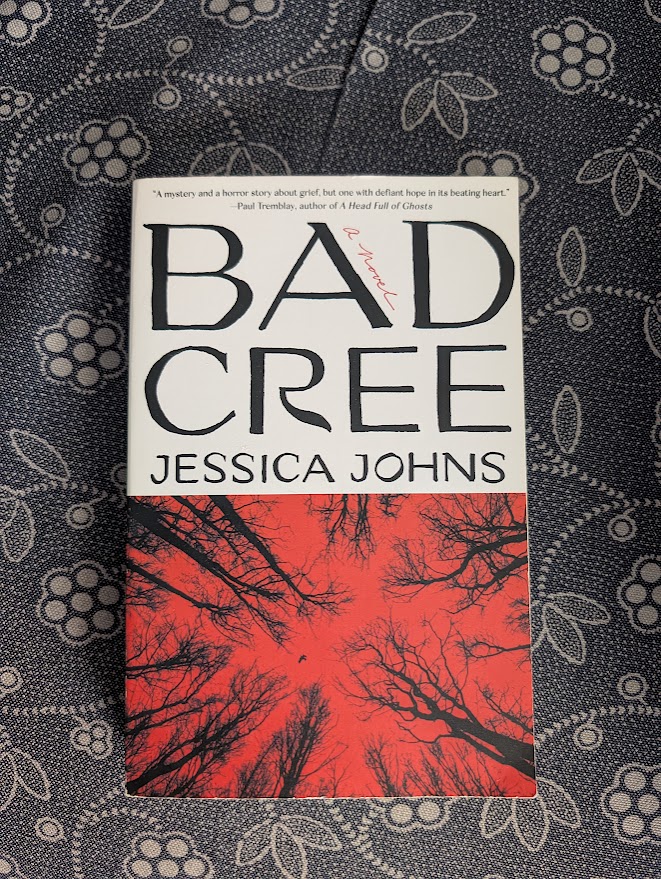
There’s a monster in this one, sure, and there are blood and mystery and reality-bending events, but Bad Cree much more about grief and community than monsters and mayhem. Mackenzie has been hiding out in the big city, not dealing with the death of her grandmother (expected) and her sister Sabrina (decidedly unexpected). She feels guilty about leaving everyone to their own grief, never calling or visiting, but she’s just not ready to deal with it all. Then Sabrina starts to haunt her dreams. Sure, the first anniversary of her death is approaching, but these dreams feel like more than just an upsurge of grief as the anniversary nears. These dreams feel urgent and terrifying. They also might be following her into waking life.
Tired and increasingly desperate, Mackenzie finally breaks down and calls her Auntie for advice. She even agrees to fly home for a few days to consult her family about this dream problem.
Most of the story unfolds on this visit home. Her family–sister, mom, cousins, aunties–circle around Mackenzie to help and comfort her. Both their deep grief and their tight bonds are clear from the beginning. What becomes equally clear and compelling is what’s missing for all of them. As tight as they are, as focused on community and heritage as they all are, there’s still so much that’s just not there. While rarely talking about it directly, this story shows how much has been taken from the Cree and how much they struggle to hold on to what’s left of their culture.
You see, Mackenzie’s not the only one with powerful, maybe magical dreams. Most of the women in her family seem to have them but no one ever talks about them. As Mackenzie figures out that her dreams are showing her a wheetigo, a ravenous wintery monster that feeds on greed and grief, her family scrambles to find any scraps of lore their community still has about this creature. I can’t help but think that a couple hundred years ago, in a former time when her ancestors and their culture were thriving, those dreams wouldn’t have been a secret and more people would know what to do about a wheetigo. Mackenzie’s personal grief over her grandma and sister are magnified by this greater loss of culture and community and history, and this understanding is all the more powerful for its subtlety.
As a study in grief, this is an excellent story. Mackenzie’s dreams are bloody and terrifying but they lead her and her family to an important and ultimately healing showdown with the wheetigo. Nothing can erase the larger loss and pain her community has faced (and continues to face) but Mackenzie reconnects with her family and this crisis gets everyone to open up about their dreams and maybe rekindle a tiny part of their culture as they share their spiritual connection more freely.
As a horror tale, Bad Cree is a bit slow and repetitive, spending a lot of time on family scenes that do highlight the larger themes but sometimes bog down the story. Some of it feels like padding as Johns struggles to turn a great short story into a less great novel. The novel starts well, jumping right into Mackenzie’s terrifying dream world, and it ends pretty well as she and her family face the wheetigo, but the middle drags at times and if you’re looking for a tight and exciting read, this won’t satisfy. Still, there’s an emotional resonance here that has stuck with me. If you don’t mind a slower read and like a more emotional aspect to your stories, this is the book for you.
How dark is it? entirely centered on disturbing abuse and body horror
How good is it? 3/10 open wounds
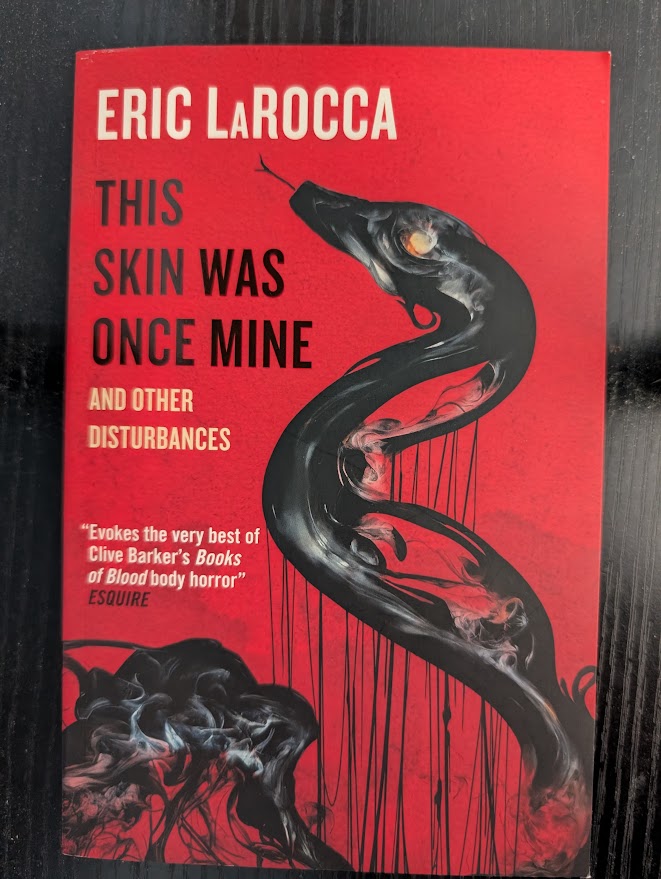
LaRocca gets compared to Clive Barker, it’s right there on the cover, and I can see why. Last century, when I was young, Stephen King and Dean Koontz were the giants of horror but I always preferred Barker’s sensibility. I loved his short stories and was a big fan of Hellraiser. LaRocca shares a certain love of eroticized body horror with Barker. LaRocca also seems to be building on Barker’s queer sensibility, bringing queerness more openly into their stories. But where Barker brought depth and nuance to, say, Pinhead and the cenobytes, making them compelling and even sympathetic in the midst of their worst excesses, LaRocca can’t seem to bring that same depth to their stories. It’s a shame; I’d love to see a true successor to Barker.
This is a collection of four stories, all built around various images or tableaux: an enormous pyre built of fine furniture, a woman meeting a warped and stunted reflection of herself, a father and son literally exploring their shared wounds, a gleaming shard of glass poking out of someone’s skin, an old man choking a baby with a small stone. These tableaux are exquisitely disturbing and often steeped in eroticized body horror. The images at the heart of these stories pull no punches and they’re brilliant in their bloody way.
Everything else about these stories is pretty bad, though. LaRocca seems to have no idea what kind of characters would end up in these awful scenarios or how they’d get to and from them, so everything surrounding each tableau is pretty thin and sometimes nonsensical.
Sometimes the badness is logistical issues that completely pull me out of a story: the story will shift locations with no transition, or a character who can barely walk will suddenly stab the hero and manage to drag her up several flights of stairs and down a ladder. Or a character claims that his stab wounds full of glass never get infected because he carefully removes the glass each night and reinserts it every morning. I’m no doctor but I’m pretty sure that wouldn’t help anything. Also, that same story features a guy walking into the store for a knife to cook with and walking out with a gold-handled jewel-encrusted bit of ridiculousness and nobody ever thinks this is dumb. Have you ever seen a Top Chef whip out a jewel-encrusted knife? Damascus steel, yes, jewels you can’t clean chicken juice off of, no. Without including a bunch more spoilers, there are a lot of dubious and impossible moments for a book this short and many times it was bad enough to detract from the atmosphere if not outright ruin it.
Some of the badness is very thin flat characters. Even when we follow a character’s thoughts we don’t really get any insight into who they are as people beyond the one issue in the story. The best example is the protagonist of the third story, All the Parts of You that Won’t Easily Burn. We spend page after page in this guy’s head but all he ever does is obsess about how erotic it is to cut yourself and put glass in the wounds. There are slight hints that before his marriage he was interested in self-mutilation or some sort of pain play but we never find out why or why he stopped. In fact, in spite of living in his head with him we find out almost nothing about this guy even as he goes from “fine, I’ll try this one little thing” to some fullblown crazy murderous stuff over the course of a couple of days. This flatness is pretty much true of every character. There’s no real rhyme or reason to most of their actions because the characters don’t matter, only the central tableau LaRocca’s rushing to set up.
Maybe the thin characters and nonsensical details are supposed to add to the surreal and dreamlike atmosphere, but if that’s the case I’d like them even less developed. Go all in on the metaphor and allegory instead of dwelling on the characters and plotting at all. What we get here is the worst of both worlds–the characters aren’t relatable and storytelling is sketchy nonsense but the exquisite horror of the central images doesn’t quite hit that emotional center that a good symbol or metaphor does. None of it quite hits right.
LaRocca also, in their desire to be evocative and poetic with their language, makes odd and distracting word choices. People keep glaring when they’re not angry or simpering when nobody’s looking, or using phrases like “all too inherent” in ways that don’t make a lot of sense. It feels like they’re plugging in synonyms from a thesaurus with no idea whether they actually fit where they’re putting them. If I were really invested in the stories I would have overlooked this almost unconsciously; it bothered me because I was already having trouble immersing myself in the horror.
It was all so frustrating because this author does have a gift for evocative imagery and the body horror in this is gutsy and creative, but everything else about these stories is so shitty. This author has written several novels but I’m not sure I could force my way through them. I’ll probably just rummage through used books for Clive Barker’s old stuff.
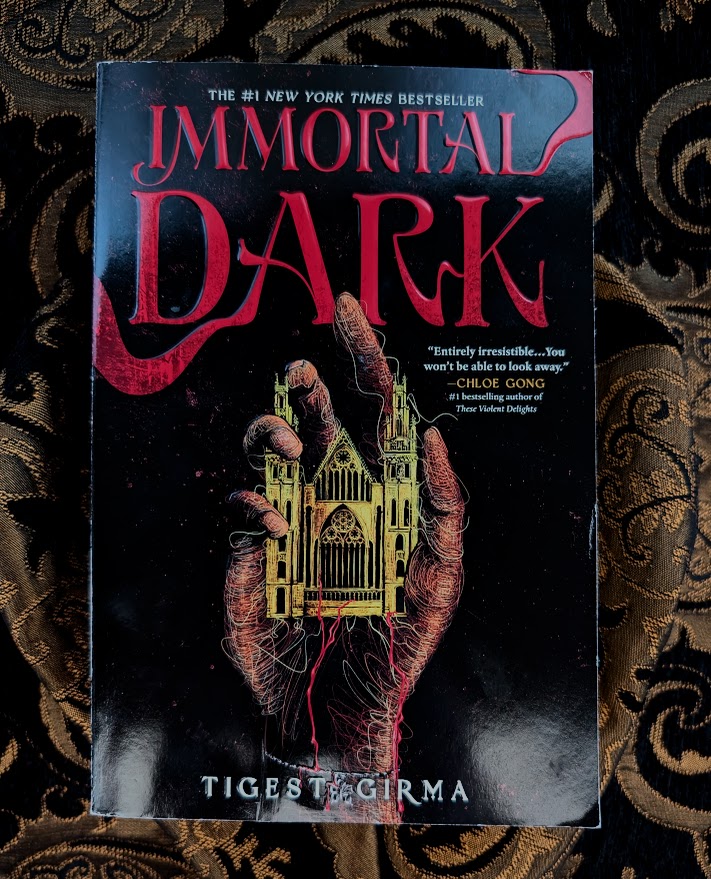
Kidan Adane hates vampires. In the year since her sister, June, was kidnapped Kidan has come to hate one vampire in particular. She hates Susenyos Sagad with the heat of ten thousand suns but to find out what happened to her sister, Kidan has to share a house with this monster.
In ancient times, a powerful sage made a magical pact that bound all vampires to only feed from eighty families. Kidan’s family is one of them. Since her sister disappeared Kidan is actually the potential heir to House Adane but if she becomes unable to inherit, Susenyos Sagad will inherit the family fortune and, quite literally, their house.
The Adanes are founding members of Uxlay University, which is more of a magically closed community than a regular university. In order to inherit her family’s legacy, she has to go live at Uxlay and pass a class certifying her as a vampire companion. When she accepts this challenge, her main plan is to force Susenyos to tell her where June is and then kill him. Inheritance be damned. Once Sagad is dead and her sister is avenged, Kidan can happily leave all this vampire nonsense behind.
The book kind of stalls here for about two hundred pages, with Kidan and Susenyos trying very hard to kill each other but also feeling deeply and strangely attracted to one another. There were hints of conspiracy and intrigue but they were largely unexplored as our two rivals focused on each other. I got bored and frustrated. It was painfully obvious that Susenyos did not kidnap June at all but Kidan couldn’t accept that and they just kept trying to kill each other anyway. I got really worried this would turn into some bullshit romantasy reeking of wasted potential. I like romance but I get bored fast when hotness and sexual chemistry are the only things the love interests have in common.
I also had some issues believing in this “university” where we only see Kidan take a couple of classes, the main one being a “philosophy” class with only one set of correct answers. At times it felt like cheap pandering to the Dark Academia crowd. (Don’t get me wrong, I love dark academia but I don’t love weak crap that sells just because of a label.) Kidan has to pass this class, the answers are set in stone and they’ve been that way for generations, her friends in the class have powerful families hoping they’ll pass, and no one just tells these kids the answers? Riiiiiight.
Still, I actually ended up liking this book quite a bit.
About halfway through the story started to really pick up steam. The intrigue really got going, Kidan and Susenyos created a weird alliance that actually became interesting, and there were some real surprises near the end that got me excited for the sequel. Kidan becomes more interesting and likeable as she wrestles with and somewhat embraces her fierce nature, her friends from “philosophy” class become more interesting and integral to the plot, and Susenyos turns out to have a cool backstory. Also, we finally start figuring out what actually happened to June. All of this was action-packed and got me invested in this world.
I’m glad the world building and plot picked up because I loved the aesthetic of this book from the very beginning, even while I hated Kidan and the stalled plot. The Ethiopian vampire thing totally worked for me. Taking the classic debauched decadence of your basic European vampire and steeping it in African history and mythology gives this vampire world a richness and sense of deep time I enjoyed. And of course a world of African vampires is full of beautiful braids and locs and afro puffs, silky mahogany skin and rich dark eyes. Girma does a great job creating a sumptuous and sexy world that, as the story finally gets going, is as dark and complex as any vampire lore I’ve read and features lovingly rendered African characters in a powerful story. If they ever make a streaming series out of this I would put it on my watchlist, for sure.
If you have a high tolerance for romantasy and ‘enemies to lovers’ tropes, you should definitely check this out. If your tolerance is lower, like mine, I think it’s still worth your time. Even in the draggy first half there’s some moral darkness and shocking behavior and the aesthetic is rich and luxurious. I like where the worldbuilding seems headed and I hope the sequels flesh that out in interesting ways. Uxlay University is made up of only a dozen of those eighty families bound to vampires and we get some tantalizing hints about what other families and groups of vampires might be up to. I hope the intrigue deepens.
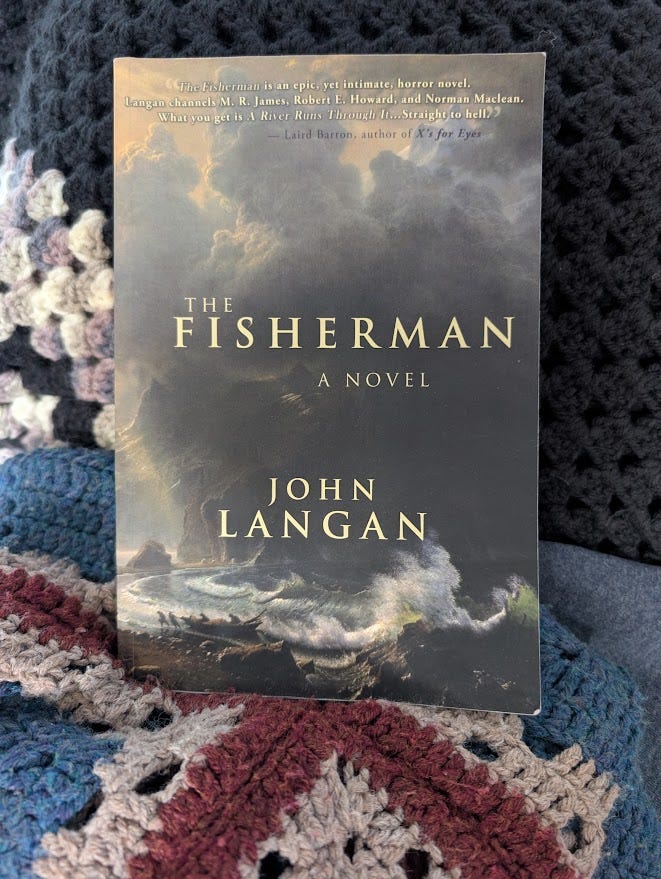
This one’s gonna stick with me. This is more in the vein of weird fiction than typical horror, with the main characters encountering truly mythic forces and being scarred and sometimes warped by them. There is some blood and terror but it’s more the ponderous weight of nature and myth that have stayed with me. Most of the novel is told by old men, the kind that “once caught a fish as big as you!” It’s an unbelievable set of tales, surely exaggerated or maybe entirely made up, but these fish stories are told with such intensity and deadly earnest . . .
This is a slowish story, focused on atmosphere and emotion instead of action or gore. It spends a lot of time on the characters’ ordinary lives and that can be a touch slow. The book builds up to a dramatic climax but it’s more emotional and mythical than action-packed. If you’re looking for something fast and exciting or chock full of gore, this will bore you to tears. If you’re a more patient reader, one who will follow as the layers of the story build and can let the heavy waves roll over you, you’ll be rewarded with a powerful reading experience.
The Fisherman is narrated by Abe, an aging widower. Shortly after they married, Abe’s wife found out she had cancer. When she died tragically young, Abe fell apart as he mourned both the love of his life and the future they’d planned to build together. After months of drinking and unrelenting pain he took up fishing, almost on a whim. It gave him something to do, something to focus on, and eventually those quiet moments in nature gave him the sense that his wife’s spirit might be looking down on him. It wasn’t a dramatic change but in a very real way, fishing saved his life.
Years later, when his coworker Dan loses his wife and sons in a gruesome car accident, Abe invites him fishing. Abe wants to help this broken man but he’s not sure what else to offer but this quiet companionship and something to fill Dan’s hours. They become fishing buddies and it seems, for a while at least, to ease Dan’s grief. Then fishing season ends and Dan begins to fall apart again, hard. Dan’s family tries to keep him occupied, tries to give comfort, and Abe even invites him to dinner once or twice, but nothing seems to pull Dan out of his spiral.
Abe is surprised when once again, come fishing season, Dan wants to come with. Dan even suggests a new stream, Dutchman’s Creek, way up in the Catskills near the reservoir. Eager to help his friend, Abe agrees to check it out with him.
Here follows a story within the story, one that goes back to the building of the reservoir and beyond, involving black magic and mythical forces and the attempts of desperate men to bring back wives lost to the great beyond. Eventually we’re brought back to the present day to see Abe and Dan have their own brush with these same mythical forces, with harrowing consequences. There are moments of blood and horror in both stories, present and past, but more important is the heavy atmosphere created by the weight of grief and the immensity of the netherworld pressing against our own. The build up is slow but the payoff is worth the work to get there.
You’ve probably noticed already the deep river of grief that runs through the book, especially grief at the loss of a wife. Abe’s wife is dead, Dan’s wife is dead, several characters in the story within the story lose their wives to various tragedies. This is a story about men, a deeply male-centered and masculine story about love and grief. Especially as seen and lived through Abe’s eyes, it feels like a deep and compassionate look into the emotional lives of men. Pretty much every man in the story holds his emotions behind that traditional facade of stoic strength, and while it protects them and their families it also separates them and in the worst cases it blocks up all that grief and pain until it breaks the man trying to contain it. Looking so deeply into their inner lives made all these men feel real and relatable, even when some of them resorted to desperate and even horrific measures.
I’m acutely aware of the mountains of books written by, for, and about men and sometimes I wonder how many more we could possibly need. This one, though, I’m glad I read. I absolutely was thrilled by the deep cosmic horror and lovingly detailed monsters and madness; I absolutely was moved by the powerful emotions and difficult decisions faced by Abe and the other men in this story. It felt like an illuminating mix of traditional manly tales with a new, softer understanding of the hearts behind their stoic facades. This book, on many levels, felt like a glimpse of something vast and fascinating. It had a weight that will be with me for a long time to come.