La Llorona

This post first appeared on our Substack in September 2025.

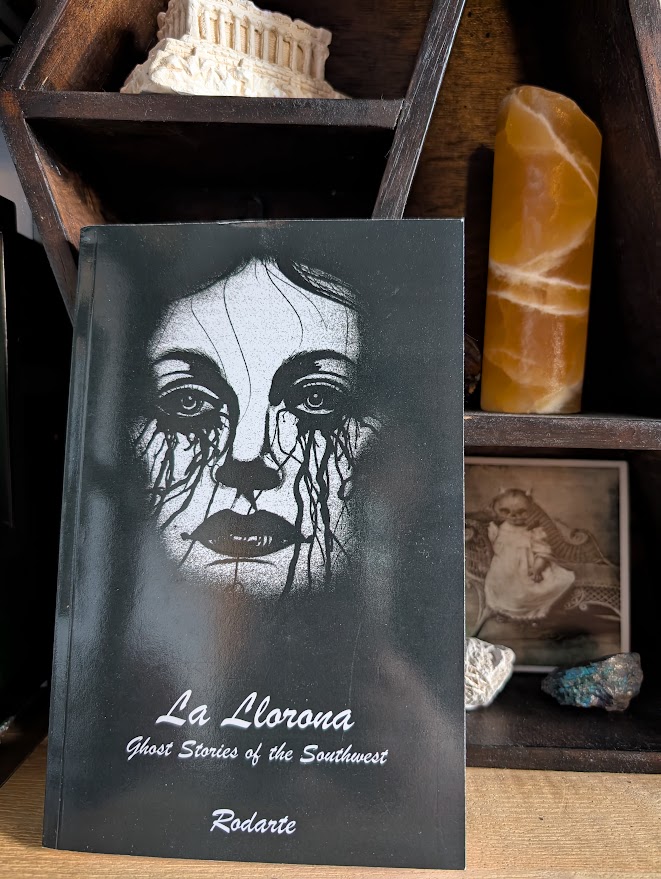
Let’s talk about La Llorona, a collection of short stories by Chris Rodarte.

I picked this one up in a gift shop. We’d first moved to Santa Fe and were still doing tourist stuff. Gift shops are a surprisingly good place to find offerings by local historians and folklorists. My copy seems to be signed by the author, who grew up in Albuquerque, but I didn’t notice that at the time. In fact, at the time I laid it on a table and promptly got distracted by other books. I remember squashing a large bug with it and though I thoroughly wiped it off the cover still feels a bit psychically tainted with bug guts. I think this is why it took me two or three years to actually start reading La Llorona. No, I’m not kidding. Yes, that’s a dumb reason to put off reading this.

Chris Rodarte’s author page says he’s a teacher, which explains his writing style. It feels a lot like a “Scary Stories to Tell in the Dark” collection. Dark and spooky tales told in a simple easy style that’s accessible to just about anyone. A great collection for young readers looking for a scare, with the same potential to either scar a kid for life or ignite a lifelong fascination with the darker side of literature. It’s a quick read with a nice variety of Llorona tales, ranging from uncanny to terrifying to tragic.

Some of the stories are inspired by real events and stories told to the author personally, but they’re not raw ghost experiences. The raw stories are recreated and blended into tight little tales fitting into various common categories–hitchhiking ghost, graveyard haunting, spirit warning, cautionary tale–and all with La Llorona as a central figure.

To be honest, I’m not convinced all the specters are actually La Llorona; some of the connections seem pretty tenuous. I’m not even sure if I believe in ghosts, but La Llorona has a pretty specific backstory and connection to drowning so if she does exist, some of these stories fall pretty far outside her usual bailiwick. Still, even if these experiences aren’t all La Llorona’s doing, they’re chilling nonetheless.

One of my favorites is “The Stick Lady”, based on a friend’s experience. As kids, the woman and her friends were caught in an arroyo when a storm hit in the distance. They began to hear loud cracks, like branches breaking, and saw a terrifying old lady walking toward them ahead of the storm. They fled from the ditch just in time to escape the stick lady and a flash flood coming their way. This was a quick and believable story, made more eerie by being unsure whether the Stick Lady was warning them of the flood or bringing it to them.

Another great story is “Two Minutes to Midnight”, a made up story set in a real building in Santa Fe. The Public Employees Retirement Administration (PERA) building was put up in the 1960s, partially over the site of a historical graveyard. It seems the builders just paved over a lot of bodies, which means every time they try to add or renovate they find old bones. I’m not surprised that ghost sightings began pretty much from the moment the building opened. (Fun fact: this building is not that far from my house. Luckily we’ve never been haunted by its ghosts.)

In this story, two friends are allowed to ghost hunt by an uncle who cleans the building at night. The building is so haunted they have a hard time keeping night workers, so the building is deserted as the uncle leads them way down into the sub-basement and leaves them there. The kids’ annoyance at this prank turns to terror as La Llorona and an army of rats chase them through the building. The PERA building’s history makes this story more intense but it’s spooky and suspenseful even without knowing about the building.

Like most local ghost story collections, this isn’t high literature or destined for the best seller lists. It’s charming, though, an easy read, and an exciting perspective on New Mexican folklore and history. If you like little hints of truth and experience in your spooky tales or have a youngster looking for a good scare, this is a fun little book to pick up.

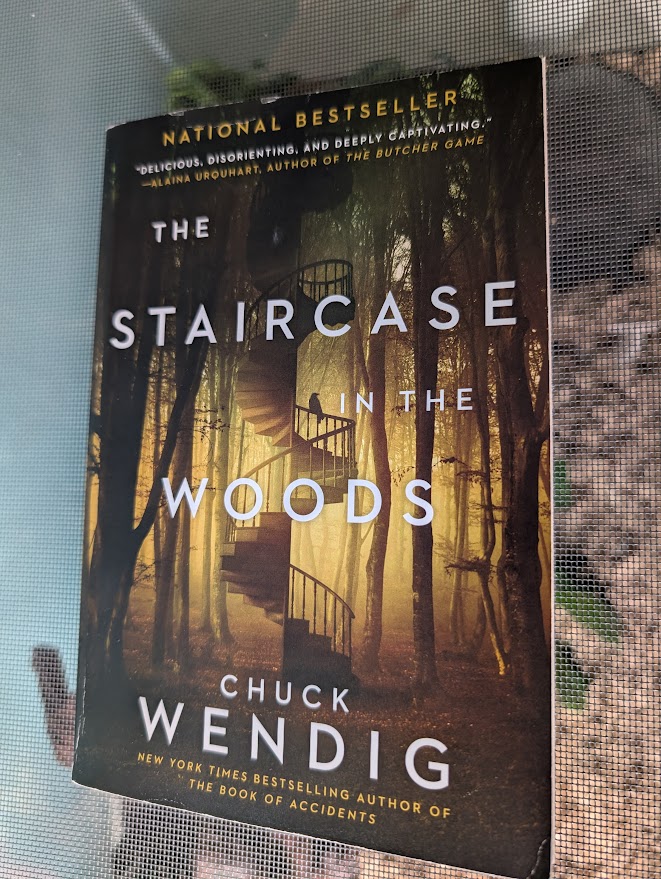
The Staircase in the Woods: a Review

What’s the book? The Staircase in the Woods by Chuck Wendig

How dark is it? Not too gory but kind of existentially dark

How good is it? I give it 6/10 decaying fish

This book was pretty surreal. I saw it on a display and thought, “yeah, I remember pictures of woodland staircases going around the internet a while back. Makes sense they would inspire a horror story.” This book was, indeed, inspired by those pictures.

Mostly, this book is devoted to the kind of otherworldly house those stairs might lead to.  

Way back in high school, Owen and his friends hiked out to a local camping spot to get wrecked in peace and anjoy the wonders of nature. On the way they discovered this random staircase that had never been there before. Just a staircase, all by itself, with no sign of a house around it. That was weird and terrifying, so they ignored the hell out of it and hiked on. But they were high schoolers so eventually drama happened and one of them decided to climb it. Matty, the most popular and well-adjusted of the friends, wanted everyone to climb the staircase with him but no one else was into it. They were all fighting with each other or too high to understand the request or dealing with their own shit. When everyone refused to join him, Matty climbed the ladder by himself and when he got to the top he just . . . vanished.

All his friends had to go home and just live with that confusion, as well as the suspicion of the whole town because there was no trace of Matty and no convincing explanation of his disappearance. Because the staircase vanished, too. The remaining friends, Owen, Lore (known as Lauren back in high school), Nick, and Hamish try to move on with their lives and . . . it doesn’t go that well. Owen and Nick are largely consumed by various mental health issues and Lore and Hamish, while outwardly successful, are emotionally far from okay. They spend decades like this, ignoring each other and nursing their various wounds, until Nick finds another staircase and convinces everyone to climb it. For Matty. This time they all vanish.

At the top of the stairs is a nightmare realm, literally. They’re trapped in a house where room after room is the scene of decay and tragedy; some rooms are the scenes of murders or suicides, some are the scenes of low points in the friends’ own lives. This dreamworld isn’t out to kill them, exactly, but it’s definitely trying to beat them down until they maybe kill themselves or each other in despair. It’s definitely trying to catch each one alone and vulnerable.

Most of the book takes place in this nightmare series of rooms, which makes it kind of a surreal book that runs on dream logic. While there’s plenty of gore and tragedy to be seen in the rooms, we’re really here for the emotional journey each character is taking as they attempt to rescue themselves and each other. We learn about each of the friends and the various pains they carry, both secret and not so secret. They’re all interesting and relatable enough that I was invested in their journey and whether they (and their friendships) survived this ordeal. It felt a little “after school special” in parts, trying too hard to teach me emotional lessons, but I do have a sappy side so I still enjoyed the book overall. 

When I was little I was really weirded out by stories that ran on dream logic; Alice in Wonderland freaked me right out more than anything actually meant to scare me. I’m way more tough and grown up now but dream logic still sucks me in pretty well, disorienting me in a way that makes the horror scenes much more effective. The book starts to lose me near the end as the dream logic devolves into a backstory that doesn’t make a lot of sense but by then I really did care about the characters and whether they’d make it out alive (and of sound mind). I don’t know that I’m itching to read Wendig’s entire oeuvre but I didn’t hate this.

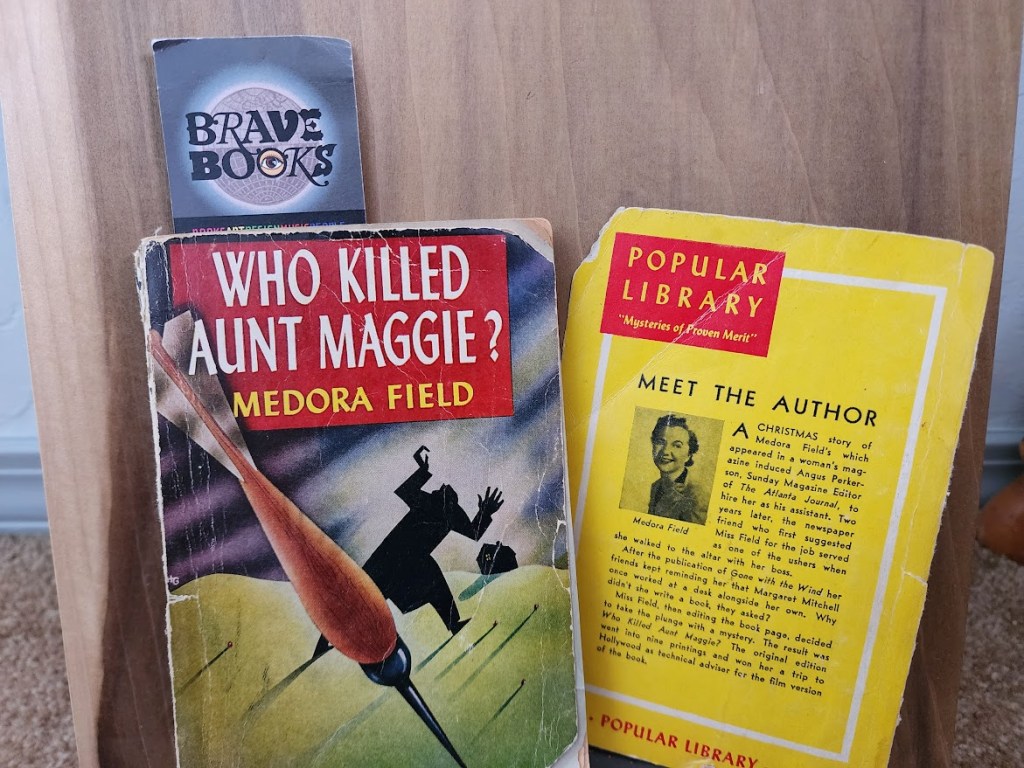
Who Killed Aunt Maggie

This review first appeared on our Substack in September of 2025.

Let’s talk about Who Killed Aunt Maggie by Medora Field. This is one of a handful of pulp novels I picked up in El Paso. I basically scanned the pulp table looking for female author names and murdery titles. I knew nothing about Medora Field and I didn’t know how hard this book is to find these days. Like a lot of pulp paperbacks, my copy started falling apart the second I opened it up, so I’m not surprised they’re becoming rare.

This book is casually racist. It was published in 1939 by a well off white lady from Georgia, so it’s no surprise. The only black characters in this mystery are servants, and they’re all portrayed as kind of dumb and childlike (and extremely devoted to the rich white family who employs them). Late in the book there’s a short speech about the moral inferiority of black people. Medora Field (married name Medora Field Perkerson) was an advice columnist and historian who wrote a book about Georgia’s historical buildings and was friends with Margaret “Gone with the Wind” Mitchell, who was also racist.

Honestly, it’s the unthinking casualness of the racist bits that gets to me. I read a lot of older novels so I’ve run across a lot of racist and sexist and colonialist content. As a modern white American lady, I have the luxury of taking a detached view of most of it. A surprising number of old novels actually examine and push back against the views of their time in ways that are interesting and hopeful, even when they fall far short of modern standards. Sometimes, though, there’s just zero thought and zero pushback and the old timey awfulness just sits there stinking up an otherwise decent story. (I suppose that’s sometimes true in contemporary fiction, too.)

It’s a shame because this is an otherwise decent story. Not great, but decent. The mystery takes place in a grand old plantation house Sally Ambler has inherited from her family. She’s offered to host an impromptu engagement party for her friends Claire and Bob. Bob’s old fling, Eve, is crashing the party and Sally’s Aunt Maggie has also been staying at the house to look through the library and do some family research. Maggie has also been nosily looking at all the recent renovations and making one last search for the secret room their ancestor was rumored to have built back before the Civil War.

As soon as she arrives to get the party ready, Sally feels something isn’t right. Who was that man she saw dashing away through the backyard? Where have the servants got off to, when they were supposed to be here dusting bedrooms and preparing dinner? She’s a bit spooked, but soon all the guests arrive and those thoughts are pushed out of her head. Until bedtime, that is, when she walks out of the kitchen to find Aunt Maggie crumpled at the bottom of the back stairs. At first Sally assumes Aunt Maggie fainted or somehow tripped down the stairs but it soon becomes clear that something far more sinister is afoot . . .

We spend a lot of time watching characters bumble about the house while learning about their various tense relationships and wondering who might have motive for such a crime. Sally and her husband try to call the police but the phone line has been cut. They try to get Andrew, the butler, to drive to the nearest town for help but all the cars’ tires have been punctured. A fierce storm comes up and the electricity goes out, which leads to a night of various suspects roaming about the house with candles, finding clues and having spooky moments. This isn’t the tightest of mysteries but there are fun and intriguing moments as the night progresses.

The next day they finally get the police and coroner out to investigate but at first this only leads to more confusion and questions. The coroner, by the way, is a blind lawyer. In these forensics-heavy days of medical examiners and crime scene investigators, it’s easy to forget that coroners with no medical expertise did and still do exist. This coroner’s expertise is in ferreting out motives and secrets by listening intently to the way people talk. He’s an interesting character, but he’s also the one who gives the racist speech, so that ruins things a bit.

After a lot of worrying and conjecture and confusion, Sally literally stumbles onto the mystery’s solution, which is a lot more tense and suspenseful than it sounds. The book’s finale was pretty exciting. Not sure it was worth the racism, but it was a good ending.

And there we have it. Who Killed Aunt Maggie was an interesting experience but I’m not itching to find Field’s second novel. It might interest you to know both of her books inspired movies in the 1940s; I haven’t seen either movie and the synopsis for the Who Killed Aunt Maggie film sounds not much like the book, but if you’re into old movies you might look them up. Tell me if they’re any good. Tell me if they’re also casually racist.

Incidents Around the House: a Review

What’s the book? Incidents Around the House by Josh Malerman

How dark is it? Light grey. Like, so light it’s almost just plain white. 

How good is it? I give it 1/10 hauntings. Did not enjoy.

The book is narrated by Bela, a young child being haunted by a mysterious entity calling itself her “other mother.” The entity wants Bela to let it “into her heart” so it can use Bela’s body to reincarnate. If Bela agrees to this plan, her own soul will go . . . somewhere else. The entity is pretty vague about where. The entire book revolves around Bela and this haunting, so connecting with this character is key to enjoying the book. 

I did not connect to Bela at all. I’m guessing Josh Malerman doesn’t spend much time around kids because Bela doesn’t sound like any kid I’ve ever known. She sounds like random bits and pieces of lots of kids I’ve known, of lots of different ages. Supposedly she’s eight years old but she talks with the unreflective simplicity of a 5-year-old and she still calls the toilet a “potty” like she’s even younger than that. Then, when it’s convenient to the plot, Bela suddenly has the understanding and reactions of a young teenager. She also has no personality beyond being a good dancer  and having a demonic imaginary friend. Bela didn’t feel like a real person to me, and since she didn’t feel real I couldn’t care less what happened to her. Without that, nothing about the book is scary or even particularly interesting. 

Bela’s parents, who carry forth most of the book’s actual action as they try to get help for Bela, are almost as flat as Bela herself. Daddo is almost pathologically positive and easygoing and Mommy’s only personality traits are being super high strung and cheating on Daddo with anyone she can find. Also, they both drink way too much. Also, their marriage is slowly disintegrating, probably because of all the drinking and cheating. If Bela were an interesting character, I’d be interested in how she deals with these pieces of human wreckage. But I don’t care about her so it’s hard to care how her parents’ poor decisions affect her. 

Mommy and Daddo’s emotional issues and relationship build up to a climactic reveal, which comes in the form of a huge monologue dumped on Bela herself, who seems to understand it and react on a teenage level but narrates it with her typical kindergartener flatness. Not to spoil too much, but I was underwhelmed when the big reveal was that (SPOILER ALERT!) Mommy was married before and Daddo is actually Bela’s stepdad. The monologue is very emotional for Mommy bacause it involves even more cheating and drinking than she currently does, but I don’t see an 8-year-old having any idea what to make of this at all. It’s presented in a very adult way in an attempt to “destroy Bela’s innocence” but just knowing a bunch of adult stories doesn’t really do that; part of being an innocent is being too young to get what any of that means even when you are told about it. So the whole reveal felt shoehorned in to bring the parents’ issues to some sort of climax.

If I squint really hard I can see this book trying to be the sensitive study of a troubled marriage and an emotionally neglected child, framed by the haunting story. It didn’t work for me, but I think this is what some people enjoyed about the book. For me, these parts felt too repetitive and underdeveloped to have much impact. This is the real down side of choosing a child as the narrator–we get a lot of faithful reports of conversations Bela overhears, but no real introspection or exploration of, say, why Bela has no friends or why Mommy feels so compelled to explore her dark side to its limits. Without that exploration, this feels more like a hamfisted moral lesson than a deep look at, well, anything. There’s no depth here for me.

The actual entity was pretty well done and suitably creepy, I’ll give it that. Its size and shape are constantly shifting in an unsettling way. it also mimics Bela’s loved ones as it tries to manipulate her into giving up her body; some of those scenes build nicely as some trusted person slips into disturbing territory and you realize this is not who you thought it was. I think some people read Bela and just mentally insert some actually endearing child in her place, and if you can do that I think the horror elements are much more effective. 

After I finished this book I looked up reviews, and this seems to be a polarizing book. A whole lot of people where just as bored as I was, but a whole lot of people got deeply invested and started checking their closets for monsters. I do think the cartoonishly flat characters are the key to both reactions: some of us just can’t bring ourselves to care about these people as written and some people are able to replace them in their imaginations with much better characters they actually can care about. Of maybe fans of this book have just never met a child and don’t know any better. Yeah, maybe that’s it.

The Works of Vermin: a Review

What’s the book? The Works of Vermin by Hiron Ennes

How dark is it? Um, it’s hard to say. On the one hand, people are dying in droves and every character’s life is a horrorshow. On the other hand, none of this is told in a dark way at all so . . . maybe that makes it even darker? Technically, darkest of dark. Drenched in blood and sap. But I was personally more fascinated than horrified.

How good is it? On a scale of 1 to 10 pests. 9/10 pests. But it’s also very weird and not for everyone. Read a few pages in the store before you decide.

This book is a glorious chaos. From beginning to end, I was just barely hanging on as I followed the various characters on their adventures through this splendidly horrific fantasy city. I’m still not sure I understood it all because no one ever explains anything in this book, but I think I loved it. Yeah, I’m pretty sure I loved it.

Tiliard is a city tunneled into an impossibly large tree stump straddling a river. At the top of the stump are the rich, obsessive about their opera and perfumes and fashions. They’re also, it seems, always caught up in deadly political drama. We’re following the Laurel Chancellor and his right hand man, the Marshall Revenant, as they attempt to defend their positions against any and all upstarts. We’re also following the Marshall’s head perfumer, Aster, as she befriends an exciting newcomer to town. Who is this new guy, this Mallory vant Passand? Is he part of the latest group of starving artists trying to overthrow the Chancellor? Is he angling to meet Olaf Aufhocker, the reclusive author of this era’s most popular operas? Is he just really into Aster? Who knows?

While that drama unfolds, we’re also following denizens of the city’s underbelly, who literally live on catwalks and bungalows hanging from the giant stump’s underside. Guylag is a humble exterminator, doing his best to look out for his little sister Tyro and willing to do literally anything to give her a better life than he has. Since this entire city is built in a rotting stump, there are always new and exciting vermin to smoke out and extermination is a booming but dangerous business to be in. Guylag (Guy for short) and his partner Dawn answer a particularly tricky call that results in a nasty sting for Guy and a whole new species of pest for his team to hunt down. Pretty soon the hunt for this particular pest becomes all-out war between the various extermination companies of the undercity, and Guy and Dawn are on the front lines.

It’s clear that the rulers on top of the city must somehow connect with our plucky undercity exterminators, but it’s not at all clear why or when or how. Since the book hurtles ahead at full speed and never explains anything ever, I was utterly surprised when these questions were answered. I can’t remember exactly what page it was, but I was well over halfway through and still confused (though increasingly delighted) when everything snapped into focus. Suddenly it all made sense. Or, well, nothing in this book quite makes sense but it all came together in the most satisfying way. I read a whole lot of books and it’s become hard to surprise me, but I did not see this twist coming. That made me love this book all the more.

This book is part horror, part fantasy, part I-don’t-know-what. You need a strong vocabulary and a high tolerance for confusing experimental vibes to enjoy this book, but if you can get past that it’s a unique brand of excitement and fun. It’s always on the verge of becoming nonsense but Hiron Ennes manages to keep it just barely together, and amid the chaos I found myself really attached to most of the characters, hero and villain alike. 

Now for a slight spoiler.

Stop here if you hate spoilers.

Okay.

Ready?

Mallory vant Passand is a trans gentleman. Or possibly genderfluid. Or nonbinary? Mallory is beyond labels. This is clear from very early on and seems of zero importance to any of the characters, including Mallory. Tilliard is a very accepting tree stump city, possibly because everyone’s so distracted by all the operas and murder. Eventually, as Mallory’s history is revealed, it becomes key to the plot in a way I should have caught onto sooner. In my defense, I was distracted by the many assassination attempts and the exterminator war unfolding. I mention it at all because I was thoroughly excited by Mallory as a bold adventuring character. As the book progresses Mallory’s loose relationship with gender becomes a very cool part of the adventure and I can’t review this book without mentioning how much I love how it plays out. It felt like an inspiring call to transcend our hang-ups around gender and sex and just live freely, without ever actually saying anything like this at all. Because, as I’ve said before, this book never explains anything ever. It doesn’t have time; it’s too busy living its best life.

An Education in Malice: a Review

What’s the Book? An Education in Malice by S. T. Gibson

How dark is it? Eh, not that dark. Lot of sex, very little murder.

Is it good? On a scale from 1 to 10 vampire kisses. 2/10 vampire kisses. Did not love.

Man, I wanted to like this way better than I did. I love the vibes of Dark Academia and I was excited to read this mashup of Carmilla (lesbian vampire classic) and The Secret History (elite New England college, charismatic professor teaching a hypercompetitive literature class). I’d seen this in all the stores and heard a lot of good buzz, but I was deeply bored and disappointed once I actually got to reading. The book felt like a rough draft that was rushed to publication way before it was ready. 

Laura is a shy Southern girl away from home for the first time. She wants to become a priest, but also secretly longs to be a dominatrix. Carmilla is a rich jaded Austrian whose parents gave her everything but love, who came to this school specifically to study with their charismatic poetry professor, Doctor Delafontaine. Delafontaine is a vampire searching for her lost lover while grooming Carmilla to be her . . . her thrall? Acolyte? Replacement lover? Probably all of the above. 

Laura and Carmilla totally get together, of course, but not before Delafontaine turns Carmilla into a vampire. This happens as Delafontaine reawakens her own sire, Isis, hoping they can get back together. (Delafontaine clearly has her own dramatic relationship history that is hinted at but barely explored.) Isis, however, turns out to be more of a bloodthirsty monster than the average vampire and this causes some exciting problems for our trio. 

The bits with Isis are pretty bloody and exciting, but there aren’t many of them. This is mostly a romantasy with fairly typical tropes and moderately steamy sex scenes between Laura and Carmilla. If you’re a big fan of romance and really only care about steamy sex scenes then sure, read this book. If you want more than that–coherent characters, good pacing, and a solid storyline to your romance–this book will come up short.

Carmilla is a pretty undeveloped character, and since she’s underdeveloped the weird relationship she has with her vampire professor feels awkward and forced, especially since Delafontaine’s character is also underdeveloped. She’s a predator who has clearly groomed Carmilla in some deeply inappropriate ways, and it’s implied that Delafontaine’s sire maybe did the same to her so . . . something something generational trauma? There could be something interesting there but it’s not well explored and in the end *Spoiler Alert* Delafontaine seems to sensibly feel bad about what she’s done to Carmilla and leaves, setting up Carmilla and Laura for a happy future without her. It’s unbelievably sensible and empathetic behavior for a predator. And I mean that I literally don’t believe it would happen that way. It feels cheap and anticlimactic. 

 Laura’s character is explored more but not enough. She’s deeply religious yet unashamed of her lesbian dominatrix urges yet terrified for anyone to know yet confident enough to have public sex yet deeply insecure about her body yet . . . you get the idea. With careful handling, Laura could be a complex woman struggling with desires that don’t fit together easily, but instead of being explored and struggled with these contradictions are just thrown out there and then ignored when they become inconvenient. 

I was also a bit frustrated that despite the heavy fantasies both girls have about domination and submission, this part of the plot doesn’t really come together. There are several explicit sex scenes and some of them sort of have these overtones but they feel quite tame. I mean, the tameness would be realistic for actual new lovers who don’t have much experience but nothing else about this book is realistic or nuanced, so it’s odd that the author pulled her punches so hard here. 

Next to all that my last complaint might seem kind of petty but I’m going to add it anyway. This book is set in 1968, and to establish this the author throws in every random thing from the 1960s she can think of, along with a few things that definitely didn’t happen until the 1970s and ‘80s. My best guess is the late ’60s vibe was supposed to enhance the themes of sexual liberation but it felt so forced that it detracted instead.

Yeah, like I said. Decent for a rough draft. Lots of good ideas that just don’t come together. Needs a lot more work to become an actually good book. Honestly, I expect this kind of sloppy writing from a cheap romance, which is why I don’t generally read them anymore. At this age I’m looking for something more. But this isn’t marketed as a cheap romance so it caught me off guard. Money wasted. Lesson learned. 

Mexican Gothic: a Review

What’s the book? Mexican Gothic by Silvia Moreno-Garcia

How dark is it? Maybe a deep cloudy gray. Major haunted house vibes, family secrets, several sort-of-graphic rapey bits.

Is it good? On a scale of 1 to 10 ghosts. Solid 6/10 ghosts. I’d bump it up to 7 if you’re really into atmosphere.

Noemi Taboada is a bit of a party girl. She’s not into anything bad, she just loves being young and enjoys all the excitement 1950s Mexico City has to offer. She’s in college and loves school, but she has no idea what she wants to study or who she wants to be when she grows up. Of course, this is the 1950s, so her parents want her to settle down with a nice boy from a good family. Noemi wants to settle down someday with a nice boy, too, she’s just not looking to do that anytime soon. She might even want to go to grad school first. 

Noemi’s dad is not in love with the grad school idea. Some of his objection is basic 1950s sexist stuff and some is a healthy suspicion that grad school is just another passing fancy. Really, Noemi changes majors almost as often as she changes boyfriends. Still, he loves his daughter and wants her to explore her options. He’ll pay for grad school if Noemi agrees to take a trip up north and visit her cousin. 

Cousin Catalina was an excited newlywed last time Noemi and the family saw her. After a whirlwind romance, she married the handsome Virgil Doyle and moved up north to his family estate and silver mine. When her letters slowly stopped coming, everyone assumed she was busy with her new life. But Noemi’s dad has just received a very disturbing letter. Catalina seems to be sick, paranoid, not making much sense. The Doyles insist everything’s under control and their family doctor is taking care of everything but Mr. Taboada is not so sure. If Noemi went up for a friendly visit, she could check up on her cousin and maybe even convince the Doyles to bring her to Mexico City for a second opinion. 

This quick trip ends up being way more than Noemi bargained for. The Doyle family is simultaneously very boring and very creepy. Their silver mine is defunct and they’re slowly running out of money. They live in a once-grand manor house that everywhere shows signs of dirt and decay. It’s also very damp and moldy and none of the family seems to care anymore. Everyone is sour and silent and looks down on Noemi; they’re an Anglo family (most of them refuse to even learn Spanish despite living in frickin’ Mexico) who really believes in eugenics and racial purity, so Noemi’s mestizo coloring fails to impress them. Well, except for the family’s aging patriarch, who has a grudging admiration for her strong constitution. Their disdain was already bad, but disdain plus creepy fascination? No thank you.  

The only one nice to Noemi is Virgil’s sickly younger brother, Francis. Francis is about the opposite of the type of guys she’s usually into but he seems sweet and with Catalina barely coherent most of the time, Noemi doesn’t have anyone else to talk to. He also seems to be the only family member who’s bothered to learn Spanish, which makes it easier to pump Francis for information without fear of eavesdroppers. As the two develop an awkward friendship, Noemi learns more about the family’s history but comes no closer to understanding what’s wrong with her cousin. 

To be honest, not much happens in this book in terms of plot. I can’t say much else about it without spoiling the few plot points there are. Instead, this book relies heavily on spooky gothic atmosphere and a deep sense of mystery. These carried me through the book–I was aware that not much was actually happening but I enjoyed the creepy house and family so much I was enthralled anyway. The ending is also quite dramatic and action-packed, all the more jarring because of the slow buildup to that point. 

I also enjoyed the characters a lot. Noemi was young and flighty in an endearing way; she never felt dumb or vapid, just inexperienced and totally unprepared for this weird crisis she’s stepping into. Francis is also endearing, clearly used to being ignored and pushed around by his family and, until he meets Noemi, entirely resigned to it. He’s clearly got a crush on this sparkly city girl but it’s more helpless and adorable than creepy. As the book progresses, Francis becomes more and more likeable while his charming brother Virgil becomes more and more gross and creepy. Their contrasts were a delight to follow. 

I picked up this book because I read Moreno-Garcia’s Silver Nitrate a while ago and liked it. That story was solid while also teaching me a bit about the Mexican film industry. This story is also solid (even better than Silver Nitrate in some ways) while again drawing on aspects of Mexican history I could stand to learn more about. The story explores race relations and colonialism in ways that enhance the drama and tension of Noemi’s situation without bogging down the story. It was excellently done. If all my history classes included horror novels, I’d probably remember a lot more about it.

Moonflow

What’s the book? Moonflow by Bitter Karella

How dark is it? It’s pretty dark. Slasher movie levels of gore and some of it involves children. There’s also a lot of graphic sex but that’s generally between consenting adults.

How good is it? On a scale from one to ten poisonous mushrooms, I give it a seven. 7/10 poisonous mushrooms.

The description on the back of Moonflow talks about the King’s Breakfast, a magic mushroom that creates truly transcendent experiences. The cover art is super psychedelic. This book is obviously about drugs but somehow I did not make this connection when I bought it. I feel a bit silly and hopelessly uncool for missing this. 

This book also comes with a content warning, as a lot of books do these days. I don’t pay much attention to these, as a rule. When I pick up a horror novel I expect, even want, to read disturbing material. Most of the time the actual novel isn’t nearly as disturbing as the content notes warn/promise. This novel, however, was even more graphic than the content note suggested, and I can’t say I wasn’t warned. Literally. On the first page. I was also warned about the heavy drug use depicted, though I really should have known that already.

We follow Sarah, a trans woman. She’s a grower and seller of magic mushrooms on a bizarre journey of weirdness and discovery. She is, indeed, looking for the King’s Breakfast so she can cultivate and sell it. This most magic of magic mushrooms grows only in the mysterious Pamogo forest way up in northern California. Her guide is Andy, who works in the State Park visitor’s center near the forest no one seems to ever visit. Only a few hours into their little forest jaunt we begin to see why there are so few visitors. It’s one of those dark and creepy forests where the landmarks seem to shift when you’re not looking. There are weird piles of racoon bones and Andy seems to navigate using dead hikers as landmarks. If you’re looking for a pleasant day hike, maybe a beautiful vista or two, the Pamogo will disappoint. This forest is more about mushrooms and mayhem.

The only people who seem to live in the Pamogo are a cult of mushroom-fueled radical feminists with nicknames like Skillet and Hell Slut and Mother Moonflow. Mother Moonflow is their visionary leader and their paragon of feminine power. She’s also constantly high and maybe not the most stable and grounded of people. The Moonflow cult seem to be on a quest to birth an avatar of the Green Lady, a spirit of pure plant-based feminine energy. There are a lot of psychedelics and female orgasms involved. Also murder. There’s lots of murder involved. 

When Sarah and Andy meet this cult they’re not sure at all what to think. The cult, likewise, isn’t sure what to think about Sarah and Andy. They’re all lesbians for political reasons, so Andy’s pretty useless to them, but they’re split on Sarah. Mother Moonflow agrees that trans women are women and it’s cool to have Sarah there but some of the other cult members aren’t so sure. Sarah and Andy would be happy to leave, only they’re hopelessly lost by the time they meet the cult so they’re pretty sure they’ll die in the woods if they can’t get directions from one of these women. Plus, Sarah figures out pretty quick that Mother Moonflow has access to the King’s Breakfast. Maybe they can get along with these women long enough to get hold of some. 

That’s the basic story but none of that explains how fast-paced, weird, and at times gruesome this story is. Maybe get really high and read this while fighting your way through a few hallucinations? (No, wait, don’t do that. I’m not recommending that to anyone.) What you should maybe do is go watch Andrei Tarkovsky’s cult classic Stalker. Andy, as he leads Sarah into the freakiness of the Pamogo, starts telling Sarah about Stalker, surprised she hasn’t seen it. I dutifully looked it up on YouTube (it’s free there) to see what the hell it had to do with anything and a)Stalker is also about a creepy dangerous forest where landmarks seem to shift when you’re not looking and b)both places seem to confront wanderers with the deepest truths about themselves. 

Many of Sarah’s deepest truths, and many of the cult members’ deepest truths, involve their complex feelings about humanity and femininity. Sarah, in particular, becomes ever more entranced by thoughts of the Green Lady and the cosmic femininity she embodies. She’s really not sure the cult has the answers she seeks but maybe the King’s Breakfast could show her a transcendant thing or two.

This book is funny and gross and horrific but it’s also deeply beautiful and visionary in parts. I don’t want to add details because the summary wouldn’t capture the book’s essence anyway, but Sarah really does find a kind of transcendence in the Pamogo. 

If you like fast pacing and weird twists and turns, and if you have a strong stomach and aren’t easily traumatized by books, you should give this one a try. It reads like gory splatterpunk fun but there’s a lot under the surface that will stick with you long after the bloodstains fade. 

Girl Dinner: a Review

What’s the book? Girl Dinner by Olivie Blake

How dark is it? Barely. The darkness is implied and discussed but rarely seen.

How good is it? On a scale from 1 to 10 murder weapons of choice? Pretty low. Maybe 3 knives. At best.

As you can see, I got this on sale.

It’s called Girl Dinner and there’s a bloody fork on the cover, so I hope I’m not spoiling anything when I say it’s about cannibals. Cannibals who are also sorority girls. Sounds great, right? Girl Dinner is very much billed as a satire making fun of the dog eat dog world of elite colleges and the pressure women feel to be perfect and successful in every way at all times. Unfortunately, this book is about 97% college stuff and 3% cannibalism, at best. I wanted more cannibalism. Also more actual humor. This satire didn’t work for me.

We alternate chapters between Nina Kaur and Doctor Sloane Hartley. Nina is desperate to get into The House, the best sorority with the most beautiful classmates and successful alumnae on campus. Sloane is sought after by one of those alumnae, who hopes Soane will become the sorority’s new faculty adviser. Nina is desperate to fit in and be validated by the most exclusive set of girls on campus. Sloane is desperate to avoid the disappointing “mommy track” to nowhere as she gets back into teaching after having her first child. Both are drawn deep into The House’s sisterhood even as hints appear that something darker is at the heart of it. 

Both our heroines are basically just bundles of feminist buzzwords and endless anxiety spirals. It’s a constant barrage of both. “Nina . . . didn’t care what a bunch of frat guys thought of her. She also understood that many of these disgusting frat guys would be competing with her for the same law schools and that, eventually, whether she liked it or not, their acceptance would determine her success in the workplace and in life.” “‘I’m glad she’s in daycare now,’ the pediatrician said, implying heavily that any given stranger would be much better for Isla [Sloane’s baby] than Sloane, a decorated academic who nonetheless could not nurture her only child to save either of their lives.” “Sloane looked up, noticing that Max was now gesturing broadly with his hands. She caught Alex’s eye, and there was a moment–a little slip of pretense–where Sloane became aware that Alex was performing attentiveness.” “Nina could finally rewrite the story, reorienting herself on the path. In six weeks, she’d wear the . . . letters like a badge of honor. Like a brand on her blessed, anointed chest.” 

It’s all like that all the time. Every single thought receives endless attention and analysis. There’s so much of it that there’s really not much room for the plot and there’s very little to the characters beyond the endless self-analysis. I’m pretty sure the characters are supposed to be flat, so full of education and expectations and anxieties that there’s barely room left for individuality, but that makes them pretty boring and annoying and kind of hard to sympathize with. I often felt like the book was trying so hard to Say Something that it didn’t end up saying anything much at all.

To be totally fair and honest, some of this is just me. Blake’s style reminds me heavily of Don DeLillo, meant to recreate a certain kind of inner landscape and emotional tone. DeLillo is a genius or whatever but his writing doesn’t speak to me at all, so Blake’s knock-off version speaks to me even less than that. If you’re a DeLillo fan, though, this book might speak to your soul.

Everything about this book bored and annoyed me except the ending, which was the only sad and horrific thing about this book (and the twist ending was definitely Saying Something. Finally. After more than three hundred pages of statements that didn’t add up to much.) I don’t want to spoil the twist but if you like Blake’s writing style at all, you’ll probably dig the ending.

I recommend you find this book in person, open it to any random page, and read that page right in the middle of the bookstore. If that page bores or annoys you this book is not worth your time, even for the twist ending. If you find that random page funny and interesting, you’ll like the whole book. Also, you’ll probably love Don DeLillo. Support your local bookshop by picking up White Noise or something while you’re there.

Mirrored Heavens: a Review

Spoiler alert: Mirrored Heavens is the third book in Rebecca Roanhorse’s Between the Earth and the Sky series and I can’t discuss this one without spoiling the first two. If you haven’t read Black Sun and Fevered Star (review here), go do that. The third book makes no sense if you haven’t read the first two. In fact, it only sort of makes sense even if you did read the first two.

I’m gonna be up front with you. I found this book kind of disappointing. By far the weakest of the three. The second book sets a lot of events in motion and the third book tries to bring them all together in grand fashion but, for me, it’s not a success. 

We start in a world on the brink of war. Serapio, avatar of the Crow god, and Naranpa, avatar of the Sun god, were supposed to fight to the death in the first book but missed each other due to unforeseen circumstances. They put off their fight to the end of the second book but their hearts weren’t in it. Instead of an epic battle, the second book ends with an uneasy truce between Serapio and Naranpa. It was a crazy twist. As the third book begins, Naranpa has departed for the northern wilderness to learn more about the gods and their dealings, leaving Serapio in charge of preparing Tova for war with the many nations conspiring against it. Naranpa feels that Serapio’s the best chance of uniting Tova’s clans and defending the city from the forces combining to attack it.

This book is setting us up for an epic clash between the Gods as the avatars of several deities each follow their own paths to Tova. Balam, the Jaguar acolyte, is leading an army to conquer the city. Xiala, now the avatar of the ocean goddess, crosses the ocean to avenge her people and aid Serapio. Serapio himself is caught between his own commitment to save Tova and his Crow god’s desire for an epic confrontation with the Sun god. Naranpa, avatar of the Sun, feels inexorably pulled toward that same confrontation, but Naranpa also has her eye on Balam. 

Complicated, right? As we’d expect from the third book in an epic fantasy trilogy. I’m fine with a series sprawling a bit, but this one never really comes back together and there are so many unanswered questions and story arcs that either fizzle or veer off course.

We follow Naranpa as she prepares for her epic spiritual battles, we keep following as she wanders off to rescue her friend Iktan, and we wish we hadn’t when she arrives in Tova ready for war and instead (huge spoiler!) just razes a huge chunk of the city without actually contronting either the Jaguar dude or Serapio. This pointless destruction is especially disappointing because it doesn’t fit with anything we’ve learned about Naranpa or the Sun she serves in the last three books. It makes no sense at all.

Xiala’s arc is slightly better. We follow her as she tries to rescue and avenge her people after one of the Cuecolan lords tried to conquer their islands. Parts of this plot feel forced and hamfisted but there’s some exciting action and it’s cool to see Xiala finally connect with the Sea goddess and become truly badass. She does manage to finally reconnect with Serapio as well, so that’s nice.

Serapio spends most of the book waiting for the other gods to show up and fight his god. To keep him occupied, the Coyote god throws him a bizarre multi-part prophecy to fulfill. It all feels a bit forced and random but at least it keeps Serapio busy? He does end up facing the Jaguar avatar (but not Naranpa or the Sun) and it turns out his true battle is against the Crow god within him as he fights for his independence from his destiny. This part is actually pretty underdone. This is an interesting conflict and it’s handled a bit too quickly compared to even the arcs of a few minor characters.

As this series went on the pacing got more and more choppy, and by the end of this book things just felt too disjointed to really enjoy. The trilogy started tight, opened out until it involved everyone on the map, and though it tried valiantly to bring all those threads back together and tie them up neatly, mostly it felt muddled and disappointing.

Still, right up to the end I loved the world building and cosmology of these books. Meroamerican history and mythology feel like fresh and exciting sources for fantasy world building and Roanhorse does great things with them. Even though the series petered out in a way I found deeply unsatisfying, I give her credit for amazing world building and detail. I would love to see what other fantasy authors could do with these influences. 

New reviews every Friday. Embrace the darkness and read more books!