
This review first appeared on Substack back in 2025, before we started publishing over here. It was written by me. Enjoy.
Let’s talk about The Moonstone by Wilkie Collins. I got this from the Barnes & Noble classics shelves at some point (but you can also read it free from Project Gutenberg). I’d enjoyed The Woman in White, his most famous book (or the one that makes all the gothic literature lists) and decided to try another one.
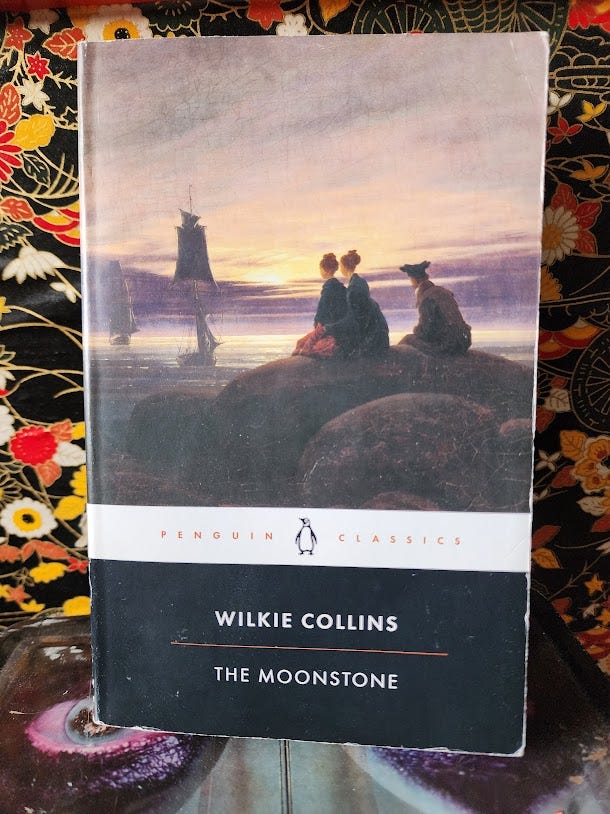
I’ve got to be honest, The Moonstone is not that dark. On a scale from powder puff pink to the alarming maroon of dried blood, The Moonstone is at worst a lovely blush rose. It is, however, an early forerunner of the modern cozy mystery novel. It features a possibly cursed and definitely valuable diamond (the moonstone of the title), an English country estate, several good suspects, brandy spiked with opium, and the weary but keen-witted Sergeant Cuff. It’s an entertaining story even if there is only a single death involved.
The story starts in India, where the moonstone is stolen by Colonel Herncastle during the Siege of Seringapatam. (That was a real battle, by the way. Collins did some real research for this novel.) Herncastle steals the moonstone from the local temple, killing the people guarding it, and then he doesn’t really know what to do with it. He keeps it a secret for years, afraid the Indians will find it and steal it back, and upon his death he leaves the moonstone to his niece Rachel as a birthday present.
A family friend, Franklin Blake, offers to deliver it to Rachel at her home in the countryside. It turns out Herncastle is right about the Indians; three of them are hot on Franklin’s trail, looking to intercept the moonstone and take it home.
At this point, I was afraid the Indians would turn out to be the villains. This novel was written in 1868, so I started bracing for some racist colonialist nonsense to pour forth. I was surprised and delighted when that didn’t happen. I mean, we don’t get any serious anti-colonialism and it’s definitely not an informed or nuanced take on Indian culture. It’s still kinda racist. But the Indians are not the villains, and when they finally manage to steal the moonstone away from the real villain and take it home, this is presented as a just and happy ending. Good for Collins, being somewhat less imperialist than most. Polite Victorian hand clap for him.
Anyway, even though the story begins and ends in India the main mystery is focused on the guests and staff at Rachel’s birthday party. She wears the moonstone for her party, stores it for the night in a drawer in her sitting room, and wakes up to find it gone. Franklin, who by now is infatuated with Rachel and eager to give any help he can with this mystery, gets the renowned Sergeant Cuff to come out and investigate.
In a surprising twist, Cuff gets sent away before fully solving the mystery. To everyone’s surprise, Rachel is thoroughly uncooperative with the investigation and furious with Franklin for dragging it out. Cuff is making progress but keeps being blocked by Rachel, and eventually Rachel’s mother just pays him and sends him away, afraid of upsetting her daughter further. It’s her diamond; if she doesn’t want to find it her mom’s not going to force her.
I’ll stop short of telling you the entire plot. You can look it up on Wikipedia, anyway. Let’s just say there are several twists and turns before we get to the end and it turns out Cuff really did figure out the likely culprit before everyone else did.
The story is told through a series of witness statements and diary entries, gathered by Franklin Blake from various people involved. When Rachel had Cuff fired, she also broke up with Franklin and stopped speaking to him, but he’s still determined to solve the mystery for her. Most of the narrators, from the amusing Betteredge to the self-righteous religious nut Miss Clack to the sad and mysterious Ezra Jennings, have their own distinct voices and backstories. It was fun to read the story through their eyes and watch it unfold from different angles. I also enjoyed Cuff, who was great at solving mysteries but kind of disillusioned about human nature; he eventually retired to become an obsessive rose gardener, which feels to me like a very English thing to do.
Cozy mysteries have become a huge genre, and you can see many of their features developing here. It’s got a lot of twists and turns without being particularly scary and as I said at the top, only one person dies. The Moonstone reminds me why I read so many older novels. Many of them are quite good once you’re used to the older language and writing style, and it’s so interesting to see where our modern tropes and genres were born.

