This was first published on our Substack in 2025. This is Part 2 and since I’m republishing these in reverse order (sorry) part 1 is coming soon.
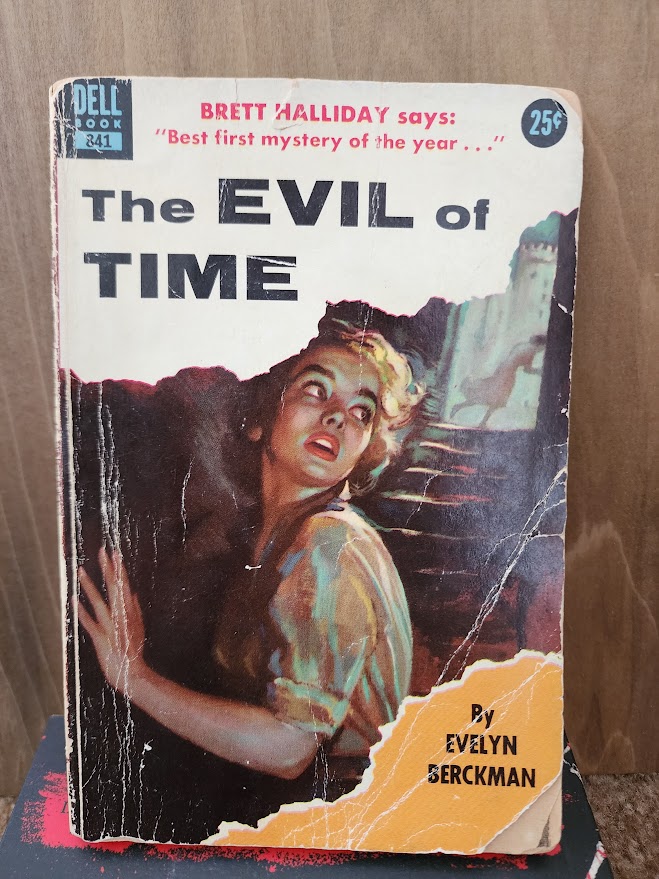
Let’s talk about The Evil of Time by Evelyn Berckman.
I picked up two Evelyn Berckman novels on the same day, because Brave Books in El Paso gave me free beer and offered me pulp fiction. I am a sucker for both. Even though I read The Evil of Time second, it appears to be Berckman’s first novel, written in 1954. This might explain why it was . . . pulpier? than the other novel I picked up, House of Terror (aka The Blind Villain). Hous of Terror was more subtle, centered on complex family relationships, and this one is a more straightforward mystery in a decrepit castle. I actually loved this book, though. It was suspenseful and the mystery was set up well. It actually gave me a “jump scare” moment, which I almost never have when reading.
The story is set in southern Germany in the aftermath of World War 2. We’re following a woman named Keith who works with the U.S. army hunting down and returning art stolen by the Nazis. Her bosses have been searching Drachensgrab, home of the mysterious Von Kaithur sisters. They’re pretty sure there’s a cache of stolen art there–a Greek tapestry, an obscure Rembrandt, a gold cup by Cellini, and a few other treasures. There are also rumors of money hidden somewhere around the place but the big boss, Colonel Ridge, and his crew have searched everywhere and found neither art nor money. Everyone’s been ordered to move on, but technically they have three days left to search and Keith’s supervisor asks her to go up and look around. Maybe one harmless looking expert in history will find something a pack of stompy soldiers missed.
The head of the house, Luise von Kaithur, is a rabid Nazi sympathizer who bitterly resents all these Americans in her home. There are also weird voices and footsteps in the castle at night. Oh, and one soldier “fell” down a flight of stairs and died. But other than that, what harm could there be in having another look around the place?
Still, Keith is eager for the chance to solve this puzzle and maybe show up the annoying and condescending Colonel Ridge. If she could find something big that Ridge missed, that would be worth the danger. I think everyone hopes Luise “I love Hitler” von Kaither will be less frosty towards a blonde woman in civilian dress; that could give Keith more freedom in her investigation.
This castle is one of the most effectively creepy castles I’ve ever read. It’s not even technically haunted but it’s scarier than many haunted houses I’ve read about. Something about postwar Germany as written by someone so close to the actual war gives the setting a feeling of lingering evil that really got to me but beyond that, Berckman’s writing is vivid and creative. Luise and her sister have a grand ancestral estate but pretty much no money so it’s literally falling apart. Keith can see gaping holes where plaster angels have fallen from the ceiling of her assigned bedroom, and when she pulls the covers off the bed she’s offered, rats scurry out. (She wisely elects to find another room to spend her nights in. One of the few with a decent bed and a lock on the door.) Some of her explorations take her to the attic, with odd domes in its floor (the tops of arched ceilings beneath) and centuries worth of junk piled up, and the old chapel on the grounds, whose organ pipes are filled with dead bats. She also explores the overgrown garden looking for a hidden grotto–grottoes were all the rage in the 1700s, the last time the estate was renovated. While she’s continually frustrated in her search for this elusive grotto, she does find proof that she’s not alone with the von Kaithur sisters. She spies a couple of old men creeping about the place on searches of their own.
She also briefly works with the fiercely masculine Captain Barth, almost working up a romance in the brief time they’re together. Just like the other Berckman novel I read, this story is driven by women and the romantic aspects are largely seen from Keith’s perspective. She’s a bit more stereotypical than Dana, the hero of The Blind Villain. Keith is getting older and worried her abrasive smarts will keep her from finding love, so she decides to deliberately tone it down around Captain Barth. She also needs a bit of rescuing by a big strong man at the story’s end.
True to what I love about Berckman, though, Keith is her own agent making her own decisions. At the last second, even while chastising herself for her contrariness, she sends Barth packing. In the end, she goes for Colonel Ridge, who in spite of his cold exterior, really comes through when she needs it. More than that, after he saves her life he shows a softer side and also freely gives her all the credit for solving the mystery. He has to earn her interest by respecting and admiring her as a person. Romantically speaking, it was a pretty progressive ending for an old pulp novel.
You might notice I’m purposely not telling you exactly how the mystery turns out, and that’s because you should really read this book if you can find a copy. It’s a quick read with an exciting payoff. It’s also fascinating and surprisingly spooky. This book, written by an American transplant to England, is very anti-Nazi but it doesn’t have that epic “good vs. evil” feel you get from more modern takes on World War II. It’s got a personal feel, with the German characters all having different feelings about the war and occupation and the Americans never quite sure who to trust. Luise von Kaithur, for example, is a rabid Nazi and everybody knows it but she wasn’t a soldier or even a financial supporter. She sucks but what can you do? Would she be pro-Nazi enough to push that soldier down the stairs? To hide neo-Nazis? Or will she just frown frostily at all the soldiers invading her home and do nothing? Who knows? The small town scale of the story was scary and thrilling but also added some humanity and nuance to the story.
After two novels, I’m already determined to track down more of Berckman’s work. I think she’s due for a revival.