The Works of Vermin: a Review

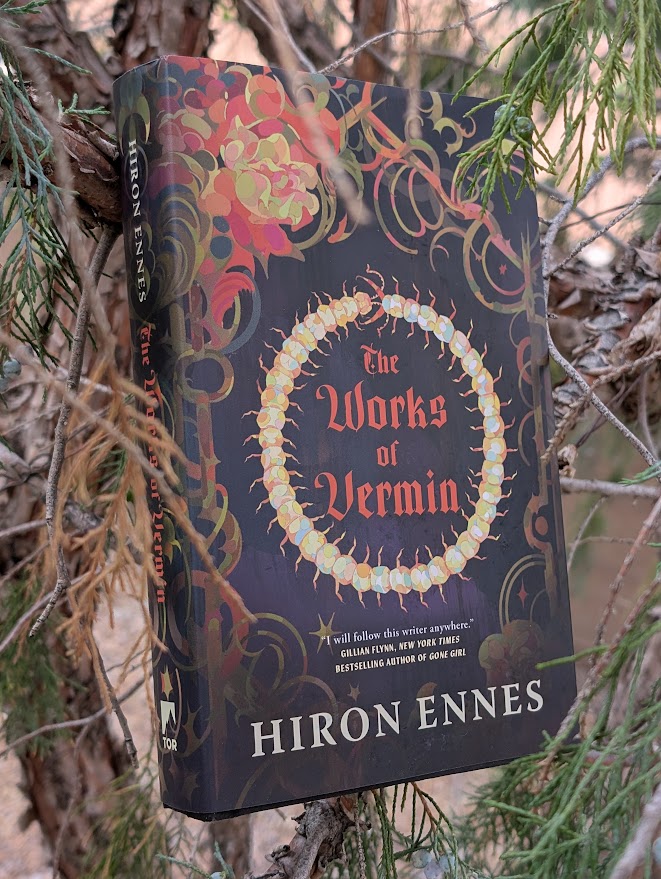
What’s the book? The Works of Vermin by Hiron Ennes

How dark is it? Um, it’s hard to say. On the one hand, people are dying in droves and every character’s life is a horrorshow. On the other hand, none of this is told in a dark way at all so . . . maybe that makes it even darker? Technically, darkest of dark. Drenched in blood and sap. But I was personally more fascinated than horrified.

How good is it? On a scale of 1 to 10 pests. 9/10 pests. But it’s also very weird and not for everyone. Read a few pages in the store before you decide.

This book is a glorious chaos. From beginning to end, I was just barely hanging on as I followed the various characters on their adventures through this splendidly horrific fantasy city. I’m still not sure I understood it all because no one ever explains anything in this book, but I think I loved it. Yeah, I’m pretty sure I loved it.

Tiliard is a city tunneled into an impossibly large tree stump straddling a river. At the top of the stump are the rich, obsessive about their opera and perfumes and fashions. They’re also, it seems, always caught up in deadly political drama. We’re following the Laurel Chancellor and his right hand man, the Marshall Revenant, as they attempt to defend their positions against any and all upstarts. We’re also following the Marshall’s head perfumer, Aster, as she befriends an exciting newcomer to town. Who is this new guy, this Mallory vant Passand? Is he part of the latest group of starving artists trying to overthrow the Chancellor? Is he angling to meet Olaf Aufhocker, the reclusive author of this era’s most popular operas? Is he just really into Aster? Who knows?

While that drama unfolds, we’re also following denizens of the city’s underbelly, who literally live on catwalks and bungalows hanging from the giant stump’s underside. Guylag is a humble exterminator, doing his best to look out for his little sister Tyro and willing to do literally anything to give her a better life than he has. Since this entire city is built in a rotting stump, there are always new and exciting vermin to smoke out and extermination is a booming but dangerous business to be in. Guylag (Guy for short) and his partner Dawn answer a particularly tricky call that results in a nasty sting for Guy and a whole new species of pest for his team to hunt down. Pretty soon the hunt for this particular pest becomes all-out war between the various extermination companies of the undercity, and Guy and Dawn are on the front lines.

It’s clear that the rulers on top of the city must somehow connect with our plucky undercity exterminators, but it’s not at all clear why or when or how. Since the book hurtles ahead at full speed and never explains anything ever, I was utterly surprised when these questions were answered. I can’t remember exactly what page it was, but I was well over halfway through and still confused (though increasingly delighted) when everything snapped into focus. Suddenly it all made sense. Or, well, nothing in this book quite makes sense but it all came together in the most satisfying way. I read a whole lot of books and it’s become hard to surprise me, but I did not see this twist coming. That made me love this book all the more.

This book is part horror, part fantasy, part I-don’t-know-what. You need a strong vocabulary and a high tolerance for confusing experimental vibes to enjoy this book, but if you can get past that it’s a unique brand of excitement and fun. It’s always on the verge of becoming nonsense but Hiron Ennes manages to keep it just barely together, and amid the chaos I found myself really attached to most of the characters, hero and villain alike. 

Now for a slight spoiler.

Stop here if you hate spoilers.

Okay.

Ready?

Mallory vant Passand is a trans gentleman. Or possibly genderfluid. Or nonbinary? Mallory is beyond labels. This is clear from very early on and seems of zero importance to any of the characters, including Mallory. Tilliard is a very accepting tree stump city, possibly because everyone’s so distracted by all the operas and murder. Eventually, as Mallory’s history is revealed, it becomes key to the plot in a way I should have caught onto sooner. In my defense, I was distracted by the many assassination attempts and the exterminator war unfolding. I mention it at all because I was thoroughly excited by Mallory as a bold adventuring character. As the book progresses Mallory’s loose relationship with gender becomes a very cool part of the adventure and I can’t review this book without mentioning how much I love how it plays out. It felt like an inspiring call to transcend our hang-ups around gender and sex and just live freely, without ever actually saying anything like this at all. Because, as I’ve said before, this book never explains anything ever. It doesn’t have time; it’s too busy living its best life.

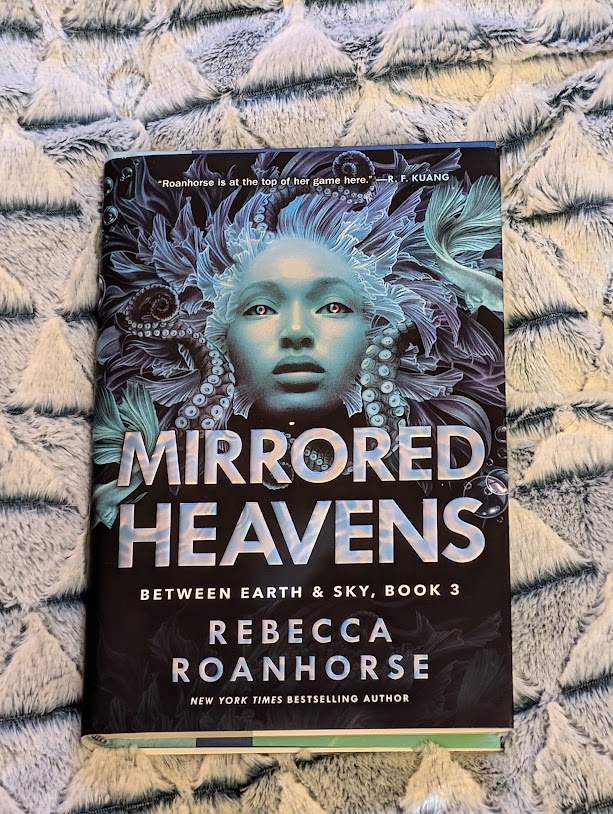
Mirrored Heavens: a Review

Spoiler alert: Mirrored Heavens is the third book in Rebecca Roanhorse’s Between the Earth and the Sky series and I can’t discuss this one without spoiling the first two. If you haven’t read Black Sun and Fevered Star (review here), go do that. The third book makes no sense if you haven’t read the first two. In fact, it only sort of makes sense even if you did read the first two.

I’m gonna be up front with you. I found this book kind of disappointing. By far the weakest of the three. The second book sets a lot of events in motion and the third book tries to bring them all together in grand fashion but, for me, it’s not a success. 

We start in a world on the brink of war. Serapio, avatar of the Crow god, and Naranpa, avatar of the Sun god, were supposed to fight to the death in the first book but missed each other due to unforeseen circumstances. They put off their fight to the end of the second book but their hearts weren’t in it. Instead of an epic battle, the second book ends with an uneasy truce between Serapio and Naranpa. It was a crazy twist. As the third book begins, Naranpa has departed for the northern wilderness to learn more about the gods and their dealings, leaving Serapio in charge of preparing Tova for war with the many nations conspiring against it. Naranpa feels that Serapio’s the best chance of uniting Tova’s clans and defending the city from the forces combining to attack it.

This book is setting us up for an epic clash between the Gods as the avatars of several deities each follow their own paths to Tova. Balam, the Jaguar acolyte, is leading an army to conquer the city. Xiala, now the avatar of the ocean goddess, crosses the ocean to avenge her people and aid Serapio. Serapio himself is caught between his own commitment to save Tova and his Crow god’s desire for an epic confrontation with the Sun god. Naranpa, avatar of the Sun, feels inexorably pulled toward that same confrontation, but Naranpa also has her eye on Balam. 

Complicated, right? As we’d expect from the third book in an epic fantasy trilogy. I’m fine with a series sprawling a bit, but this one never really comes back together and there are so many unanswered questions and story arcs that either fizzle or veer off course.

We follow Naranpa as she prepares for her epic spiritual battles, we keep following as she wanders off to rescue her friend Iktan, and we wish we hadn’t when she arrives in Tova ready for war and instead (huge spoiler!) just razes a huge chunk of the city without actually contronting either the Jaguar dude or Serapio. This pointless destruction is especially disappointing because it doesn’t fit with anything we’ve learned about Naranpa or the Sun she serves in the last three books. It makes no sense at all.

Xiala’s arc is slightly better. We follow her as she tries to rescue and avenge her people after one of the Cuecolan lords tried to conquer their islands. Parts of this plot feel forced and hamfisted but there’s some exciting action and it’s cool to see Xiala finally connect with the Sea goddess and become truly badass. She does manage to finally reconnect with Serapio as well, so that’s nice.

Serapio spends most of the book waiting for the other gods to show up and fight his god. To keep him occupied, the Coyote god throws him a bizarre multi-part prophecy to fulfill. It all feels a bit forced and random but at least it keeps Serapio busy? He does end up facing the Jaguar avatar (but not Naranpa or the Sun) and it turns out his true battle is against the Crow god within him as he fights for his independence from his destiny. This part is actually pretty underdone. This is an interesting conflict and it’s handled a bit too quickly compared to even the arcs of a few minor characters.

As this series went on the pacing got more and more choppy, and by the end of this book things just felt too disjointed to really enjoy. The trilogy started tight, opened out until it involved everyone on the map, and though it tried valiantly to bring all those threads back together and tie them up neatly, mostly it felt muddled and disappointing.

Still, right up to the end I loved the world building and cosmology of these books. Meroamerican history and mythology feel like fresh and exciting sources for fantasy world building and Roanhorse does great things with them. Even though the series petered out in a way I found deeply unsatisfying, I give her credit for amazing world building and detail. I would love to see what other fantasy authors could do with these influences. 

New reviews every Friday. Embrace the darkness and read more books!

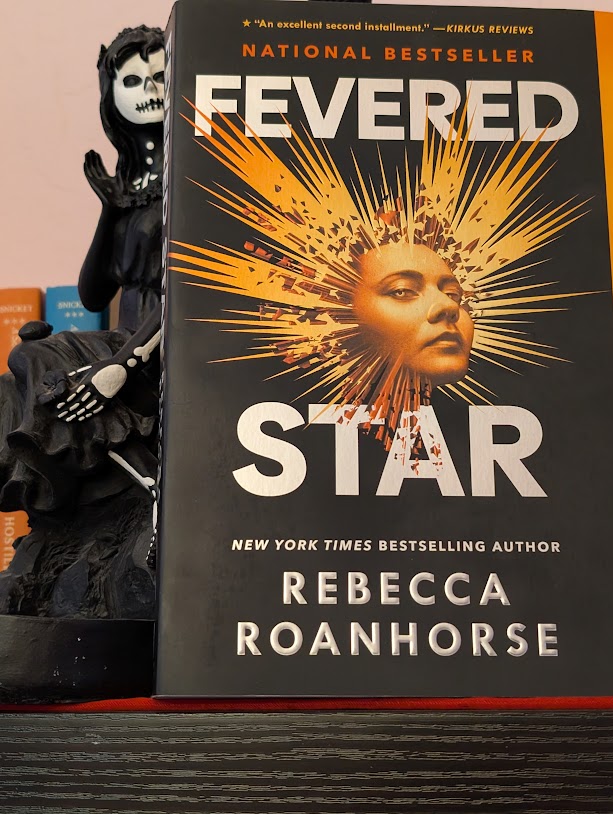
Fevered Star: a Review

Spoiler alert: Fevered Star is the second book in the Between the Earth and the Sky series and I can’t discuss this one without spoiling the first one. You can read that review here. If you haven’t read Black Sun and don’t want it ruined, go read it now. I’ll wait . . . 

Okay. In Black Sun, Serapio (avatar of the Crow god) sets out to kill the Sun Priest (named Naranpa) and all the priests who follow her. He crashes their winter solstice ceremony, the moment when the sun is at its weakest and the shadowy Crow god is strongest. Everything goes according to plan for the Crow god, except that mere days before, Naranpa had been assassinated and replaced by a sort of puppet Sun Priest. The Crow god can tell the difference–all that killing and the Sun is not defeated. 

Which means Naranpa must not be entirely dead; somewhere, she must be alive and still holding the Sun’s power within her. 

Which means Serapio s mission is still unfulfilled. He was supposed to crash the Solstice ceremony, kill everyone on behalf of the Crow god, then die. His little crow friends sacrificed themselves to save Serapio but the Crow god isn’t too thrilled with the defeat and Serapio was not prepared at all for life after that battle. The Crow clan, who he thought would embrace him as family, has decidedly mixed feelings about their god walking amongst them. Some of them worship him as the Odo Sedoh, the Crow Grandfather, but many of their leaders wish their god had never returned. He’s upset the balance of power and the Crow Clan’s matron is afraid of reprisals from the city’s other clans. 

While Serapio navigates life as a living god (but also a nice young man), Naranpa is back in Coyote’s Maw, revived by her estranged brother and his witch friend. Once Naranpa is revived, she begins to realize she’s become more than just a priest of the Sun. She seems now to be the sun’s vessel on earth. Instead of escaping certain death, she’s still on a collision course with the Crow god. 

The book rocks back and forth between three stories this time. We follow Serapio’s story as he forms an uneasy relationship with Okoa, brother of the Crow Clan’s leader. We follow Naranpa as she attempts to find allies in Coyote’s Maw. We also follow Xiala, Serapio’s Teek friend, as she travels with Iktan, another surviving priest (an assassin, the Priest of Knives) to distant Hokaia. In Hokaia, the Eagle clan conspires with Hokaia’s spear maidens, a band of Teek warriors, and a couple of Cuecolan merchant lords (one of whom was briefly Xiala s boss in the first book. Small world.) Together, they make plans to attack Tova now that the Watchers are dead and the city is in confusion. Well, all those other people want to attack the city; Xiala just wants to find Serapio and help him out if she can. She misses her weird crow-loving friend. They really bonded in the first book and now that she knows Serapio survived his big revenge mission, Xiala desperately wants to see him again.

As epic fantasies tend to do, this one sprawls a bit. There are a lot more moving parts than the first book had, and a lot more secondary characters. We still have the central conflict between the Crow and the Sun, represented by Serapio and Naranpa respectively. Along with that, we now have impending war, with representatives of several nations planning to invade a fractured and weakened Tova. One of the Cuecolan lords, Balam, is also trying to master the magic of dream walking in order to defeat Tova and ultimately become the avatar of his own god, the Jaguar. As all this is brewing, Xiala’s mother is head of the Teek contingent and none too happy to see her daughter. Xiala is, in fact, sent packing back to Teek against her wishes, only to find Teek has become a shell of itself while she’s been gone. 

This book is messier than the first, not as tight or touching, but there are some interesting twists and turns, and the ending really surprised me. It ends, as the first does, with a confrontation between the Sun and the Crow, but this one turns out much differently than either of the avatars expect. In some ways it’s a much weaker ending but I respect it for going in a direction I did not see coming. At the end of this I was immediately itching to start the third book and see how Roanhorse was going to bring all this back together.

You’ll find out how that went next week. Until then, embrace the darkness and read more books.

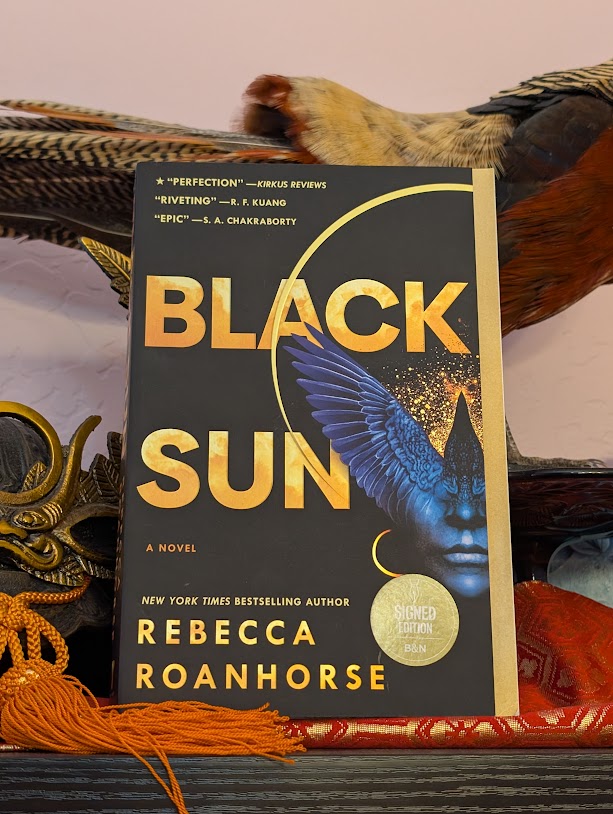
Black Sun: a Review

Technically Black Sun (by Rebecca Roanhorse) is epic fantasy instead of horror and I actually didn’t pick it up for the blog at all. I was talking to a friend about the upswing in indigenous horror writers and she said she was reading this fantasy series set in the ancient Americas. It sounded cool so I got myself a copy and started reading. (I didn’t do this on purpose, but my copies of all three books are signed by the author because she’s got New Mexico connections. So that’s neat.)

The first chapter features a mother doing some very bloody ritual magic on her son, attempting to turn him into a vessel for the Crow God, and then throwing herself off a cliff as a sacrifice to complete the ritual. 

It was intense. It was dark. I loved it. I read the whole trilogy and now I’m gonna review it for you, one book a week, for the rest of the month.

Black Sun is set in a fantasy world inspired by various Mesoamerican cultures. There’s no one-to-one correspondence, just a fantasy mix of ancient fashions, hairstyles, beliefs and cultures. I found these inspirations refreshing and fun, and I enjoyed the truly polytheistic perspective Roanorse creates in this world. As the series progresses, more gods, through their various avatars, try to work their will in this world. She sets up an epic battle between spiritual forces without any of them being clearly good or evil. This first book was especially successful at that.

The book alternates between Serapio (the Crow God’s intended vessel but also quite a nice young man) and Naranpa, the Sun Priest Serapio is divinely mandated to overthrow. While Serapio sails from the Cuecolan coast toward the holy city of Tova (don’t worry, there’s a map in the front of the book), Naranpa is trying to revitalize the city’s priesthood and battling politics between the city’s four great clans and the poor clanless folks of Coyote’s Maw (don’t worry, there’s a map for this, too). 

As we follow both of them, we’re given tantalizing bits of the events that set both Serapio and Naranpa on their current paths. We learn about the Watchers, the priestly hierarchy Naranpa rules, that were created a few hundred years ago after a great war between several nations and their various gods. We learn that much more recently, a generation ago at most, the Watchers led a raid against the Crow clan. In attempting to stamp out worship of the Crow God with bloody finality, they drove one rebellious Crow to find a way to bring back her god in human form and exact revenge on the Watchers. Serapio, of course, is that vessel, born for revenge. This is mostly local politics but since Tova is officially the spiritual center for several nations, fights between Tovan factions can have much broader ripples.

Serapio knows this. About the Crow Clan and the revenge, I mean. Not about international relations. He was born and raised for revenge on the Sun Priest and educated in war and pain and dedication by his mother’s allies. He embraces his destiny. But he’s also barely an adult and this boat ride to destiny is the first chance he’s ever had to get out of the house and meet people. He becomes friendly with Xiala, the boat captain in charge of delivering him to Tova. She’s a Teek, a sort of Siren or mermaid from a small reclusive island nation. She tells him stories and he keeps her company as she guides the boat through the starlit night. For the first time in his life, Serapio finds a friend and for the first time in a long time, Xiala finds someone who just likes her instead of being fascinated or repelled by her Teek heritage. (There are a lot of superstitions about Teeks. They can speak to the sea and calm its waters so everyone wants one on their boat, but the minute things go wrong guess who they blame?) It’s a beautiful little relationship that deeply affects them both. 

Meanwhile, Naranpa is dodging assassination attempts while trying to revitalize her city’s faith. Naranpa is originally from that poor clanless Coyote’s Maw, while pretty much everyone else in the priesthood are honored members of the four major clans. She’s the Sun Priest, the head of the whole council, supposedly the greatest power in Tova and owed allegiance by most of the surrounding nations as well. Ever since that raid on the Crows, though, the Watchers’ reputation in the city is tarnished and to make things worse, the Clan leaders look down on Naranpa herself for her background. She’s got a tough road ahead if she wants to reform the city. 

I won’t spoil the inevitable confrontation but I will say it’s spectacular. The book takes its time, letting us really get to know our lead characters and several supporting characters, but this battle is always looming ahead of them. What I loved most is that I couldn’t decide who I was rooting for. Serapio is so sad and endearing, Naranpa is so idealistic and embattled. I loved them both but by  the end I also understood there could be no agreement between these two. This made for a moving and complex ending I thoroughly enjoyed. 

New reviews every Friday. Embrace the darkness and read more books!