
Spoiler alert: Mirrored Heavens is the third book in Rebecca Roanhorse’s Between the Earth and the Sky series and I can’t discuss this one without spoiling the first two. If you haven’t read Black Sun and Fevered Star (review here), go do that. The third book makes no sense if you haven’t read the first two. In fact, it only sort of makes sense even if you did read the first two.
I’m gonna be up front with you. I found this book kind of disappointing. By far the weakest of the three. The second book sets a lot of events in motion and the third book tries to bring them all together in grand fashion but, for me, it’s not a success.
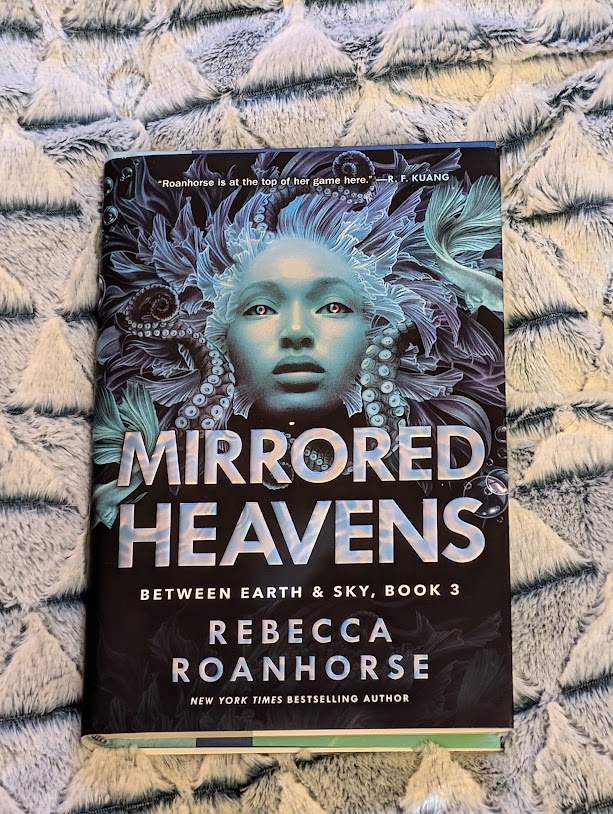
We start in a world on the brink of war. Serapio, avatar of the Crow god, and Naranpa, avatar of the Sun god, were supposed to fight to the death in the first book but missed each other due to unforeseen circumstances. They put off their fight to the end of the second book but their hearts weren’t in it. Instead of an epic battle, the second book ends with an uneasy truce between Serapio and Naranpa. It was a crazy twist. As the third book begins, Naranpa has departed for the northern wilderness to learn more about the gods and their dealings, leaving Serapio in charge of preparing Tova for war with the many nations conspiring against it. Naranpa feels that Serapio’s the best chance of uniting Tova’s clans and defending the city from the forces combining to attack it.
This book is setting us up for an epic clash between the Gods as the avatars of several deities each follow their own paths to Tova. Balam, the Jaguar acolyte, is leading an army to conquer the city. Xiala, now the avatar of the ocean goddess, crosses the ocean to avenge her people and aid Serapio. Serapio himself is caught between his own commitment to save Tova and his Crow god’s desire for an epic confrontation with the Sun god. Naranpa, avatar of the Sun, feels inexorably pulled toward that same confrontation, but Naranpa also has her eye on Balam.
Complicated, right? As we’d expect from the third book in an epic fantasy trilogy. I’m fine with a series sprawling a bit, but this one never really comes back together and there are so many unanswered questions and story arcs that either fizzle or veer off course.
We follow Naranpa as she prepares for her epic spiritual battles, we keep following as she wanders off to rescue her friend Iktan, and we wish we hadn’t when she arrives in Tova ready for war and instead (huge spoiler!) just razes a huge chunk of the city without actually contronting either the Jaguar dude or Serapio. This pointless destruction is especially disappointing because it doesn’t fit with anything we’ve learned about Naranpa or the Sun she serves in the last three books. It makes no sense at all.
Xiala’s arc is slightly better. We follow her as she tries to rescue and avenge her people after one of the Cuecolan lords tried to conquer their islands. Parts of this plot feel forced and hamfisted but there’s some exciting action and it’s cool to see Xiala finally connect with the Sea goddess and become truly badass. She does manage to finally reconnect with Serapio as well, so that’s nice.
Serapio spends most of the book waiting for the other gods to show up and fight his god. To keep him occupied, the Coyote god throws him a bizarre multi-part prophecy to fulfill. It all feels a bit forced and random but at least it keeps Serapio busy? He does end up facing the Jaguar avatar (but not Naranpa or the Sun) and it turns out his true battle is against the Crow god within him as he fights for his independence from his destiny. This part is actually pretty underdone. This is an interesting conflict and it’s handled a bit too quickly compared to even the arcs of a few minor characters.
As this series went on the pacing got more and more choppy, and by the end of this book things just felt too disjointed to really enjoy. The trilogy started tight, opened out until it involved everyone on the map, and though it tried valiantly to bring all those threads back together and tie them up neatly, mostly it felt muddled and disappointing.
Still, right up to the end I loved the world building and cosmology of these books. Meroamerican history and mythology feel like fresh and exciting sources for fantasy world building and Roanhorse does great things with them. Even though the series petered out in a way I found deeply unsatisfying, I give her credit for amazing world building and detail. I would love to see what other fantasy authors could do with these influences.
New reviews every Friday. Embrace the darkness and read more books!

