American Ghosts: Part 1

If you really want a quirky read that tells you a whole lot about the person who wrote it, find a book of local ghost lore. They’re not hard to find in gift shops and independent bookstores and they’re usually quick and easy reads. Most of them are published by tiny presses or occasionally the authors themselves so they’re not heavily edited; reading one really feels like getting to know the author, for better and worse. I haven’t done much traveling lately but when I do I try to pick up a ghost book or two. I’ve read a handful this year, some from places I’ve been and some featuring places I’d like to go someday, and for Spooky Month I thought I’d share a few with y’all. I’ll show you two this week and next Tuesday I’ll show you two more.
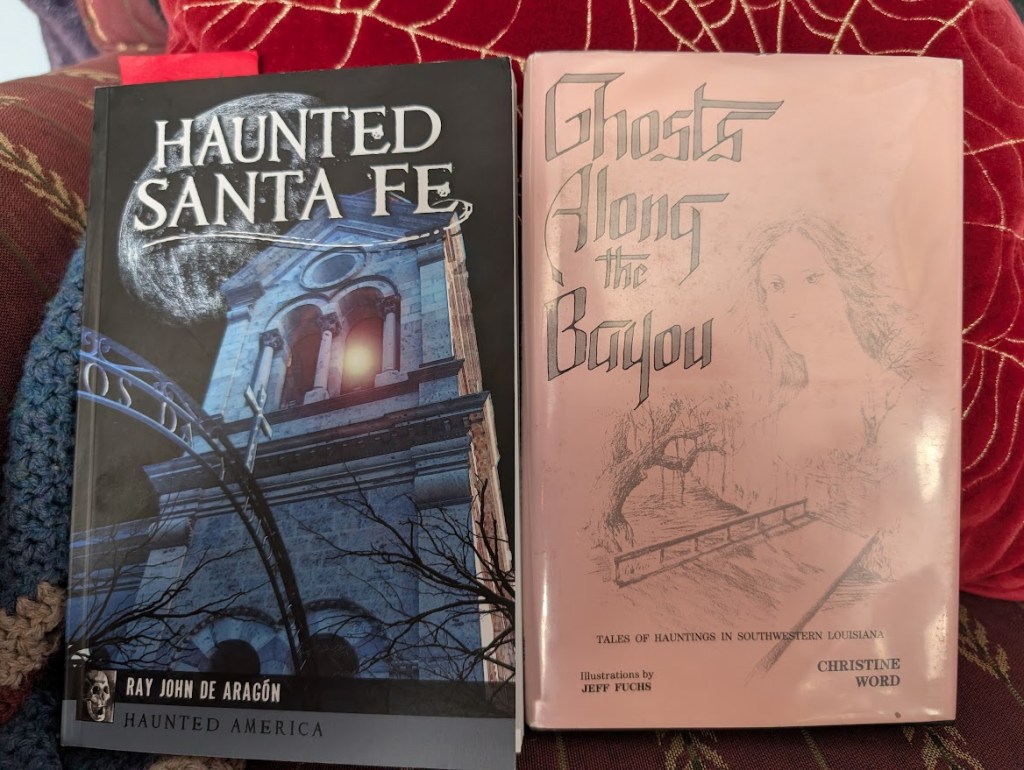
There’s always a balance to be struck between sharing local history and telling cool ghost stories, and today’s two books are on the extreme ends of the scale. Both are lovingly focused on their respective regions, though, and both are peppered with interesting black-and-white illustrations.

Haunted Santa Fe is almost entirely focused on history, mostly the history of the Spanish conquistadors of New Mexico and their descendants, which is Aragon’s proud specialty. Most of the stories are pretty much “here’s this famous person from New Mexico history, and yeah, maybe they’re a ghost now or something.” I prefer more ghosts in my ghost stories but the stories are colorful and occasionally touch on less famous people and events, which is nice. I have to admit, though, Aragon’s writing style doesn’t work well for me at all. He seems to be striving for a primitivist vibe, with a simple and almost childlike approach but I find it disjointed and hard to follow. In striving to be accessible he almost sounds like a child saying “this happened and this happened and wait, oh yeah, she was like this and that, and then this other thing happened and they were all . . .” It’s a style you’re either hate (me) or love (maybe you?) but if you love it you’re in luck because Aragon has written several books besides this one. If, like me, you hate it you can try one of the zillion other titles in the Haunted America series, all written by a variety of authors.

Ghosts Along the Bayou, as a contrast, is almost entirely focused on the ghost stories. Christine Word collected them from family and friends in the area, including the owners of a suspicious number of historical homes turned into hotels and bed & breakfasts. I was charmed by tale after tale of people hearing weird noises, seeing lights where there shouldn’t be any, feeling cold spots and seeing things they couldn’t explain. Finally, a ghost book totally focused on the weird things people experience. The near total lack of history comes off as slightly racist when people talk about the ghosts of enslaved people or make bitter remarks about the Union army without any real context, but most of the stories are really personal and small scale. Many ghost books are just excuses to talk about local legends, so I like that this one is so totally focused on the paranormal. The author even claims she has an arm that goes numb and cold now, thanks to a ghostly encounter. That’s hardcore.

And that’s it for this Tuesday’s ghost stories. Next week I’ll have two more books to share. Until then, I’d love to hear your city’s best ghost stories.
Bat Eater: a Review

What’s the book? Bat Eater and Other Names for Cora Zeng by Kylie Lee Baker

What kind of dark is it? Ghosts, murder, and lots of gore. This book’s got it all, baby!

How good is it? 8/10 hungry ghosts

Apparently China’s spooky month is August and I never knew. I knew a little about hungry ghosts and burning joss paper and Buddhist festivals for the dead but I somehow never noticed it all took place in August. I feel a bit dumb about this. Now that I’ve finished Bat Eater, though, I’ll probably never look at August the same way again.

This book is a ghost story and like so many ghost stories, it’s told in kind of a melancholy and lyrical tone. In fact, for the first few pages I was bored and a little annoyed by how literary and poetic Baker was trying to be. Then Cora’s sister got decapitated by a train and I wasn’t worried about the lyricism anymore.

The lyricism didn’t end. The book is full of poetically broken people and shown entirely through the lens of Cora’s narration, which is moody and introspective and melodramatic as hell. It’s just that on top of that silliness is an intensely gory and disturbing story full of hungry ghosts, crime scene clean-up, and murder. It’s intense and I loved it. Cora’s navel gazing about her OCD and her angst at being caught between cultures (and more specifically between her white Christian aunt on one side and her traditional Chinese aunt on the other) becomes a nice counterweight to the terror and gore she’s suddenly dealing with on a daily basis.

Oh, and this is also happening during the Covid Pandemic, which is both ramping up Cora’s germ phobias and seriously hindering the investigation of the serial murders Cora’s pretty sure are happening all around her. No surprise, the murdered people are all Asian and the killings appear to be hate crimes. With people regularly yelling “bat eater” at Cora on the streets, she’s pretty sure what the bats left at these scenes are supposed to mean.

Cora and her friends do try to investigate the murders but this isn’t a thriller or mystery novel. The emphasis is squarely on the horror, both human and supernatural. A lot of horror novels pull back on the gore in favor of the more subtle aspects of horror but this one smacks us full in the face with the violence of it all. Horror, especially in novels, is often a vehicle to talk about some larger moral or emotional question and it’s easy to get the balance wrong. Too much blood and nobody notices your message; too little and the reader is left bored and wondering why you didn’t just start a Substack instead of pretending to write a horror novel. For me, Baker gets the balance pretty much right, giving us an exciting story that also highlights the issues of identity and racism she wants to discuss.

The anti-racist message is also pretty heavy-handed at times but I’ve definitely seen worse and it’s an interesting perspective on the Pandemic. The messaging never takes over the story entirely and I appreciate the way Baker balances the cartoonishly racist white folks with a variety of Chinese characters, some of whom are also cartoonishly evil as far as we can tell. Sure, there’s a lot of suffering caused by racism but there’s a lot of suffering in general, caused by a lot of things.

That said, parts get a bit silly if you think about them too hard. Even in a pandemic, even with cartoonish levels of racism at play, this story’s murders would have been pinned on somebody way before Cora got involved. Horrific and creative murders done in crowded apartment complexes by multiple not-so-bright copycats? One of them’s getting caught and blamed for everything. The mystery part of this book is dumb. Still, with all the ghosts and poetic brokenness and tragic backstories I had a lot to entertain and enlighten me, even when the mystery fell a bit flat.

Queens of the Abyss

October has arrived! The dark nights are growing ever longer and the wind is starting to chill our spines, which makes this the perfect month to cozy up with ghost stories and weird tales. This year I’m devoting spooky month to tales with a supernatural bent, featuring folklore, ghosts, and the occasional monster.

I’ll start with a book I actually bought last October. I was all the way down in Tucson tending to some ghosts of my own when I walked into Antigone Books. This is a feminist and political bookstore and their horror section was tiny, even around Halloween, but I still found a couple of interesting titles and this was one of them.

Queens of the Abyss is a collection focused on stories from the 1800s and early 1900s, featuring a number of women who are either less well known or better known for something besides weird tales. It features a few big names, like M. E. Braddon and Leonora Carrington, along with a host of writers largely forgotten by now. All we tend to remember about the ‘weird tales’ era of horror is H. P. Lovecraft and, if you’re lucky, Algernon Blackwood or M. R. James; I love books that get beyond the biggest names and this book really delivers on that.

The editor, Mike Ashley, gives a tiny introduction of each selected author and a couple of suggestions for further reading, which makes this a decent jumping off point for finding further weird tales if you’re interested. There’s a varied selection of ghosts, demons, and general weirdness included and I enjoyed the sampling. A few of my favorite stories were The Haunted Flat by Mary Belloc Lowndes, The Nature of the Evidence by May Sinclair, and The Bishop of Hell by Marjorie Bowen. If you’re looking to cozy up under a blanket or by the fire with a good book, you could do a lot worse than Queens of the Abyss.

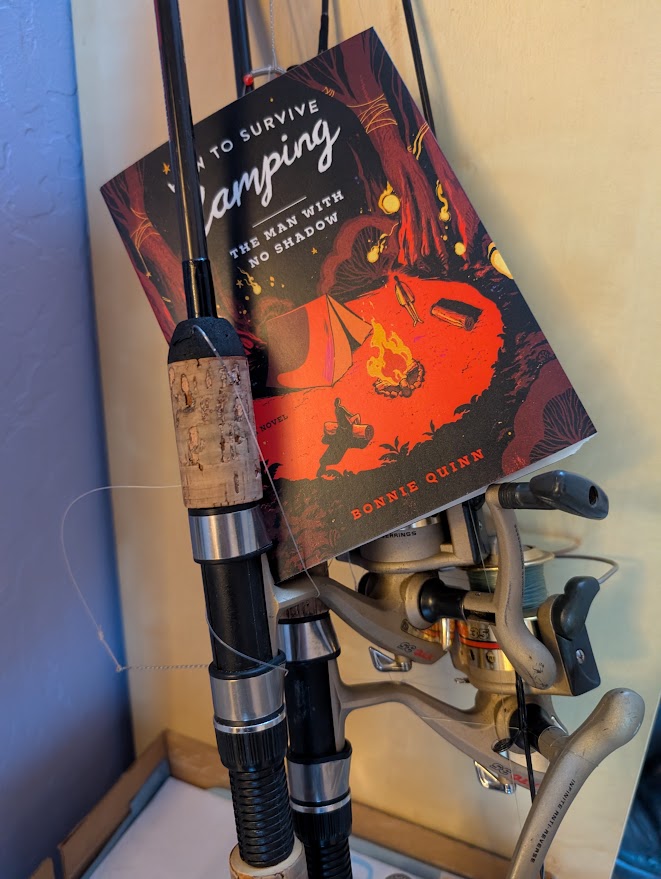
How to Survive Camping: a Review

What’s the book? How to Survive Camping: the Man with No Shadow by Bonnie Quinn

What kind of dark is it? Ghosts and goblins and moderate gore

How good is it? 7/10 faerie tricks

It starts with a list of rules, which had me worried. The list was funny, a good mix of sound camping tips (how to space your tents and avoid flooding) and rules for avoiding death at the hands of mysterious beings (apparently the children with no wagon are not to be trusted and the man with no shadow is bad news). The list promised a fun romp in the haunted woods but it also felt a bit gimmicky, so I worried that haunted romp would be thin on character development and lazily plotted, perhaps. I was delighted to find I was mostly wrong. This wasn’t a deep character study or anything but the story that grows from this goofy set of rules is pretty satisfying.

The woman who wrote the rules is Kate, who inherited this campground when her parents died. She was pretty young when they were taken from her, not quite finished with college, so she had a rough start running the place but it’s been several years now and she’s started to really get the hang of the job by now. Or so she thinks.

This piece of land has been in Kate’s family for a few generations now, which is a source of pride and stability but also the source of most of Kate’s problems. Her family has owned the land so long that it’s become Old with a capital ‘O’. The kind that attracts beings of myth and folklore like fairies and shulikun, along with beings that have power but no stories to their names. At least none Kate’s found in the many books on folklore that line her office walls. Kate’s campground is a huge source of income for the nearby town but it’s also understood that Kate’s job is to keep all those beings contained and controlled. Keep the town safe, keep the land in the family. A simple mandate but not always easy to carry out. Lately things have gotten extra difficult. Some of her land’s inhabitants have gotten restless and one in particular, the Man with no Shadow, seems to want a change of leadership.

I like Kate. She doesn’t seem like a very nice person, truth be told, but she’s tough and serious about her duties both mundane and supernatural. I found myself rooting for her as she fought both the Man with No Shadow and a whole lot of her ungrateful neighbors. I started to see her as tough but fair, willing to take each eldritch being on its own merits; if you’re a being (human or supernatural) willing to deal fairly with Kate, she’s willing to deal fairly with you. I found it refreshing to follow someone trying to really wrestle with and live along side the forces of darkness instead of the usual fleeing or fighting we usually get. Though Kate’s not afraid to kick ass when she needs to. The story was a good balance for me between tough kickassery and vulnerable humanity.

It’s also a perfect book for October, the spooky season of ghosts and goblins and darkening skies, because it’s all about learning to live with the things that go bump in the night. Quinn is a newer author and this is the first in what is now a growing series of stories about Kate and her campground. I plan to eventually pick up further installments of Kate’s adventures and if you want a cozy bit of autumn horror this would be a good choice.

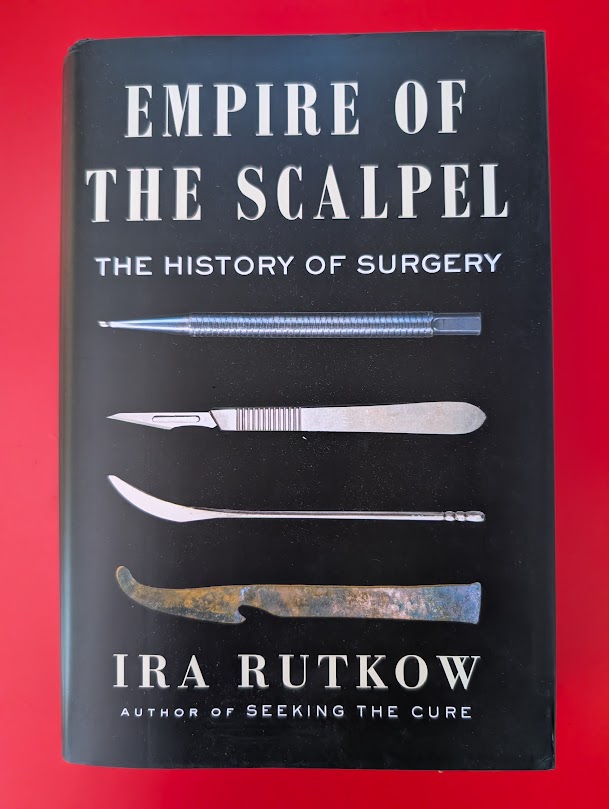
Empire of the Scalpel: a Review

What’s the book? Empire of the Scalpel by Ira Rutkow

What kind of dark is it? It’s a medical history book so there are gross bits but it’s mostly uplifting. Unless you have a severe blood phobia you’ll probably be fine.

How good is it? 7/10 scalpels

This is another Morbidly Curious Book Club selection, meaning I didn’t choose it for myself. I liked it, though. It’s a solid little popular history that tries to balance individual stories with a serious timeline of surgical history, starting at the very beginning, the moment when prehistoric humans first dared to drill holes in each others’ skulls.

Humans have been trying to fix each other with knives and stitches for a very long time, and popular histories of such big topics are always pretty surface level. Sometimes they also end up pretty random, but this author does a good job of choosing a couple of central themes and organizing his facts and stories around them, which keeps this history engaging and easy to follow.

One theme is the social and professional fortunes of surgeons and how those have changed over the centuries. We learn about barber-surgeons and the split between surgery (often seen as a dirty and unskilled job) and medicine (full of ‘real doctors’ who spoke Latin and didn’t get their hands bloody). We learn about fights between guilds and the very slow rise of surgeons from back-alley bloodletting to celebrated rockstars who performed transplants and saved lives.

The second theme is the series of practical problems surgeons had to solve along the way, saving more lives and earning themselves respect and admiration as these problems got solved. We read about the surgeons who revolutionized the study of human anatomy, invented anesthesia for surgery, promoted antisepsis, and figured out how to type blood and give transfusions safely. With every problem solved and advance made, surgery gets a little safer and more useful.

Rutkow was a surgeon himself, so he inserts a few stories from his early years into his history. It’s become common for authors to tell their own stories as they relate to some larger story about history or science; I’ve come to expect it and I think Rutkow hits a good balance. He tells enough stories to show us his personal connection to the topic and take his tiny place in the grand history of surgery without making the book about himself. In fact, though he also tells many stories about famous surgeons throughout history Rutkow is careful to keep this from becoming just a list of great men throughout Western history. He always brings the story back to what those discoveries or inventions mean to the craft of surgery and the lives of patients in need. I appreciated this approach.

This book isn’t meant to be a deep dive for experts but it’s a nice ride through history. It’s maybe a tad dry and Rutkow uses the phrase “knife bearers” a whole lot but I have no major complaints about this book and I found it kind of uplifting. I’ve read enough novels from the Victorian era and earlier to appreciate how far medicine has come and be glad I live in an era of laparoscopic procedures and sterile operating rooms and antibiotics. I had a good time reading about the history of these modern miracles.

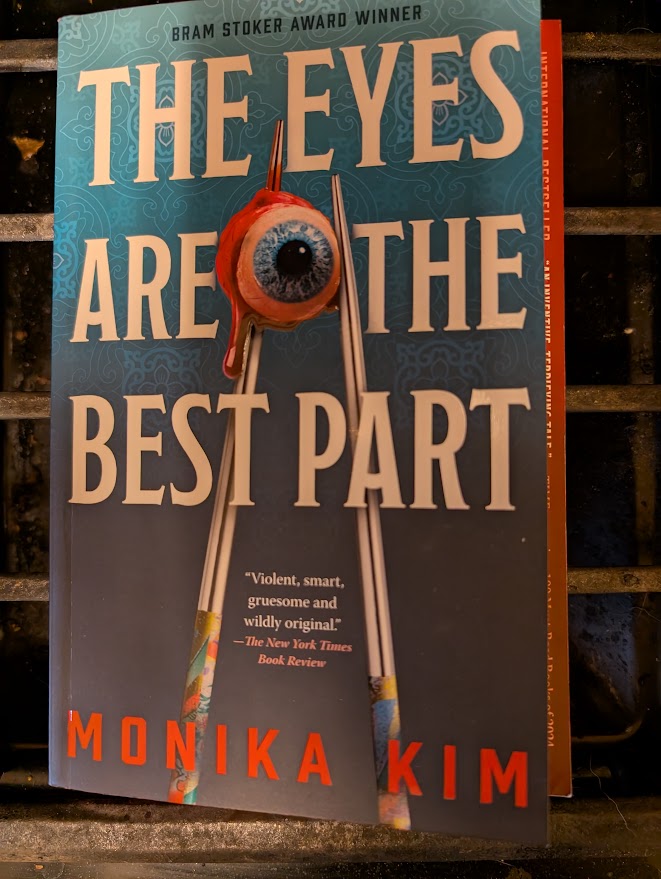
The Eyes are the Best Part: a Review

What’s the book? The Eyes are the Best Part by Monika Kim

How dark is it? Not as dark as the eyeball theme promised

How good is it? 3/10 tasty tasty eyeballs

The beginning of this was promising. Ji-won’s dad runs off with another woman and her mom is paralyzed by it. Ji-won’s sister isn’t doing much better. Ji-won herself is starting college but instead of going to her dream school with all her friends, she’s stuck all by herself at the local college here in town. Things only go downhill from there as her mom starts dating George, who’s clearly a creep with a fetish for Asian ladies, and Ji-won herself develops a worrisome obsession with eyeballs. Specifically, she wants to eat eyeballs. Blue eyeballs. George’s blue eyeballs. 

That’s creepy and interesting. We also find out early on that maybe Ji-won’s always been a bit unbalanced. Back when all her friends got into Berkeley and Ji-won didn’t, she went to great lengths to break up the friend group just because she was bitter and envious. When we learn that, Ji-won’s growing obsession and her quest to destroy George make a twisted sort of sense and Ji-won herself becomes intriguing. 

Unfortunately, none of that promise pans out. The intriguing set-up quickly devolves into a weird revenge fantasy involving George and Ji-won’s new college friend Geoffrey, neither of whom have any redeeming qualities whatsoever. George is a cartoonishly gross fetishist with several Asian girlfriends who each think they’re the only one. He takes an actual “business trip” to Thailand that we all know is code for sex tourism. Geoffrey is an overblown parody of a ‘Nice Guy’ who wears feminist t-shirts and spouts feminist quotes while literally stalking Ji-won in a cartoonishly gross way. Yet, in spite of how clearly gross these guys are, they don’t actually do a lot. ‘Ji-won vs the Cardboard Cut-outs’ gets boring pretty fast; it’s hard to excited about her bringing down such useless villains. Of course, if I had gotten invested I would have been even more disappointed at the ending. Ji-won’s revenge ratchets up and up only to largely fizzle out in a fairly unsatisfying way.

The back of this book has a short interview with Monika Kim that says she wants to turn stereotypes about Asian women being passive sex objects on their heads. I get how this book is meant to do that but I’m not sure it actually does much toward that project. Ji-won’s mom and sister are utterly passive, with almost no personality beyond anxiety and spinelessness. Even at the end, when George is in the hospital after literally trying to kill Ji-won, her mom is sneaking off to see him, still hoping this creep will rescue her from her empty life. My best guess is that her utter infuriating helplessness is supposed to highlight Ji-won’s rage-fueled cleverness by contrast but it seems ham-handed and has a “Ji-won’s not like other Asian girls” feel that doesn’t sit well. 

There could have been shades of ‘American Psycho’ here, where Ji-won gets away with multiple murders because no one believes a cute little Asian girl would do such grisly things. If that angle had been played up things might have got intriguing again, but that’s not really where Kim takes it. 

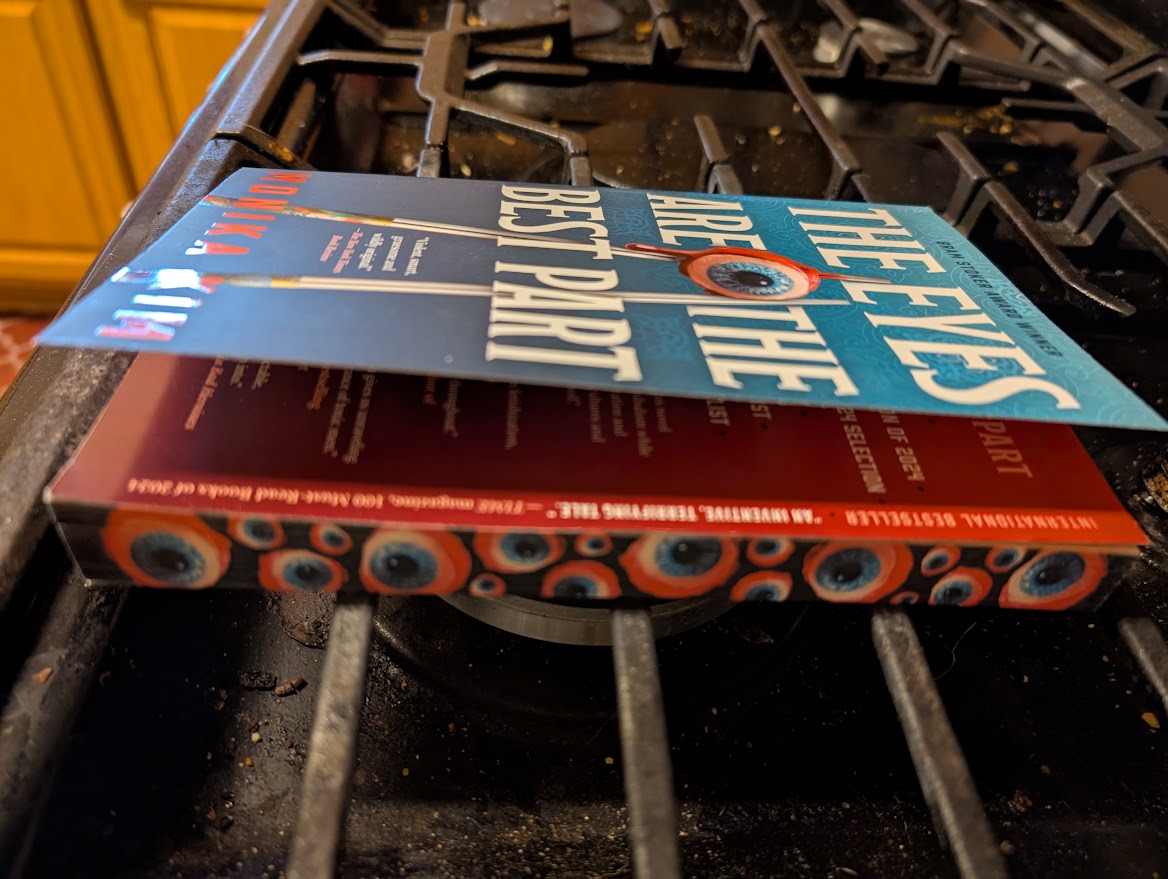
This was a quick read and the eyeball obsession was kind of interesting but by the end I was mostly just bored and annoyed. There was a lot of wasted potential here. The cover is cool, though, and the page edges have creepy eyeballs on them. So that’s something.

Evelyn Berckman Deserves More Fame

This was first published on our Substack in 2025. This is Part 2 and since I’m republishing these in reverse order (sorry) part 1 is coming soon.

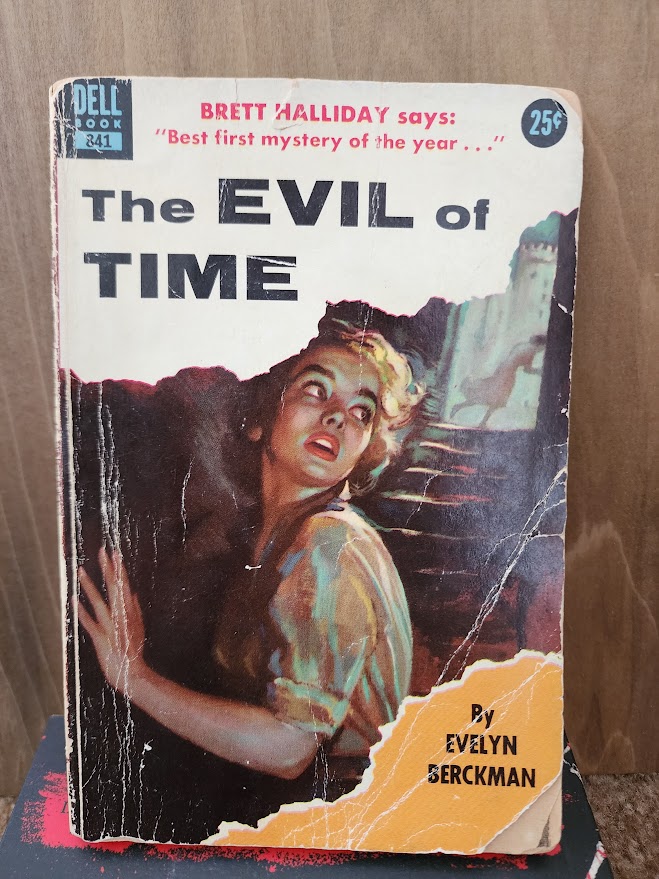
Let’s talk about The Evil of Time by Evelyn Berckman.

I picked up two Evelyn Berckman novels on the same day, because Brave Books in El Paso gave me free beer and offered me pulp fiction. I am a sucker for both. Even though I read The Evil of Time second, it appears to be Berckman’s first novel, written in 1954. This might explain why it was . . . pulpier? than the other novel I picked up, House of Terror (aka The Blind Villain). Hous of Terror was more subtle, centered on complex family relationships, and this one is a more straightforward mystery in a decrepit castle. I actually loved this book, though. It was suspenseful and the mystery was set up well. It actually gave me a “jump scare” moment, which I almost never have when reading.

The story is set in southern Germany in the aftermath of World War 2. We’re following a woman named Keith who works with the U.S. army hunting down and returning art stolen by the Nazis. Her bosses have been searching Drachensgrab, home of the mysterious Von Kaithur sisters. They’re pretty sure there’s a cache of stolen art there–a Greek tapestry, an obscure Rembrandt, a gold cup by Cellini, and a few other treasures. There are also rumors of money hidden somewhere around the place but the big boss, Colonel Ridge, and his crew have searched everywhere and found neither art nor money. Everyone’s been ordered to move on, but technically they have three days left to search and Keith’s supervisor asks her to go up and look around. Maybe one harmless looking expert in history will find something a pack of stompy soldiers missed.

The head of the house, Luise von Kaithur, is a rabid Nazi sympathizer who bitterly resents all these Americans in her home. There are also weird voices and footsteps in the castle at night. Oh, and one soldier “fell” down a flight of stairs and died. But other than that, what harm could there be in having another look around the place?

Still, Keith is eager for the chance to solve this puzzle and maybe show up the annoying and condescending Colonel Ridge. If she could find something big that Ridge missed, that would be worth the danger. I think everyone hopes Luise “I love Hitler” von Kaither will be less frosty towards a blonde woman in civilian dress; that could give Keith more freedom in her investigation.

This castle is one of the most effectively creepy castles I’ve ever read. It’s not even technically haunted but it’s scarier than many haunted houses I’ve read about. Something about postwar Germany as written by someone so close to the actual war gives the setting a feeling of lingering evil that really got to me but beyond that, Berckman’s writing is vivid and creative. Luise and her sister have a grand ancestral estate but pretty much no money so it’s literally falling apart. Keith can see gaping holes where plaster angels have fallen from the ceiling of her assigned bedroom, and when she pulls the covers off the bed she’s offered, rats scurry out. (She wisely elects to find another room to spend her nights in. One of the few with a decent bed and a lock on the door.) Some of her explorations take her to the attic, with odd domes in its floor (the tops of arched ceilings beneath) and centuries worth of junk piled up, and the old chapel on the grounds, whose organ pipes are filled with dead bats. She also explores the overgrown garden looking for a hidden grotto–grottoes were all the rage in the 1700s, the last time the estate was renovated. While she’s continually frustrated in her search for this elusive grotto, she does find proof that she’s not alone with the von Kaithur sisters. She spies a couple of old men creeping about the place on searches of their own.

She also briefly works with the fiercely masculine Captain Barth, almost working up a romance in the brief time they’re together. Just like the other Berckman novel I read, this story is driven by women and the romantic aspects are largely seen from Keith’s perspective. She’s a bit more stereotypical than Dana, the hero of The Blind Villain. Keith is getting older and worried her abrasive smarts will keep her from finding love, so she decides to deliberately tone it down around Captain Barth. She also needs a bit of rescuing by a big strong man at the story’s end.

True to what I love about Berckman, though, Keith is her own agent making her own decisions. At the last second, even while chastising herself for her contrariness, she sends Barth packing. In the end, she goes for Colonel Ridge, who in spite of his cold exterior, really comes through when she needs it. More than that, after he saves her life he shows a softer side and also freely gives her all the credit for solving the mystery. He has to earn her interest by respecting and admiring her as a person. Romantically speaking, it was a pretty progressive ending for an old pulp novel.

You might notice I’m purposely not telling you exactly how the mystery turns out, and that’s because you should really read this book if you can find a copy. It’s a quick read with an exciting payoff. It’s also fascinating and surprisingly spooky. This book, written by an American transplant to England, is very anti-Nazi but it doesn’t have that epic “good vs. evil” feel you get from more modern takes on World War II. It’s got a personal feel, with the German characters all having different feelings about the war and occupation and the Americans never quite sure who to trust. Luise von Kaithur, for example, is a rabid Nazi and everybody knows it but she wasn’t a soldier or even a financial supporter. She sucks but what can you do? Would she be pro-Nazi enough to push that soldier down the stairs? To hide neo-Nazis? Or will she just frown frostily at all the soldiers invading her home and do nothing? Who knows? The small town scale of the story was scary and thrilling but also added some humanity and nuance to the story.

After two novels, I’m already determined to track down more of Berckman’s work. I think she’s due for a revival.

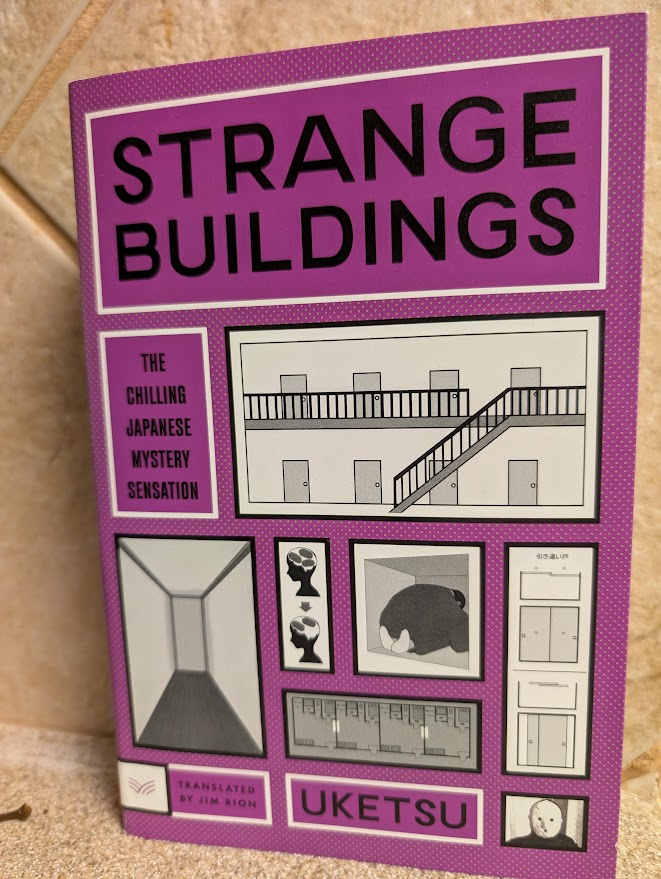
Strange Buildings: a Review

What’s the book? Strange Buildings by Uketsu

How dark is it? It’s a little dark. Darker than Uketsu’s first two installments.

How good is it? 6/10 odd houses

This is the third in Uketsu’s series about strange places and mysterious events but once again, it’s not really a sequel. The author/narrator and his friend Kurihara, the true crime enthusiast, appear again but everything else stands alone. 

Strange Houses, the previous installment, was quick and fun with an utterly redonkulous mystery. Strange Buildings is kind of the opposite. The mystery at its heart is less absurd and more interesting in terms of motive and emotional resonance but the pacing drags and the book repeats itself too much. 

Uketsu’s books are always focused on laying out a mystery and then laying out the proposed solution step by step so I was expecting that. The previous books managed to roll along quickly and keep a sense of mild tension as the mysteries unfold but this one, much longer than the previous books, dragged on and repeated itself quite a bit. It’s as if Uketsu’s so afraid we’ll miss a brilliant connection between clues that he’s constantly reminding and recapping things. At the end, when the narrator brings all his bits of evidence to Kurihara and begins to tie them together, they spend pages and pages listing all the bits of evidence I just spent a couple hundred pages reading. It got tedious and I started skimming, which isn’t what I’m looking for at the end of a mystery. 

It’s too bad the book dragged because as I mentioned before, I liked the actual mystery that unfolded. It combines family drama with cults and organized crime in surprising ways. I’ve always enjoyed Uketsu’s books as fun puzzles but this is the first time I really connected with the characters at all and felt bad for their suffering. In spite of its flaws, I have a feeling this is the mystery that will stick with me long after his first two books have faded from memory. 

I know the author is famous originally for YouTube videos and his three translated novels have each been successively longer and more ambitious. Maybe what I’m seeing is the struggle to move beyond cute puzzles into something closer to a real novel with emotional depth. It wasn’t entirely successful on that score but I’m game to see what Uketsu brings us next.

Bored Gay Werewolf

This review was first published on our Substack in 2025.

Let’s talk about Bored Gay Werewolf by Tony Santorella. As you might expect from the title, it’s about a bored gay werewolf and his friends. The gay werewolf’s name is Brian.

I enjoy actual horror and weird tales but I equally enjoy stories that are only technically horror. Stories like this one that feature supernatural creatures and thus land in the horror section, while mostly being comedies or dramas or some other type of tale. This particular one is mostly a coming of age story (or a new adult story?) with a werewolf twist.

Brian knew he was gay from an early age. He tried hard to be conventionally successful and fit in with everyone around him, and when he came out and everyone seemed fine he went right on trying to be conventionally successful and fit in with everyone around him. He did well in high school, worked hard in college. His plans were going well until he was cursed with lycanthropy.

After that his life kind of fell apart. With his conventional dreams seemingly dashed, Brian had no idea what to aim for instead. He dropped out of college, moved to a drab little apartment in the city, and now works a thoroughly uninspiring job as a cafe server.

His coworkers are cool, at least. The bartender, Nik, is an aging punk slowly earning her nursing degree. One of the other servers, Darby, is glittery femby butterfly and struggling artist/musician who makes Brian laugh. Nik and Darby are basically his best friends. They’re just normal humans, though, so he’s afraid to get too close. How do you even come out as a werewolf? Will they be afraid? Think he’s delusional? Would it make things just too awkward? Better to avoid the whole thing and keep to himself.

Then, for the first time, Brian meets another werewolf. An older, richer werewolf who seems to have it all figured out and is eager to share his wisdom and cool life hacks with Brian. In fact, Tyler’s thinking of starting a self help program and online community for werewolves and in return for some help with the social media, Brian can get in early and help Tyler test his ideas for werewolf self-iprovement. Hilarity and eventually violent danger ensues as Brian falls down the self help rabbit hole and falls further into Tyler’s world.

Tyler and his buddies are pretty flat characters, aging frat boys and basic bitches. They’re more the embodiment of Brian’s own muddled expectations for himself than people in their own right. He’s been confused and depressed and full of self-loathing because some big part of him thinks he should want to be like Tyler. Rich, slick, always in control. Especially when the whole werewolf thing makes him feel so out of control, being like Tyler is an alluring fantasy. Maybe Tyler’s program can put Brian back on that safe, socially acceptable path he’d been working toward before all this supernatural stuff happened.

Brian really just needs to figure himself out and grow up a bit and honestly, some of Tyler’s advice really works. Tyler’s meditation program makes Brian’s monthly transformations much calmer and easier. Tyler’s intense workout routine helps Brian focus and take some control over his daily routine. Tyler even convinces Brian to rebuild his relationship with his father, which has been distant and strained since he dropped out of college. Of course, it all comes with a hefty dose of “everything is a competition! Learn to dominate!” that isn’t so helpful. Still, it comes all wrapped up with the good stuff so . . . Brian follows along. It’s better than what he was doing before he met Tyler, isn’t it?

Ultimately, of course, what Brian learns is that he really doesn’t want or need to be some rich frat bro. He needs to work on himself, sure, but he doesn’t need to win at life or dominate other people or embrace his inner lone wolf. What he needs is to open up to his warm and caring friends from the diner, really give them a chance to be there for him. Figure out what he really wants and move toward that. And also, um, protect everyone from Tyler’s terrifying wolfy vengeance when Brian tries to go his own way. Oops.

The whole thing is sweet and fun. Brian and his friends are engaging characters that I enjoyed getting to know. Brian is relatable and Darby and Nik both seem like great friends and super cool people. (Too cool for me, probably.) This is also a very queer book without directly talking about it much. Sometimes the werewolf stuff is symbolic of the more toxic parts of the self-improvement sphere, sometimes it’s symbolic of being queer in a heteronormative world or of wanting any kind of alternative life path in a very conventional world, and sometimes it’s just funny horror stuff. It’s not a deep book but it’s got enough layers to be satisfying beyond the obvious jokes and jump scares, and I enjoyed finding good representation in such a fun and fluffy book.

Bored Gay Werewolf also has a dramatic werewolf-laden ending and a surprise that might be hinting at a sequel, so I’ll keep an eye out for new developments in Brian, Nik, and Darby’s lives. If you like fun stories that are only technically horror, you’ll probably want to keep an eye out, too.

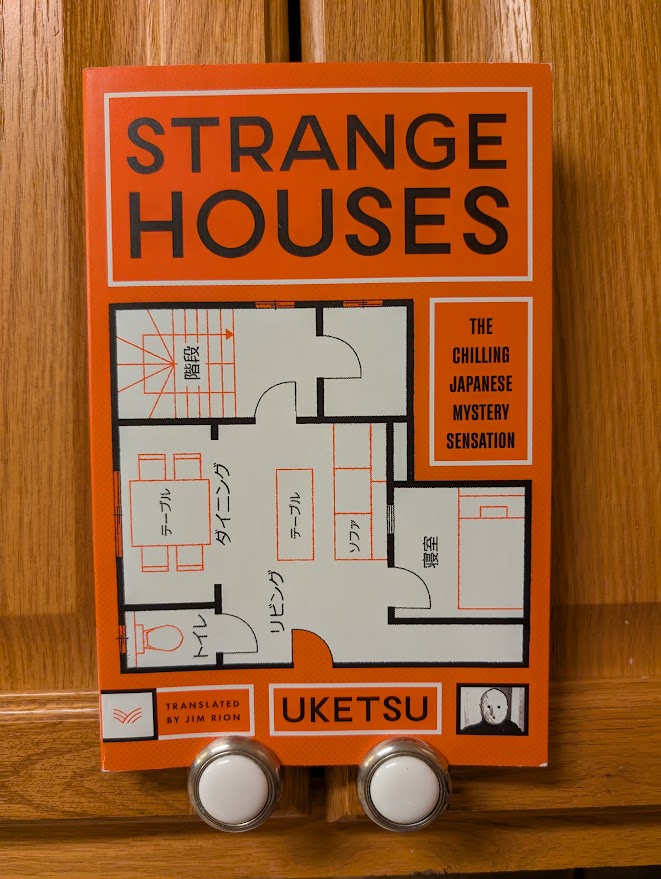
Strange Houses: a Review

What’s the book? Strange Houses by Uketsu

How dark is it? Dark blue like the blueprints for a house

How good is it? 7/10 hidden rooms

Strange Houses is the second book by Uketsu, a mystery-maker who is himself a mystery. I reviewed his first book, Strange Pictures, a while ago. Uketsu is a Japanese YouTuber who always appears in a freaky looking mask, which he also uses in his author photo for his books. (Also, I actually have no idea what Uketsu’s gender is, I’m just making a wild guess based on body shape. Sorry if I guessed wrong.) 

But I digress. On to the book. The first one, Strange Pictures, was a series of separate but interconnected stories; Strange Houses is one long story told through a series of three houses. The writing style is extremely minimalist and straightforward, making it a lightning quick read. The writing style also gives the story a clinical feel, like we’re removed from the emotional impact of the mystery as it unfolds. I don’t think this simplicity is a fault in translation. As far as I can tell, this English translation is a good approximation of the extremely accessible style Uketsu aims for. 

It’s not just the prose that’s straightforward and clinical, it’s the whole telling of the story. The narrator, a freelance writer, and his architect buddy Kurihara start looking at a very unusual floorplan and Kurihara decides it must be a murder house. Things snowball from there, Kurihara’s imagination running wild and the author going along for the ride. The thing is, it quickly becomes clear that Kurihara is pretty much spot on about his theories. The narrator, needing a quick piece for a magazine, writes a story about their murder house theory and ends up meeting someone who knows that house, which leads him to another strange floor plan, and so on. The floor plans are printed in the book so we can puzzle over them, which is fun. 

The whole book is a bit like the end of a Sherlock Holmes novel, where he explains in intricate detail how the crime was done. It’s all very logical and bloodless, which is not for everyone. I appreciated the style, though, because the actual mystery they’re unraveling is beyond redonkulous. I won’t spoil all the details but it involves secret children being trained to murder houseguests, and that’s just the beginning of the madness. Normally, I’m all for diving into the emotional depth and moral complexity of a story but this one is so farfetched that it doesn’t bear thinking about. The very dryness of the narrative keeps all that just slightly in the shadows, like a horror movie that never quite shows you the monster. For me, it works better that way. 

I’m starting to find Uketsu’s books easy reads, light little palate cleansers between more shocking or draining books. They’re still full of murder so I probably shouldn’t say this but I ended this book with a smile on my face, satisfied after a fun little romp through the murder houses. Which, now that I think about it, might be a major flaw in the books. I didn’t find either of them scary at all because none of the characters are fleshed out enough to relate to. For me, they’re fun quick puzzles but if you’re looking to immerse yourself emotionally this is not the author to take you there.