
What’s the book? Empire of the Scalpel by Ira Rutkow
What kind of dark is it? It’s a medical history book so there are gross bits but it’s mostly uplifting. Unless you have a severe blood phobia you’ll probably be fine.
How good is it? 7/10 scalpels
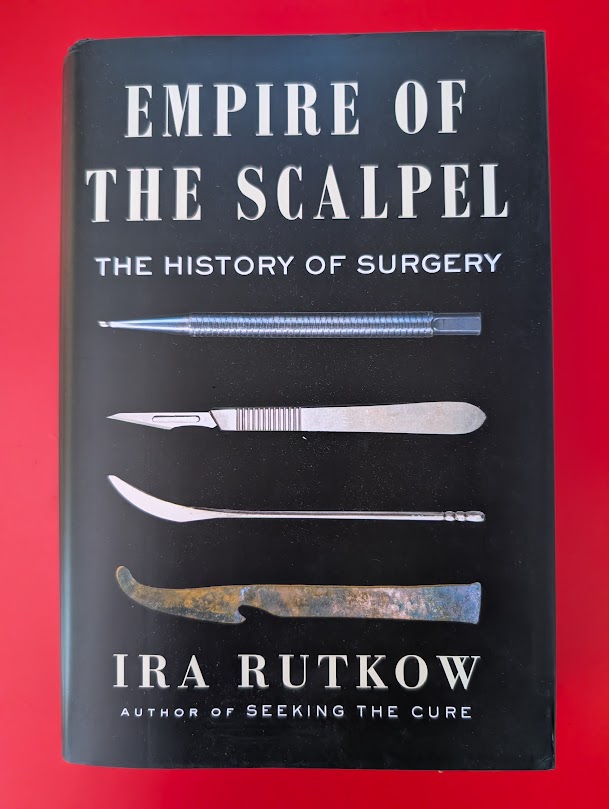
This is another Morbidly Curious Book Club selection, meaning I didn’t choose it for myself. I liked it, though. It’s a solid little popular history that tries to balance individual stories with a serious timeline of surgical history, starting at the very beginning, the moment when prehistoric humans first dared to drill holes in each others’ skulls.
Humans have been trying to fix each other with knives and stitches for a very long time, and popular histories of such big topics are always pretty surface level. Sometimes they also end up pretty random, but this author does a good job of choosing a couple of central themes and organizing his facts and stories around them, which keeps this history engaging and easy to follow.
One theme is the social and professional fortunes of surgeons and how those have changed over the centuries. We learn about barber-surgeons and the split between surgery (often seen as a dirty and unskilled job) and medicine (full of ‘real doctors’ who spoke Latin and didn’t get their hands bloody). We learn about fights between guilds and the very slow rise of surgeons from back-alley bloodletting to celebrated rockstars who performed transplants and saved lives.
The second theme is the series of practical problems surgeons had to solve along the way, saving more lives and earning themselves respect and admiration as these problems got solved. We read about the surgeons who revolutionized the study of human anatomy, invented anesthesia for surgery, promoted antisepsis, and figured out how to type blood and give transfusions safely. With every problem solved and advance made, surgery gets a little safer and more useful.
Rutkow was a surgeon himself, so he inserts a few stories from his early years into his history. It’s become common for authors to tell their own stories as they relate to some larger story about history or science; I’ve come to expect it and I think Rutkow hits a good balance. He tells enough stories to show us his personal connection to the topic and take his tiny place in the grand history of surgery without making the book about himself. In fact, though he also tells many stories about famous surgeons throughout history Rutkow is careful to keep this from becoming just a list of great men throughout Western history. He always brings the story back to what those discoveries or inventions mean to the craft of surgery and the lives of patients in need. I appreciated this approach.
This book isn’t meant to be a deep dive for experts but it’s a nice ride through history. It’s maybe a tad dry and Rutkow uses the phrase “knife bearers” a whole lot but I have no major complaints about this book and I found it kind of uplifting. I’ve read enough novels from the Victorian era and earlier to appreciate how far medicine has come and be glad I live in an era of laparoscopic procedures and sterile operating rooms and antibiotics. I had a good time reading about the history of these modern miracles.

