
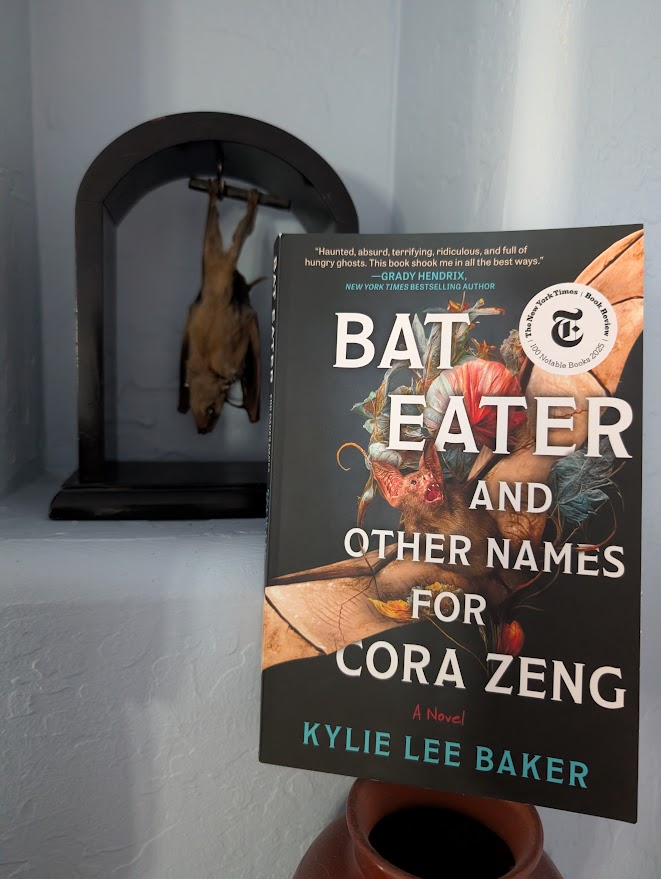
What’s the book? Bat Eater and Other Names for Cora Zeng by Kylie Lee Baker
What kind of dark is it? Ghosts, murder, and lots of gore. This book’s got it all, baby!
How good is it? 8/10 hungry ghosts
Apparently China’s spooky month is August and I never knew. I knew a little about hungry ghosts and burning joss paper and Buddhist festivals for the dead but I somehow never noticed it all took place in August. I feel a bit dumb about this. Now that I’ve finished Bat Eater, though, I’ll probably never look at August the same way again.
This book is a ghost story and like so many ghost stories, it’s told in kind of a melancholy and lyrical tone. In fact, for the first few pages I was bored and a little annoyed by how literary and poetic Baker was trying to be. Then Cora’s sister got decapitated by a train and I wasn’t worried about the lyricism anymore.
The lyricism didn’t end. The book is full of poetically broken people and shown entirely through the lens of Cora’s narration, which is moody and introspective and melodramatic as hell. It’s just that on top of that silliness is an intensely gory and disturbing story full of hungry ghosts, crime scene clean-up, and murder. It’s intense and I loved it. Cora’s navel gazing about her OCD and her angst at being caught between cultures (and more specifically between her white Christian aunt on one side and her traditional Chinese aunt on the other) becomes a nice counterweight to the terror and gore she’s suddenly dealing with on a daily basis.
Oh, and this is also happening during the Covid Pandemic, which is both ramping up Cora’s germ phobias and seriously hindering the investigation of the serial murders Cora’s pretty sure are happening all around her. No surprise, the murdered people are all Asian and the killings appear to be hate crimes. With people regularly yelling “bat eater” at Cora on the streets, she’s pretty sure what the bats left at these scenes are supposed to mean.
Cora and her friends do try to investigate the murders but this isn’t a thriller or mystery novel. The emphasis is squarely on the horror, both human and supernatural. A lot of horror novels pull back on the gore in favor of the more subtle aspects of horror but this one smacks us full in the face with the violence of it all. Horror, especially in novels, is often a vehicle to talk about some larger moral or emotional question and it’s easy to get the balance wrong. Too much blood and nobody notices your message; too little and the reader is left bored and wondering why you didn’t just start a Substack instead of pretending to write a horror novel. For me, Baker gets the balance pretty much right, giving us an exciting story that also highlights the issues of identity and racism she wants to discuss.
The anti-racist message is also pretty heavy-handed at times but I’ve definitely seen worse and it’s an interesting perspective on the Pandemic. The messaging never takes over the story entirely and I appreciate the way Baker balances the cartoonishly racist white folks with a variety of Chinese characters, some of whom are also cartoonishly evil as far as we can tell. Sure, there’s a lot of suffering caused by racism but there’s a lot of suffering in general, caused by a lot of things.
That said, parts get a bit silly if you think about them too hard. Even in a pandemic, even with cartoonish levels of racism at play, this story’s murders would have been pinned on somebody way before Cora got involved. Horrific and creative murders done in crowded apartment complexes by multiple not-so-bright copycats? One of them’s getting caught and blamed for everything. The mystery part of this book is dumb. Still, with all the ghosts and poetic brokenness and tragic backstories I had a lot to entertain and enlighten me, even when the mystery fell a bit flat.

