The Twisted Thing: a Review

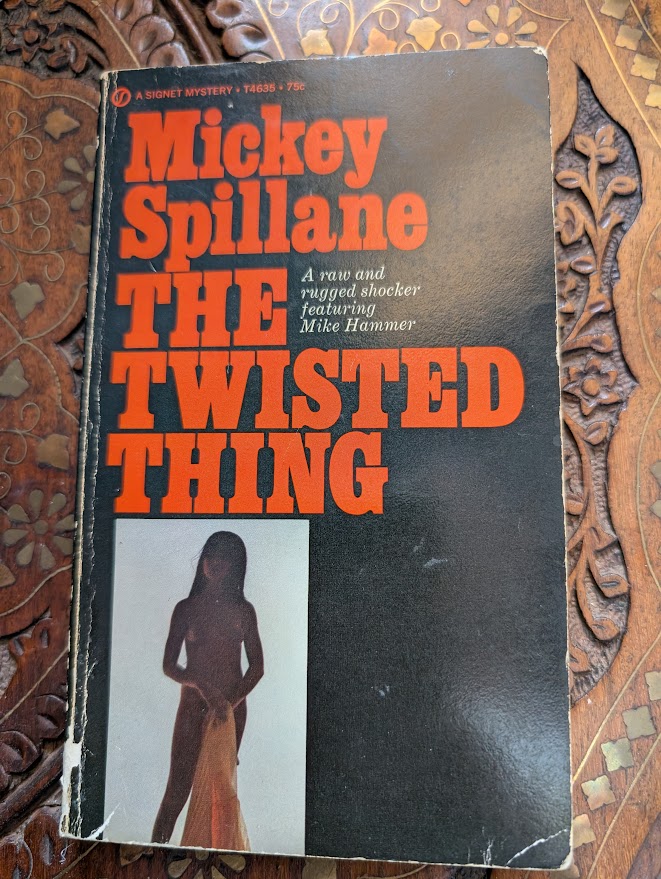
What’s the book? The Twisted Thing by Mickey Spillane

How dark is it? Super dark purply-black like a black eye

How good is it? 7/10 gut punches

This is a Mike Hammer mystery. I had heard of Hammer and knew he was one of the classic hard-boiled detective characters. I pictured him vaguely as one of those tough talking film noir characters. Back in the day, Mike Hammer mysteries were wildly popular, maybe the most popular of hard-boiled detective stories. Which makes sense, because Hammer is the most over-the-top hard-boiled detective I’ve ever encountered. He’s completely ridiculous but also utterly awesome. 

This book starts with Hammer beating up a crooked cop and only gets more violent from there. Hammer is huge and angry and kinda looking for excuses to pull out his gun. (Which he constantly calls his “rod” because he’s super hard-boiled and unbothered by metaphor.) He will punch a dude for the smallest of reasons, and this is treated as more heroic than psychotic. Hammer is also irresistible to the ladies and always lookin’ to get laid. He’s chock full of film noir slang and old school outlaw masculinity. 

He’s almost an offensive caricature of a hard-boiled detective, and the whole book is full of vaguely offensive stereotypes and stock characters: the ex-con trying to make good, the former sex worker hiding her past from her employer, the murderous lesbian with masculine vibes, the boy genius who’s emotionally stunted, the cop on the take, the casino owner with mob ties . . . every character is so over the top it’s actually hard for me to be upset about it because none of it feels serious. If you think about this story for even one second it gets pretty silly.

But Mickey Spillane’s writing is so tight and gripping that I didn’t have one second to think about how ridiculous it all was. It was thoroughly fun to watch Hammer punching twits in the face, sneaking around in dumbwaiters, swimming through freezing water to find the bad guy’s escape route. This story is all plot all the time and I couldn’t help but enjoy it. I was way more excited by reading Hammer’s adventures than I was by any of the other hard-boiled classics I’ve read. 

If you’re looking for something classy, I doubt Hammer’s what you’re looking for. Stick to P.D. James or Agatha Christie or, if you’re in a noir mood, maybe Raymond Chandler. If you want action and the hardest of hard-boiled insanity, this is the detective for you. 

Who Killed Aunt Maggie

This review first appeared on our Substack in September of 2025.

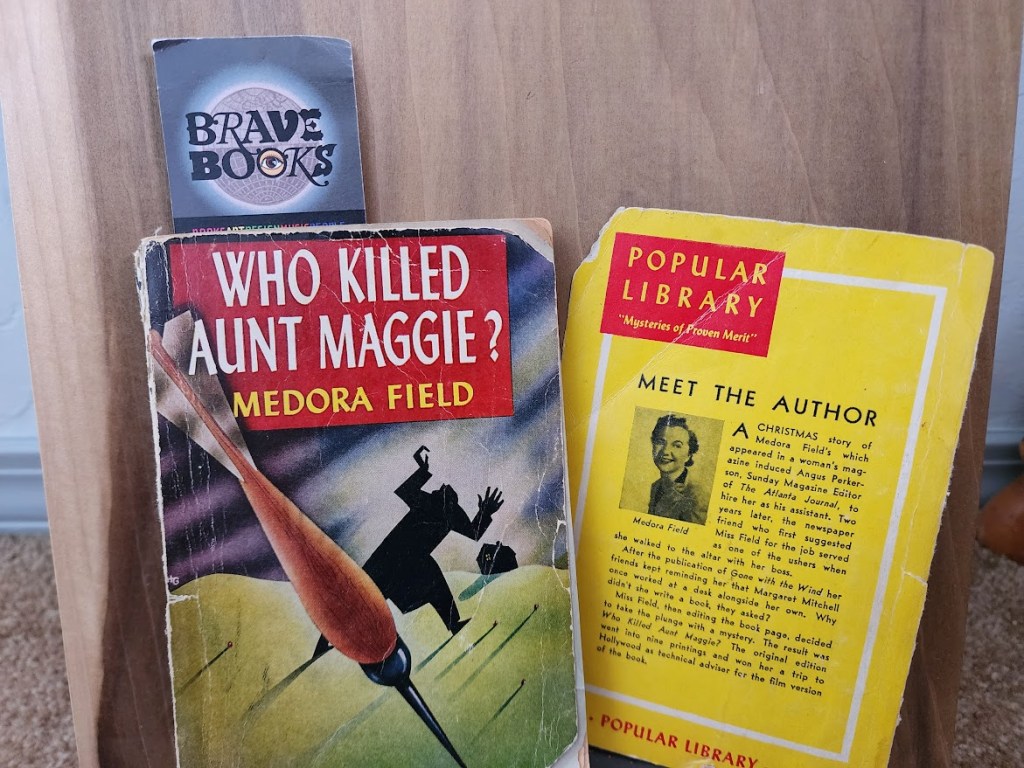
Let’s talk about Who Killed Aunt Maggie by Medora Field. This is one of a handful of pulp novels I picked up in El Paso. I basically scanned the pulp table looking for female author names and murdery titles. I knew nothing about Medora Field and I didn’t know how hard this book is to find these days. Like a lot of pulp paperbacks, my copy started falling apart the second I opened it up, so I’m not surprised they’re becoming rare.

This book is casually racist. It was published in 1939 by a well off white lady from Georgia, so it’s no surprise. The only black characters in this mystery are servants, and they’re all portrayed as kind of dumb and childlike (and extremely devoted to the rich white family who employs them). Late in the book there’s a short speech about the moral inferiority of black people. Medora Field (married name Medora Field Perkerson) was an advice columnist and historian who wrote a book about Georgia’s historical buildings and was friends with Margaret “Gone with the Wind” Mitchell, who was also racist.

Honestly, it’s the unthinking casualness of the racist bits that gets to me. I read a lot of older novels so I’ve run across a lot of racist and sexist and colonialist content. As a modern white American lady, I have the luxury of taking a detached view of most of it. A surprising number of old novels actually examine and push back against the views of their time in ways that are interesting and hopeful, even when they fall far short of modern standards. Sometimes, though, there’s just zero thought and zero pushback and the old timey awfulness just sits there stinking up an otherwise decent story. (I suppose that’s sometimes true in contemporary fiction, too.)

It’s a shame because this is an otherwise decent story. Not great, but decent. The mystery takes place in a grand old plantation house Sally Ambler has inherited from her family. She’s offered to host an impromptu engagement party for her friends Claire and Bob. Bob’s old fling, Eve, is crashing the party and Sally’s Aunt Maggie has also been staying at the house to look through the library and do some family research. Maggie has also been nosily looking at all the recent renovations and making one last search for the secret room their ancestor was rumored to have built back before the Civil War.

As soon as she arrives to get the party ready, Sally feels something isn’t right. Who was that man she saw dashing away through the backyard? Where have the servants got off to, when they were supposed to be here dusting bedrooms and preparing dinner? She’s a bit spooked, but soon all the guests arrive and those thoughts are pushed out of her head. Until bedtime, that is, when she walks out of the kitchen to find Aunt Maggie crumpled at the bottom of the back stairs. At first Sally assumes Aunt Maggie fainted or somehow tripped down the stairs but it soon becomes clear that something far more sinister is afoot . . .

We spend a lot of time watching characters bumble about the house while learning about their various tense relationships and wondering who might have motive for such a crime. Sally and her husband try to call the police but the phone line has been cut. They try to get Andrew, the butler, to drive to the nearest town for help but all the cars’ tires have been punctured. A fierce storm comes up and the electricity goes out, which leads to a night of various suspects roaming about the house with candles, finding clues and having spooky moments. This isn’t the tightest of mysteries but there are fun and intriguing moments as the night progresses.

The next day they finally get the police and coroner out to investigate but at first this only leads to more confusion and questions. The coroner, by the way, is a blind lawyer. In these forensics-heavy days of medical examiners and crime scene investigators, it’s easy to forget that coroners with no medical expertise did and still do exist. This coroner’s expertise is in ferreting out motives and secrets by listening intently to the way people talk. He’s an interesting character, but he’s also the one who gives the racist speech, so that ruins things a bit.

After a lot of worrying and conjecture and confusion, Sally literally stumbles onto the mystery’s solution, which is a lot more tense and suspenseful than it sounds. The book’s finale was pretty exciting. Not sure it was worth the racism, but it was a good ending.

And there we have it. Who Killed Aunt Maggie was an interesting experience but I’m not itching to find Field’s second novel. It might interest you to know both of her books inspired movies in the 1940s; I haven’t seen either movie and the synopsis for the Who Killed Aunt Maggie film sounds not much like the book, but if you’re into old movies you might look them up. Tell me if they’re any good. Tell me if they’re also casually racist.

Miss Pinkerton Review

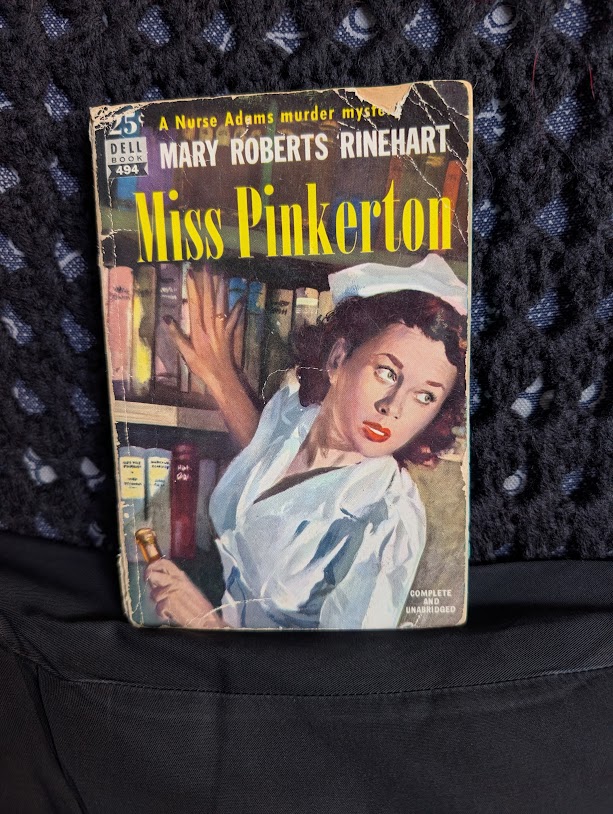
According to Wikipedia, Mary Roberts Rinehart was the American Agatha Christie. She certainly didn’t achieve Christie’s heights of fame but then again, who has? Agatha Christie famously disappeared for a couple of weeks in 1926, adding immensely to her mystique as a mystery writer. Rinehart did nothing so dramatic, but she was almost shot and stabbed by her longtime chef in 1947 and that same year went public about her battle with breast cancer, which was a pretty bold move for the times. She was also a trained nurse and a war correspondent on the front lines of World War I. She seems worth remembering for all that, if not for the long list of books she wrote. Her life sounds terrifying and it seems like she was a badass.

Many of her books are available on Project Gutenberg but it doesn’t look like Miss Pinkerton is among them. It’s actually the second (maybe third?) in a series of four books following Hilda Adams, professional nurse and secret assistant to the police. I picked this up in a used bookstore and though Miss Adams keeps referring to former cases I wasn’t sure whether that was referring to actual previous books or just a plot device. Miss Pinkerton (also called The Double Alibi) works as a standalone book but it’s neat to know there are really more stories about her.

Anyhow, it’s 1932 and Hilda Adams is a home care nurse. The police, especially Inspector Patton, sometimes arrange for her to snoop around and find clues while she’s nursing at at a suspect’s home, and this is what brings her to the elderly Miss Juliet Mitchell’s stately home. Her good for nothing nephew has just accidentally killed himself while cleaning his pistol. Or maybe he killed himself. Or maybe he was murdered and it was made to look like an accident or a suicide. Nurse Adams is helping Patton figure out what happened while she nurses Miss Juliet.

What follows is a guessing game of motives and opportunity. The elderly servants are hiding something, but what? Miss Juliet is hiding something, too. So is Paula, the dead nephew’s girlfriend. She’s sniffing around awfully hard for information. And what about Miss Juliet’s doctor, hoping Miss Juliet will leave him money in her will? And the family lawyer in charge of that will? What really happened is anybody’s guess as our heroine sneaks around looking for clues and talking to suspects, all while actually nursing Miss Juliet and secretly meeting with Inspector Patton to report. 

It’s pulpy and superficial but it’s a fun mystery and Nurse Adams is pretty plucky and independent for the 1930s. It’s also fun to read mysteries from earlier eras where so many people don’t have phones or cars. It’s a whole different feel, you know? Also, it was a little weird to realize that Nurse Adams’s medical kit has reusable glass vials of pills and a hypodermic needle she just washes and reuses forever. Of course she does, the 1930s weren’t full of single use gloves and disposable needles. But that’s what I love about reading old stuff–I always find little tidbits I’d never considered. 

Anyway, Rinehart was cool and probably worth trying if you like old-timey stuff. I don’t see the Miss Pinkerton series for free but Project Gutenberg has other mysteries she wrote, plus some of her non-fiction writing. Or you could cruise used book stores for pulp novels that haven’t yet crumbled to dust. You might get lucky and find the sequel, The Haunted Lady. But I’m hoping to find it first.

As always, you can follow us here or on Substack; embrace the darkness and read more books.

Stubs: Part 1

Sometimes I read a book that inspires thoughts and feelings, but not enough thoughts and feelings to inspire a full review. (Often the book just isn’t dark in the way I was hoping it would be.) Even the way I write, with lots of asides about where I bought the book and what random thoughts I had while reading, there’s just not enough for a coherent thousand words or so. When this happens, I save them up and throw together some mini-reviews. Let’s talk about three of these books:

Ghosts of Denver: Capitol Hill by Phil Goodstein

This didn’t merit a whole review because it’s not really about ghosts. The spooky font and haunting line drawing on the cover promised me ghosts galore, so I was bitterly disappointed to find nearly six hundred pages and almost no ghosts at all. This is about 5% ghosts and lurid tales of Denver hijinks, 95% very detailed history of the Capitol Hill section of Denver focusing largely on architecture. I love history included with my ghosts stories, especially when that history involves colorful locals and either criminals or disasters. I like architecture and I’ve actually spent a few hours looking at cool buildings in the area this book is about, but this is way more detail than I ever wanted. 

I did learn a handful of interesting things, though. I learned that Denver used radium tailings in some of their roadbeds, which made them radioactive enough to require cleanup efforts in the 1990s. I learned that 1920s Denver was kind of run by the Ku Klux Klan. I learned that during the Great Depression, movie theaters used to raffle off groceries. (That’s much more wholesome than the radium roads and the Klan thing.) There are a couple strange stories of murder and a couple of interesting ghost stories, but this book felt like a bait and switch. They lured me in with the promise of ghosts and then made me learn about city planning.

Reprisal by Arthur Gordon

Funny enough, I grabbed this book in Denver’s Capitol Hill area. I’m pretty sure I got it at Kilgore Books, a few blocks down from the fittingly named Capitol Hill books, where I got the ghost book with no ghosts in it. I was pressed for time on this book-finding trip so I grabbed several books based on hunches and cool titles, and this was one of them. 

Turns out Reprisal is trying to show us the complexities of race in the Jim Crow south. It was written in 1950 by a rich white dude from Savannah, Georgia so . . . he nails it, obviously. Deep and rich understanding of the grievances and injustices that led to the Civil Rights movement soon to gain momentum and sweep through the south.

Just kidding. He doesn’t nail it at all. It’s awkward and unsatisfying to read. The center of the story is Nathan, whose wife was lynched along with three friends. Several of the men involved were eventually brought to trial only to be acquitted by a jury of their white small town peers. When Nathan hears of the acquittal, he returns to Georgia to take justice into his own hands. This part is interesting and Nathan is a sympathetic character. Unfortunately, our author spends most of the novel following various characters who aren’t Nathan, trying to present a wide range of views on the lynching in particular and race in general. (Of course, most of these characters are white.)

There are so many characters that none of them are particularly deeply drawn and following them all bogs down the story’s pace while not saying anything particularly enlightening about race or segregation. In the story’s first few pages, a reporter wants to cover the trial and its aftermath and his editor warns him that “if you’re going to tackle the race problem–which has been hammered almost to death lately–try to write about the negroes as people, will you? Not symbols of suffering humanity or shuffling clowns. If you can make ‘em people, with fairly coherent thoughts and reactions and emotions, you’ll have done something no other feature writer has done yet . . .” This feels like the author’s mission statement and honestly, I’m not sure he succeeded. Maybe by 1950 standards . . . . 

To be fair, I don’t know what book from the pre-Civil Rights era south would meet a modern reader’s standards. It does seem like Gordon was trying to fight racism in some way with his book, which is more than most authors were doing. This book kinda sucked on both a technical and a moral level but I found the attempt weirdly interesting to think about. 

The Broken Gun by Louis L’amour

I picked this up at a used book shop purely because I wanted to try out Louis L’amour. I was booked to stay at the historic Strater Hotel for a weekend and Louis L’amour apparently stayed and wrote there often, preferring room 222. There’s a little brass plaque on the door now commemorating him. I thought it would cool to read L’amour in the hotel where he stayed. For the record, it was cool and this is a good book. It’s not my usual dark vibe, though, so an entire post on this fun L’amour book I read for goofy reasons felt like too much.

This isn’t one of L’amour’s most famous books, it’s just the one I happened to find the day I went looking. This one is set in the 1960s (and also written in the 1960s), following a writer of Westerns, Dan Sheridan, as he researches an old mystery and ends up in deep trouble. He visits the remote ranch of Colin Wells for research and immediately starts to realize Wells means trouble. Stuck in the Arizona wilderness, miles from help, Sheridan looks for a way to escape while trying desperately to figure out why Wells would want him dead at all. 

It’s a tight mystery with exciting action and interesting wilderness survival scenes. L’amour is more famous for writing what his character Sheridan writes, historical frontier fiction, but if all his books are as tense and tightly written as this I can understand his fame. Used bookshops here in the southwest are usually well stocked with L’amour so I’ll probably grab more eventually. Maybe he’ll show up in the next Stubs post I put up. Who knows?

As always, embrace the darkness here or on Substack. Read more (and darker) books! Happy New Year!

Seven Days Before Dying

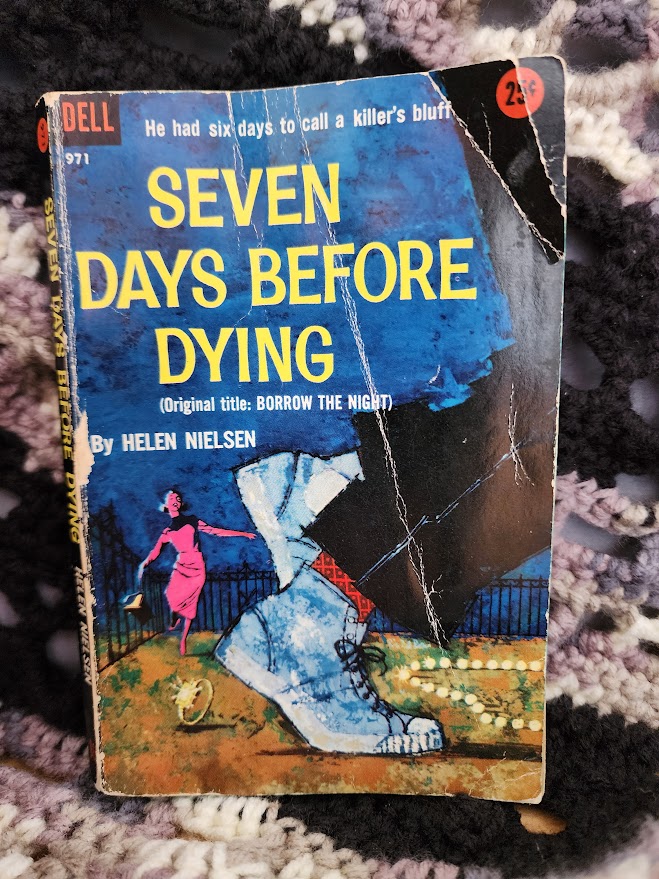
Let’s talk about “Seven Days Before Dying” by Helen Nielsen. It’s also called “Borrow the Night” but I don’t really know why. A lot of these old pulp novels have multiple titles for mysterious marketing reasons.

This one is dark in that pulp fiction/film noir/mystery sort of way. I picked it up at Brave Books in El Paso, more or less at random off a table full of pulp novels. Like most of the books I picked up that day, this was a lucky find. But enough of bookstores. On to the plot:

Judge Ralph Addison has been getting death threats for the last six days. Seven months ago he judged and sentenced a young drug addict for the Christmas Eve murder of a woman up on Mulholland Drive, and he’s about to be executed for the crime. One day before the execution, the letter writer steps up the threats, calling Addison on the private line of his home office. Finally spooked enough to take this to the District Attorney, he finds another guy already there. The arresting officer in the case, Matt Coleman, has been getting similar letters all week. According to the letters (and now phone calls), when this kid is executed tomorrow morning, Addison and Coleman will die, too.

With a choice between tracking down the “Mr. Justice” of the letters or waiting anxiously at home, Coleman goes on the hunt and Addison follows. As their last day wears into night, the search becomes less about Mr. Justice and more about finding out who the real Christmas Eve killer might be. 

I don’t want to give too much away so I’ll leave my summary there. This story has some exciting twists and turns and the characters learn a bit about themselves as they follow the clues. This is a well-constructed mystery and I enjoyed watching it unfold. Nielsen takes stock characters–aging cop with nagging doubts about that one case, shady lawyer, self-righteous judge, wayward rich girl–and gives them depth and life. Aside from a few classics I really haven’t read many pulp mysteries, and reading this one makes me feel like I’ve been missing out on some solid reading pleasure. 

Turns out Helen Nielsen was a prolific author, writing eighteen novels and dozens of short stories, as well as episodes for Alfred Hitchcock Presents and Perry Mason. The TV writing makes sense–I can picture this novel being a great TV or movie mystery in that ’50’s and ’60’s style. Sounds like there’s plenty of Nielsen out there to read and, in spite of her tiny stub of a Wikipedia entry, she’s famous enough to have made it into the internet age. Publisher Simon & Schuster’s Prologue line seems to have tons of old pulp available as ebooks for fairly reasonable prices. This is great news because a whole lot of the original paperbacks are crumbling to dust these days. The paperback of Seven Days I bought is in pretty good shape, but that only means less than ten pages actively ripped when I turned them. 

Also, this isn’t important but this is the second time I’ve searched for a pulp author on Barnes & Noble’s website and found German editions for sale. The first time I was searching for an author (Evelyn Berckman) whose books were sometimes set in Europe so I thought that was the reason for German editions. Nielsen mostly set her books in California, though, so now I’m wondering if Germans are just super into pulp fiction. Anyone know the answer to this? I’m dying to know. 

As always, follow my sister and me on here or Substack as we read and review the dark side of life and literature.