
This review first appeared on our Substack in September of 2025.
Let’s talk about Who Killed Aunt Maggie by Medora Field. This is one of a handful of pulp novels I picked up in El Paso. I basically scanned the pulp table looking for female author names and murdery titles. I knew nothing about Medora Field and I didn’t know how hard this book is to find these days. Like a lot of pulp paperbacks, my copy started falling apart the second I opened it up, so I’m not surprised they’re becoming rare.
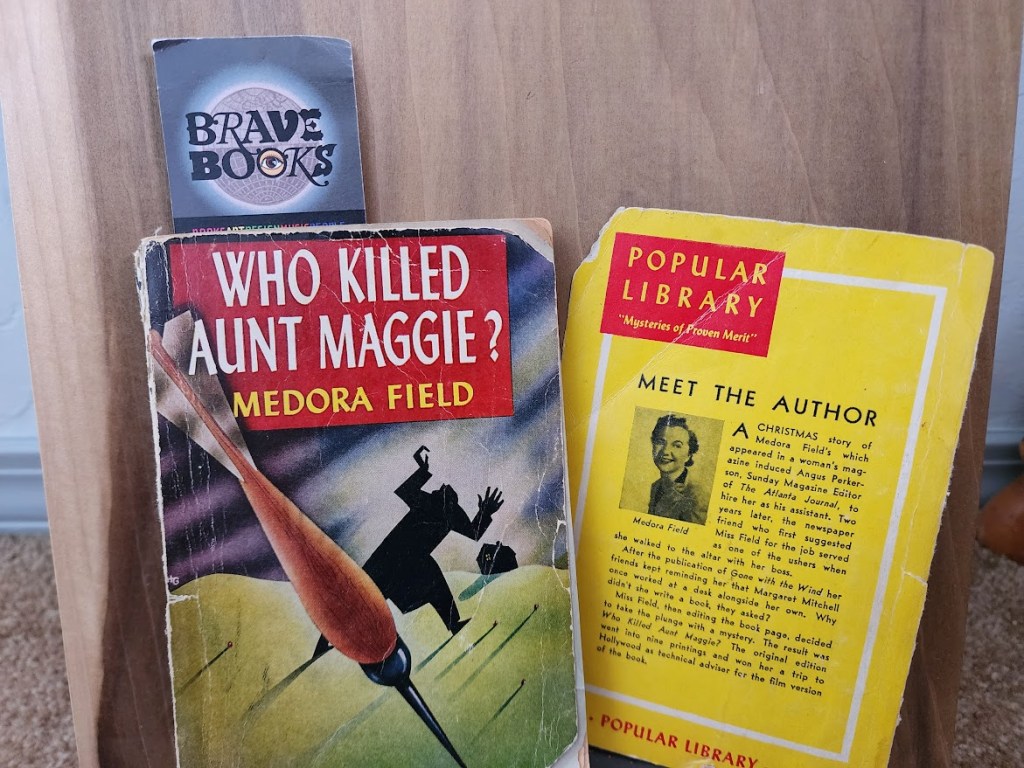
This book is casually racist. It was published in 1939 by a well off white lady from Georgia, so it’s no surprise. The only black characters in this mystery are servants, and they’re all portrayed as kind of dumb and childlike (and extremely devoted to the rich white family who employs them). Late in the book there’s a short speech about the moral inferiority of black people. Medora Field (married name Medora Field Perkerson) was an advice columnist and historian who wrote a book about Georgia’s historical buildings and was friends with Margaret “Gone with the Wind” Mitchell, who was also racist.
Honestly, it’s the unthinking casualness of the racist bits that gets to me. I read a lot of older novels so I’ve run across a lot of racist and sexist and colonialist content. As a modern white American lady, I have the luxury of taking a detached view of most of it. A surprising number of old novels actually examine and push back against the views of their time in ways that are interesting and hopeful, even when they fall far short of modern standards. Sometimes, though, there’s just zero thought and zero pushback and the old timey awfulness just sits there stinking up an otherwise decent story. (I suppose that’s sometimes true in contemporary fiction, too.)
It’s a shame because this is an otherwise decent story. Not great, but decent. The mystery takes place in a grand old plantation house Sally Ambler has inherited from her family. She’s offered to host an impromptu engagement party for her friends Claire and Bob. Bob’s old fling, Eve, is crashing the party and Sally’s Aunt Maggie has also been staying at the house to look through the library and do some family research. Maggie has also been nosily looking at all the recent renovations and making one last search for the secret room their ancestor was rumored to have built back before the Civil War.
As soon as she arrives to get the party ready, Sally feels something isn’t right. Who was that man she saw dashing away through the backyard? Where have the servants got off to, when they were supposed to be here dusting bedrooms and preparing dinner? She’s a bit spooked, but soon all the guests arrive and those thoughts are pushed out of her head. Until bedtime, that is, when she walks out of the kitchen to find Aunt Maggie crumpled at the bottom of the back stairs. At first Sally assumes Aunt Maggie fainted or somehow tripped down the stairs but it soon becomes clear that something far more sinister is afoot . . .
We spend a lot of time watching characters bumble about the house while learning about their various tense relationships and wondering who might have motive for such a crime. Sally and her husband try to call the police but the phone line has been cut. They try to get Andrew, the butler, to drive to the nearest town for help but all the cars’ tires have been punctured. A fierce storm comes up and the electricity goes out, which leads to a night of various suspects roaming about the house with candles, finding clues and having spooky moments. This isn’t the tightest of mysteries but there are fun and intriguing moments as the night progresses.
The next day they finally get the police and coroner out to investigate but at first this only leads to more confusion and questions. The coroner, by the way, is a blind lawyer. In these forensics-heavy days of medical examiners and crime scene investigators, it’s easy to forget that coroners with no medical expertise did and still do exist. This coroner’s expertise is in ferreting out motives and secrets by listening intently to the way people talk. He’s an interesting character, but he’s also the one who gives the racist speech, so that ruins things a bit.
After a lot of worrying and conjecture and confusion, Sally literally stumbles onto the mystery’s solution, which is a lot more tense and suspenseful than it sounds. The book’s finale was pretty exciting. Not sure it was worth the racism, but it was a good ending.
And there we have it. Who Killed Aunt Maggie was an interesting experience but I’m not itching to find Field’s second novel. It might interest you to know both of her books inspired movies in the 1940s; I haven’t seen either movie and the synopsis for the Who Killed Aunt Maggie film sounds not much like the book, but if you’re into old movies you might look them up. Tell me if they’re any good. Tell me if they’re also casually racist.
 Darker Books