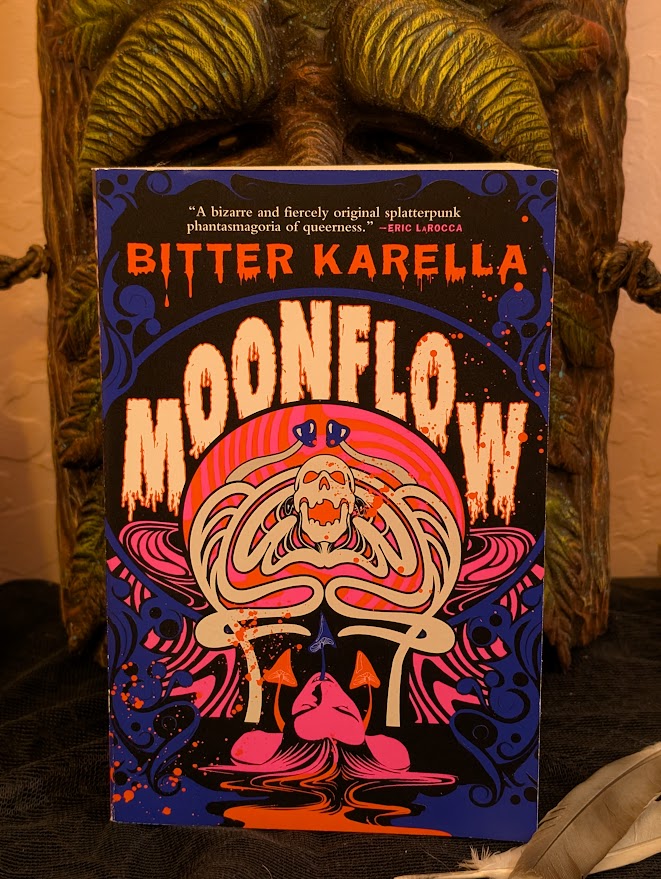
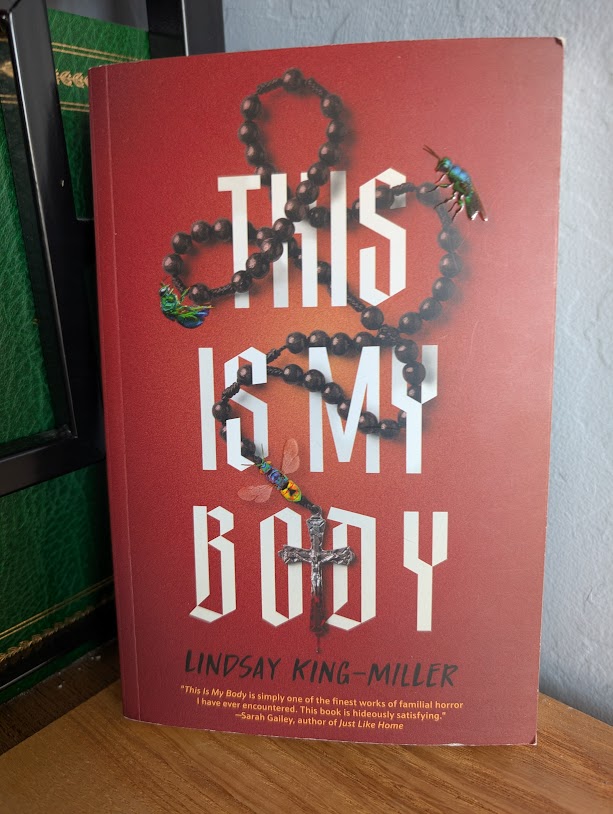
This is My Body

Let’s talk about This is my Body by Lindsay King-Miller. More specifically, let’s talk about how much I loved it because man, this book got to me. It’s got a possessed kid who levitates and eats the local birds and squirrels, but that’s not what haunts me. What haunts me is how relatable all the religious guilt and family dysfunction is.

Books about generational trauma seem all the rage right now and most of them don’t really do it for me. The trauma is so big and abstract, it’s hard to really connect to it on a personal level. This book, though, is a look at that trauma up close. Ridiculous amounts of repressed guilt and anxiety. Imprenetrable emotional armor and narcissism. Everybody blaming everyone else for their pain and everybody being at least a little bit at fault. If you pull back far enough you can see the epically oppressive institutions pouring pain down through the generations, but on the daily human level it usually doesn’t feel sweeping. It feels like a big painful mess that no one quite knows how to deal with. 

So. Back to the possessed kid. Or actually, we should start with the possessed kid’s mom, Brigid. Brigid has so much Catholic guilt. Like, as much Catholic guilt as you can fit into one person. When she was little, she and her mom (her single mom who was never married to her dad) had to move in with Uncle Angus, a domineering priest who always kept the curtains closed and wouldn’t let her watch TV or read books that weren’t the Bible. This already sucked, but when Brigid fell in love in middle school, Angus got even worse. Mostly (entirely) because Brigid’s crush was her best friend, Alexandra. I’m pretty sure a straight crush would have still bothered Angus but this gay crush was soooooo much worse. Angus rained down the wrath of his god and Brigid’s mom was pretty much on his side. It was bad.

Eventually Brigid grew up, officially came out of the closet, opened an occult bookstore, and cut Angus and her mom completely out of her life. If only she could cut the secret guilt and shame out that easily. Still, she’s tried hard to keep all that from her daughter, Dylan. Dylan’s gonna grow up pampered and protected and connected to a mother who really sees and understands her. History will not repeat itself, dammit! (Honestly, this is what most of us strive for with our kids. Sad thing is, when we don’t repeat our parents’ mistakes we usually make new and different mistakes instead.)

And then Dylan gets possessed. At first we’re not sure that’s what’s happening. Dylan’s a middle schooler and they can act pretty weird, especially when they’re going through some stuff. Dylan’s fighting with her former best friend, Kai, and when she punches him and then later actually bites him she gets in big trouble with the school. Dylan doesn’t want to talk about it and Brigid is freaking out, wondering where she went wrong as a mother. And on top of all this drama, Brigid is trying to reconnect with that old school crush of hers, Alexandra, who’s even more awesome as an adult than she was in middle school. Connecting with Alexandra (Zandy for short) is good but the timing really sucks.

Especially when, right before their first date, Brigid discovers all the dead animals in Dylan’s closet. A few pages later we’ve all decided Dylan is definitely possessed. It’s bloody and there’s levitation involved. The only person Brigid knows who’s ever exorcised someone is her shitty Uncle Angus. In the absence of better ideas, she heads to his house in Denver to beg for his help. 

This turns out to be a terrible idea. He’s just as awful as she remembers, only now he’s being all fake nice to Dylan, who is totally falling for it because she’s so delighted to suddenly have a grandpa. Brigid never told her why she didn’t talk to her family. Then Zandy calls; she googled Angus and found out he was actually defrocked in the 1980s for running a cable access show where he “exorcised” people on screen. Was the exorcism Brigid witnessed fake? But she saw it with her own eyes!

And things get even worse when Brigid finds an old journal her mother made before her suicide. It’s full of clear evidence that her mother never forgave her for being gay, but also full of news clippings of people who committed heinous crimes after being on Angus’s exorcism show. 

It’s all just crazy and Brigid has no idea what to do now. If Angus can’t actually exorcise her daughter, who even can? She has to save her daughter somehow but Brigid almost feels possessed herself, filled with panic and shame and a growing desire to just smash Angus’s face in. 

I’m not gonna tell you how it all ends. I’ll just say it gets worse and weirder before it gets better. This is a quick read full of drama and horror and I loved following all the mysterious little threads weaving together as the book progressed.

What I loved most, though, was how real and complex all the relationships felt. Angus is a hateable villain but we also get glimpses of where it all comes from. Brigid’s mom is incredibly frustrating and grossly unfair to her daughter but we also get glimpses into her own personal torture. She feels all too familiar to those of us who grew up in conservative religious families. Brigid and Dylan are sympathetic and relatable, while also being flawed and human.

I didn’t grow up Catholic but my background is close enough that this book was all sorts of familiar. I grew up during the Satanic Panic, around people who tried to “pray the gay away” and wouldn’t watch R-rated movies because they’d “drive the spirit away.” This book captures the spiderweb of complex emotions and relationships that culture tends to weave around you, while also being an exciting horror novel. If you like possession stories (which I do) and/or carry residual religious guilt (which I do) go read this book. Go read it right now.

Embrace the darkness and read more books. As always, follow us here or on Substack.

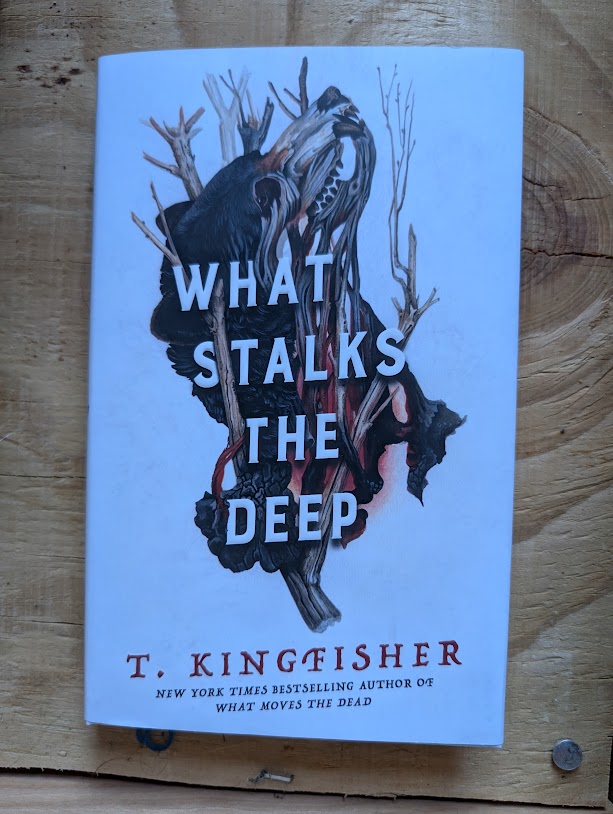
What Stalks the Deep

What Stalks the Deep is the third in T. Kingfisher’s “sworn soldier” series featuring Alex Easton. I highly recommend all three and they do relate to each other, but each of Alex’s adventures is complete in itself, so you don’t absolutely have to read the first two to enjoy this one. All you need to know going in is that Alex has been invited to America to help a friend, Doctor Denton, who was instrumental in defeating the mysterious evil Alex encountered in the first book. The way the invitation is worded, Alex is pretty sure Denton has encountered some new mysterious evil and Alex is not one to abandon a friend or shy away from battle. So off to America it is!

If you haven’t read any of these, “sworn soldier” is pretty much its own gender identity in Alex’s home country of Gallacia. Alex was born female but took on this new identity and pronouns (ka and kan) when ka became a career soldier. In Europe, this is generally accepted as “one of those quirky Gallacian things” and people are curious but not alarmed about it. Fellow soldiers tend to recognize one of their own breed in Alex. Americans, of course, know jack-all about this tiny European country so mostly Alex just poses as a man instead of trying to explain Gallacian language and culture. None of this is vital to any of the stories, I just find the whole thing (and Alex’s wry comments on Gallacia) interesting and amusing. I also think it’s a cool way to present the unique life experience and bond soldiers often have. Gender aside, it is its own thing, you know?

The real meat of this story is that Denton’s cousin has disappeared while exploring an abandoned mine his family owns, and there’s reason to think strange things are afoot. Finding out requires exploring the mine itself, and in the process Alex has to constantly remind themself (kanself? Kaself? I don’t speak Gallacian) that ka is a badass soldier who is absolutely not claustrophobic or scared of being deep underground. Nope. Nosiree, Alex isn’t scared one little bit and ka’ll die before ka’ll say otherwise. I love Alex. 

As they explore the mine and nearby town, the friends do indeed find something mysterious and maybe evil. I don’t want to give anything away, but the “sworn soldier” series (and a lot of Kingfisher’s weird tales) generally lives in that muddy area between natural and supernatural and this book definitely lives in that area. Kingfisher takes a lot of inspiration from classic authors of weird tales, like Edgar Allan Poe and Arthur Machen, and this particular one draws inspiration from Lovecraft and his stories of ancient gods and buried mysteries. I enjoyed, as I usually do, the updated and creative spin she put on the classic theme. 

I haven’t reviewed a Kingfisher book for you yet so you couldn’t possibly know this, but I love her work. I can always count on her for engaging characters and solid storytelling, and though she leans more toward haunting and fairytales than gore, she’s great at creating a spooky atmosphere and has a real knack for creative and disturbing imagery. I haven’t read a book of hers yet that I didn’t enjoy, and I find Alex Easton’s adventures especially delightful. Plus the cover art is awesome. I listened to the first two books on audio* but someday I’ll have to go buy physical copies because the artwork is just that good. 

*I don’t listen to a lot of audiobooks but I recommend these if you’re into that sort of thing. All the books are written in first person as if Alex is telling us the story, and Avi Roque does a great job conveying Alex’s sense of humor and soldierly stoicism while preserving ka’s unique identity. 

Until next time . . . as always, embrace the darkness and read more books.

Cinderwich: a Review

I guess Cherie Priest is known for steampunk but I haven’t read any of those books. This is the second horror novel of hers I’ve read, though, and I enjoyed both of them quite a bit. (I’ve read Cinderwich and The Toll. I read The Toll before I started this blog but maybe someday I’ll tell you about it.) Priest is great at creating quirky and engaging characters and setting them in delightfully haunted spots in the swamps and hollers of the American south. Cinderwich is very gothic and also very southern gothic, which I like.

Cinderwich is a short one, almost a novella at around 160 pages, and the story it tells is pretty straightforward. Ellen Thrush is named after her aunt Ellen, who disappeared before she was even born. It’s kind of awkward being constantly compared (both favorably and not) to an aunt she never knew, so she usually goes by her middle name, Kate. 

Aunt Ellen’s disappearance was quite the mystery and no one was affected more than Ellen’s girlfriend at the time, Dr. Judith Kane. Decades after the disappearance, when Kate ended up in grad school where Judith worked, they bonded for a while over Ellen’s life and possible death. Judith would share memories and Kate got to know a different side of her namesake. Eventually Kate left grad school and the two drifted apart, but Judith never entirely quit trying to solve the mystery of Ellen’s disappearance. 

Years later, Judith invites Kate to visit Cinderwich, Tennessee, where for years someone has been writing “Who put Ellen in the blackgum tree?” on walls and such. The name is right, the timing sort of fits, and Judith wants to follow this one last lead before giving up the search for good. Kate isn’t hoping for much but she agrees to meet in Cinderwich and help Judith investigate.

Ghostly things happen almost immediately, and they keep happening until the story’s dramatic ending. They meet probably most of the people left in this tiny ghost of a town, including three of the girls who originally found “Ellen” in the tree. The girls have since grown up into a kickass trio of very spooky, very gothy ladies who all seem to be kind of psychic. They and their house are awesome and Kate secretly wishes she could move in with them. So do I, frankly. They seem cool and they stock a wide variety of loose leaf tea at all times, it seems. It sounds lovely.

You might notice this story is chock full of women. It’s not a story about women exploring their womanhood, it’s not part of the town’s mystery or anything, but almost every single character is a woman of some kind. It’s just a cool ghost story centered around a bunch of women and their various lives and goals and perspectives. It gives the book a particular flavor I enjoyed.

This book isn’t gory at all, in spite of the dead body in the tree, and it’s not particularly frightening. It is, however, very spooky and magical and this town is haunted by mysterious (and sometimes malevolent) forces. I love a gothic tale with a really pervasive atmosphere and this delivers. The atmosphere is great and the mystery is satisfying, while Kate and Judith feel real and I’m rooting for them to solve Ellen’s mystery and get home safe. I highly recommend this as a quick cozy read. It’s a perfect ghost story for a long winter night.

As always, embrace the darkness with us here or on Substack.