
What’s the book? The Glowing Hours by Leila Siddiqui
How dark is it? Dark like a cloudy day. Also very trippy.
How good is it? 4/10 ghosts from the past
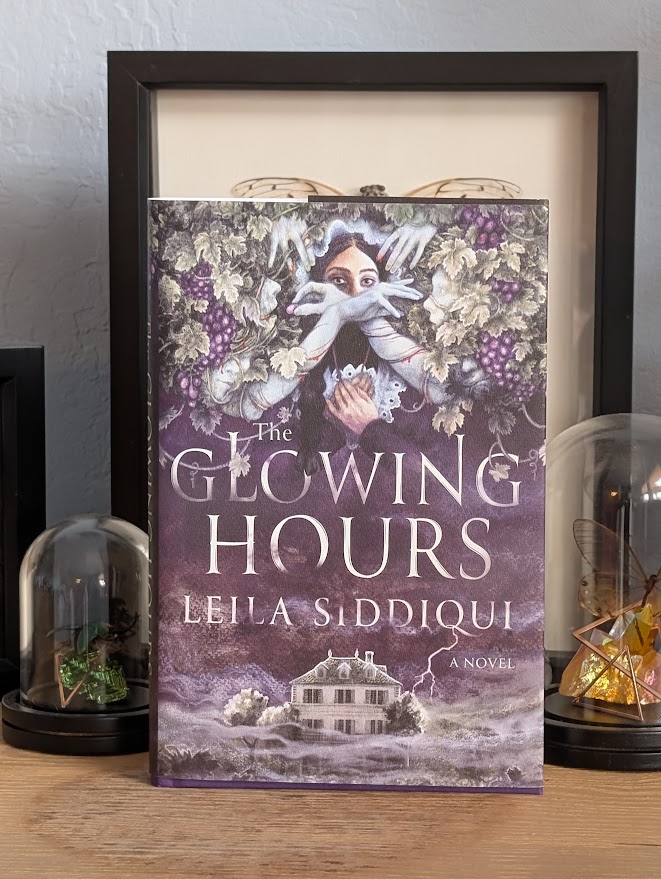
Be warned right now that spoilers abound. The last fifteen pages of this book changed how I thought of everything that came before so I can’t really review it fairly without explaining a lot of the plot. That said, here we go!
Mehrunissa Begum is the granddaughter of the Nawab of Lucknow. She’s basically a princess and she will not let us forget it. Mehrunissa Begum, Mehr for short, is also half British on her father’s side but when her British father left her mother he only took his son with him. Mehr and her mom were left in Lucknow with her uncle. They never saw him again.
Still, according to Mehr it was a wonderful life right up through her early adulthood, living in the zenana (the secluded women’s wing of her uncle’s estate) and waiting to be married off. There are a few hints that things weren’t as idyllic as Mehr remembers but we’re left to trust her story until the very end of the book. As far as we’re told, Mehr’s troubles began when her mother died and Mehr’s uncle insisted she deliver her brother’s inheritance in person, by hand. That meant a trip to England.
When she got off the ship in London, Mehr’s brother was not there to meet her. Instead, there was a lady from a ‘home for Indian women’ sent to take her in. The ‘home’ was a charity of sorts that took in Indian nursemaids out of work and found new jobs for them. After weeks and weeks with no word at all from her brother and no help from her uncle, Mehr has to train as a maid to earn money for the trip back to Lucknow. This work is beneath a princess like Mehr and she’s very very clear on that point, but she’s desperate to get home.
Who’s going to take in a maid with no experience and a huge superiority complex? Mary Shelley, that’s who. That’s right, Mehr goes to work for the famous writer of Frankenstein and her famous poet boyfriend/husband Percy Bysshe Shelley. Only Mary hasn’t written Frankenstein yet–we’re about to watch Mehr accompany them on the famous summer trip that inspires that novel.
The first half of this book is taken up by Mehr judging the hell out of the Shelleys and their friends. Mehr herself is an insufferable snob (and a terrible maid) but the Shelleys are also pretty terrible. So is Mary’s sister Claire. Lord Byron is even worse. Byron’s personal doctor, John Polidori, is only barely less terrible than the rest. This is probably pretty historically accurate; all of their terribleness is heavily based on the actual lives of all these people. They were mostly very troubled, very into free love peppered with extreme relationship drama, and probably none too mentally healthy. This book puts it in the most unflattering light possible but it’s not a completely unfair take on these authors’ personal lives.
From the beginning, Mehr takes a shine to Mary Shelley. Mary is depicted as spineless and barely there for almost the entire novel, so it’s not clear at all why Mehr likes her. They’re not really friends and Mary’s not especially nice to her or interested in her. In fact, Mary’s barely interested in anything. There’s some implication that Mehr is sexually attracted to Mary, so maybe that’s all there is to it. Percy’s a jerk and Mary’s hot, so maybe Mehr wants to sweep her away from all this? Could be, but this possibility is just barely explored and doesn’t really go anywhere.
In the second half of the book all these terrible people (including Mehr) and a handful of not-so-terrible house staff are trapped in a weird nightmare full of ghosts and possibly vampires. They’re literally trapped in a villa by the lake, unable to leave, becoming sicker and more confused as time wears on. Mehr and Polidori both have their theories about the haunting but they both think each other’s theories are stupid. Mehr thinks she’s the only one not being haunted only to find out the secret room she’s been enjoying is actually chock full of ghosts. This part is weird and full of spooky images, only everyone is so terrible it’s hard to care what happens to them. The haunting also has very little buildup, going from “maybe it was just a nightmare” to “all ghosts all the time” nearly instantly so there’s no delicious suspense building or anything like that.
So far, the entire book is watching people be terrible, then watching them be terrible and also haunted. I was irritated the whole time. I don’t know what I expected from this book but this was a painful slog I hadn’t prepared myself for.
Then it got worse. Suddenly, in the last forty pages or so, the weird haunting became a weird mystery. We suddenly find that Percy Bysshe Shelley and Lord Byron have kidnapped Mehr’s brother and hidden him in an unused room in the cellar. No, they didn’t kidnap him months ago when he was failing to reach out to Mehr. They kidnapped him a couple weeks ago in an elaborate plot to make him sign over his new inheritance. (Even though they’re not really sure what he’s inheriting or how much it’s worth.)
That’s right, the two greatest poets of the Romantic era are bumbling schemers out for a quick payday. Mehr figures this out and a stand off ensues, first with Lord Byron threatening to shoot either Mehr or her brother if he doesn’t get that money, then with Byron and Percy fighting over who deserves the stolen inheritance more. This plot twist was sudden and ridiculous and made me actively mad.
Then it got one shade more ridiculous. You might be wondering how a ridiculous kidnapping plot resulted in a horrific haunting. Turns out the answer is Mehr herself. When her mother died, she insisted Mehr deliver a taweez (kind of a talisman) directly to her absent British father. Of course, she couldn’t find him so she’s had it this whole time. Turns out the taweez is a curse, meant to torture Mehr’s dad with the memory of all that bad stuff he did but instead it’s been haunting everyone in the villa. Oopsy doopsy.
But it all has a happy ending! Turns out the inheritance Mehr thought was for her brother is actually for her. She’s rich now! She’s also not haunted because apparently once she figured out the taweez she could just . . . stop the hauntings. Easy peasy. Mehr is rich now, her brother is saved, Mary and her friends are once again free to write famous things and be awful. The book’s last fifteen pages wraps everything up in a simple little rush. It was like the whole dark novel turned into a Scooby Doo episode.
This was the most ridiculous thing I have read in a long time and suddenly, at the very end, I found it hilarious. Instead of trying to immerse myself in a moody gothic horror and failing, I stepped back and saw it all as a campy farce and I liked that much better! That’s why I’m spoiling the hell out of this book: I think I would have enjoyed it a whole lot more if I’d read it as humor from the beginning. It wasn’t quite enough to save the novel for me and I’m not at all sure the book is supposed to be funny, but reading it as a comedy bumped The Glowing Hours up at least two points on the ten point scale.
 Darker Books