
This review first appeared on our Substack in 2025 and now we’re reprinting it here for your enjoyment.
Let’s talk about The Fisherman by John Langan
This one’s gonna stick with me. This is more in the vein of weird fiction than typical horror, with the main characters encountering truly mythic forces and being scarred and sometimes warped by them. There is some blood and terror but it’s more the ponderous weight of nature and myth that have stayed with me. Most of the novel is told by old men, the kind that “once caught a fish as big as you!” It’s an unbelievable set of tales, surely exaggerated or maybe entirely made up, but these fish stories are told with such intensity and deadly earnest . . .
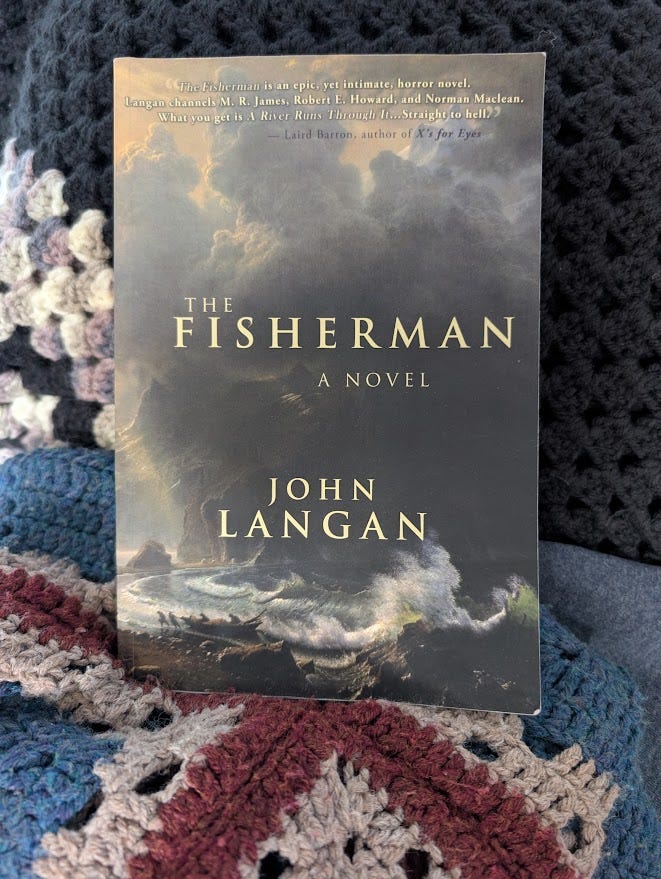
This is a slowish story, focused on atmosphere and emotion instead of action or gore. It spends a lot of time on the characters’ ordinary lives and that can be a touch slow. The book builds up to a dramatic climax but it’s more emotional and mythical than action-packed. If you’re looking for something fast and exciting or chock full of gore, this will bore you to tears. If you’re a more patient reader, one who will follow as the layers of the story build and can let the heavy waves roll over you, you’ll be rewarded with a powerful reading experience.
The Fisherman is narrated by Abe, an aging widower. Shortly after they married, Abe’s wife found out she had cancer. When she died tragically young, Abe fell apart as he mourned both the love of his life and the future they’d planned to build together. After months of drinking and unrelenting pain he took up fishing, almost on a whim. It gave him something to do, something to focus on, and eventually those quiet moments in nature gave him the sense that his wife’s spirit might be looking down on him. It wasn’t a dramatic change but in a very real way, fishing saved his life.
Years later, when his coworker Dan loses his wife and sons in a gruesome car accident, Abe invites him fishing. Abe wants to help this broken man but he’s not sure what else to offer but this quiet companionship and something to fill Dan’s hours. They become fishing buddies and it seems, for a while at least, to ease Dan’s grief. Then fishing season ends and Dan begins to fall apart again, hard. Dan’s family tries to keep him occupied, tries to give comfort, and Abe even invites him to dinner once or twice, but nothing seems to pull Dan out of his spiral.
Abe is surprised when once again, come fishing season, Dan wants to come with. Dan even suggests a new stream, Dutchman’s Creek, way up in the Catskills near the reservoir. Eager to help his friend, Abe agrees to check it out with him.
Here follows a story within the story, one that goes back to the building of the reservoir and beyond, involving black magic and mythical forces and the attempts of desperate men to bring back wives lost to the great beyond. Eventually we’re brought back to the present day to see Abe and Dan have their own brush with these same mythical forces, with harrowing consequences. There are moments of blood and horror in both stories, present and past, but more important is the heavy atmosphere created by the weight of grief and the immensity of the netherworld pressing against our own. The build up is slow but the payoff is worth the work to get there.
You’ve probably noticed already the deep river of grief that runs through the book, especially grief at the loss of a wife. Abe’s wife is dead, Dan’s wife is dead, several characters in the story within the story lose their wives to various tragedies. This is a story about men, a deeply male-centered and masculine story about love and grief. Especially as seen and lived through Abe’s eyes, it feels like a deep and compassionate look into the emotional lives of men. Pretty much every man in the story holds his emotions behind that traditional facade of stoic strength, and while it protects them and their families it also separates them and in the worst cases it blocks up all that grief and pain until it breaks the man trying to contain it. Looking so deeply into their inner lives made all these men feel real and relatable, even when some of them resorted to desperate and even horrific measures.
I’m acutely aware of the mountains of books written by, for, and about men and sometimes I wonder how many more we could possibly need. This one, though, I’m glad I read. I absolutely was thrilled by the deep cosmic horror and lovingly detailed monsters and madness; I absolutely was moved by the powerful emotions and difficult decisions faced by Abe and the other men in this story. It felt like an illuminating mix of traditional manly tales with a new, softer understanding of the hearts behind their stoic facades. This book, on many levels, felt like a glimpse of something vast and fascinating. It had a weight that will be with me for a long time to come.

