
What’s the book? This Skin was Once Mine by Eric LaRocca
How dark is it? entirely centered on disturbing abuse and body horror
How good is it? 3/10 open wounds
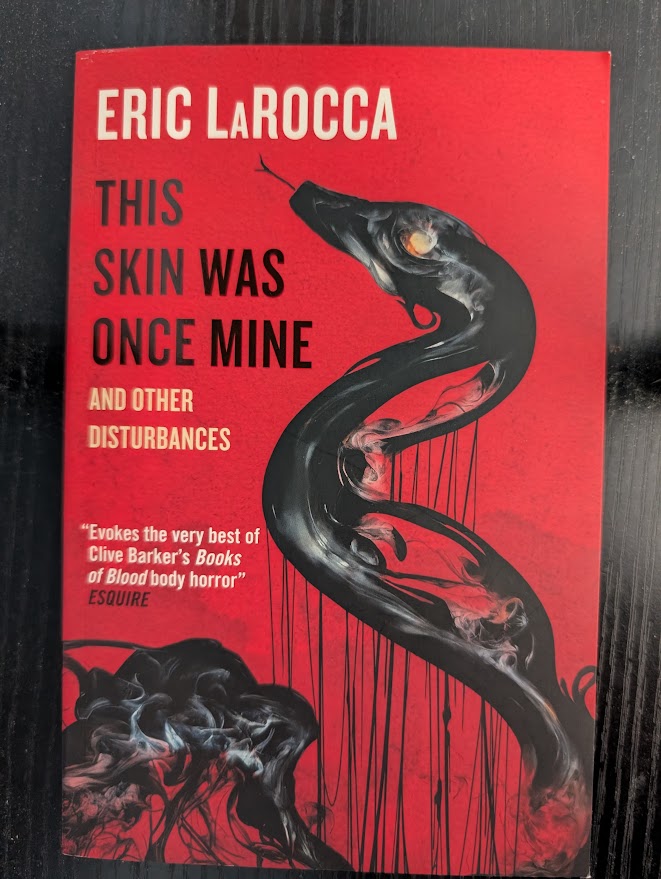
LaRocca gets compared to Clive Barker, it’s right there on the cover, and I can see why. Last century, when I was young, Stephen King and Dean Koontz were the giants of horror but I always preferred Barker’s sensibility. I loved his short stories and was a big fan of Hellraiser. LaRocca shares a certain love of eroticized body horror with Barker. LaRocca also seems to be building on Barker’s queer sensibility, bringing queerness more openly into their stories. But where Barker brought depth and nuance to, say, Pinhead and the cenobytes, making them compelling and even sympathetic in the midst of their worst excesses, LaRocca can’t seem to bring that same depth to their stories. It’s a shame; I’d love to see a true successor to Barker.
This is a collection of four stories, all built around various images or tableaux: an enormous pyre built of fine furniture, a woman meeting a warped and stunted reflection of herself, a father and son literally exploring their shared wounds, a gleaming shard of glass poking out of someone’s skin, an old man choking a baby with a small stone. These tableaux are exquisitely disturbing and often steeped in eroticized body horror. The images at the heart of these stories pull no punches and they’re brilliant in their bloody way.
Everything else about these stories is pretty bad, though. LaRocca seems to have no idea what kind of characters would end up in these awful scenarios or how they’d get to and from them, so everything surrounding each tableau is pretty thin and sometimes nonsensical.
Sometimes the badness is logistical issues that completely pull me out of a story: the story will shift locations with no transition, or a character who can barely walk will suddenly stab the hero and manage to drag her up several flights of stairs and down a ladder. Or a character claims that his stab wounds full of glass never get infected because he carefully removes the glass each night and reinserts it every morning. I’m no doctor but I’m pretty sure that wouldn’t help anything. Also, that same story features a guy walking into the store for a knife to cook with and walking out with a gold-handled jewel-encrusted bit of ridiculousness and nobody ever thinks this is dumb. Have you ever seen a Top Chef whip out a jewel-encrusted knife? Damascus steel, yes, jewels you can’t clean chicken juice off of, no. Without including a bunch more spoilers, there are a lot of dubious and impossible moments for a book this short and many times it was bad enough to detract from the atmosphere if not outright ruin it.
Some of the badness is very thin flat characters. Even when we follow a character’s thoughts we don’t really get any insight into who they are as people beyond the one issue in the story. The best example is the protagonist of the third story, All the Parts of You that Won’t Easily Burn. We spend page after page in this guy’s head but all he ever does is obsess about how erotic it is to cut yourself and put glass in the wounds. There are slight hints that before his marriage he was interested in self-mutilation or some sort of pain play but we never find out why or why he stopped. In fact, in spite of living in his head with him we find out almost nothing about this guy even as he goes from “fine, I’ll try this one little thing” to some fullblown crazy murderous stuff over the course of a couple of days. This flatness is pretty much true of every character. There’s no real rhyme or reason to most of their actions because the characters don’t matter, only the central tableau LaRocca’s rushing to set up.
Maybe the thin characters and nonsensical details are supposed to add to the surreal and dreamlike atmosphere, but if that’s the case I’d like them even less developed. Go all in on the metaphor and allegory instead of dwelling on the characters and plotting at all. What we get here is the worst of both worlds–the characters aren’t relatable and storytelling is sketchy nonsense but the exquisite horror of the central images doesn’t quite hit that emotional center that a good symbol or metaphor does. None of it quite hits right.
LaRocca also, in their desire to be evocative and poetic with their language, makes odd and distracting word choices. People keep glaring when they’re not angry or simpering when nobody’s looking, or using phrases like “all too inherent” in ways that don’t make a lot of sense. It feels like they’re plugging in synonyms from a thesaurus with no idea whether they actually fit where they’re putting them. If I were really invested in the stories I would have overlooked this almost unconsciously; it bothered me because I was already having trouble immersing myself in the horror.
It was all so frustrating because this author does have a gift for evocative imagery and the body horror in this is gutsy and creative, but everything else about these stories is so shitty. This author has written several novels but I’m not sure I could force my way through them. I’ll probably just rummage through used books for Clive Barker’s old stuff.

