
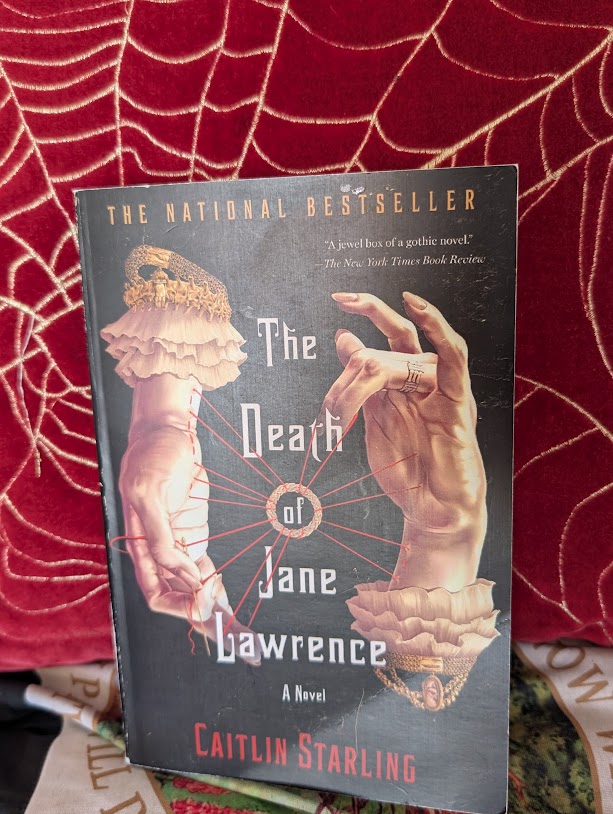
I’m not sure where I picked up The Death of Jane Lawrence by Caitlin Starling. It might have been Barnes & Noble or maybe Maria’s Bookshop in Durango, Colorado. Either way, it’s mine now. I loved this book while I was reading it. Could hardly put it down. Once I was done, though, the doubts crept in. Now that I’m sitting down to write I’m not quite sure what to say.
Victorian England was full of people trying to do magic and contact the dead. Seances and ceremonial magic were all the rage. It was also the heyday of gothic novels full of haunted country houses and dark family secrets. The Death of Jane Lawrence combines these elements to great effect. This book is set in a fictionalized version of Victorian England where the country houses are actually haunted and magic might be real.
Jane, herself, is a bundle of trauma. The book isn’t clear about its alternate history but it seems war came to Britain when she was little, killing her parents and partially destroying her hometown. Jane has lived with the Cunninghams in another city since then. Mr. Cunningham has been offered an important post in Jane’s old hometown, now rebuilt and thriving, and Jane can’t stomach the thought of moving back there. She’s mathematically gifted and has a good head for business, but not even in magical fictional England can she just get a job and live on her own. Her best option, it seems, is a marriage of convenience to a suitable local man.
She sets her sights on local doctor Augustine Lawrence, who could certainly use a business manager even if he’s unsure about marrying. Still, the two get along well and Augustine is quickly convinced to sign on to Jane’s marriage scheme. He has one odd condition, though. Once they’re married, he’ll spend every night at his family’s manor house and she’s never allowed to stay over. She’ll live at the office in town. Since Jane mostly sees this as a business arrangement she’s fine with this. It’s weird, sure, but it helps keep the boundaries firm around their arrangement.
That plan, of course, immediately falls apart. On the day of their marriage, they have dinner in Augustine’s mansion and then he promptly, anxiously, ushers her into a carriage as night falls. A heavy storm has started and, sure enough, less than a mile down the road the carriage is damaged in a mudslide and Jane has to trudge back to the mansion for the night. Their arrangement didn’t even last one day.
Believe it or not, all this background takes up very little room in the novel. It’s painted quickly, in light brush strokes, and the real meat of the story is what happens in the manor house and all the magic Jane learns in the attempt to undo what happens in the manor house. The plot rushes along at breakneck speed, with most of the events occurring in a matter of days. Immediately after her wedding, Jane figures out that Augustine’s family home is deeply haunted (and so is he) and she undertakes some expert level ceremonial magic in order to set things right and save their brand new marriage. She’s especially keen to do this because, in spite of all their careful businesslike planning, Jane and Augustine are falling in love.
Most of the book is a disorienting round of magic rituals and haunting visions, where you’re never quite sure what’s real and what’s imaginary, what’s magical and what’s mundane. I found it compelling as I was reading it, racing to the end of the novel as Jane pushed through each stage of her grand magical working. By the end I was both deeply confused and deeply invested in Jane’s goals. Things got surreal, a bit gruesome, and deeply moving in moments. The writing itself becomes more choppy and quick, jumping from scene to scene in a disorienting manner.
And then the roller coaster ended, I had time to breathe and think, and I became less satisfied. Was this an elegantly written clash of realities or a cheap string of parlor tricks? What does the ending mean? Do Jane and Augustine live happily ever after as presented, or do those little ambiguities hint at something much darker? There are a few dark possibilities and no real way to choose between them. I’m still not sure whether that’s brilliant and tantalizing or cheap and annoying.
I actually looked for opinions on the ending and was not surprised to find wildly differing takes. Some people believe Jane has learned the secrets of magic, though she’s trying to keep that secret. Some think she’s mentally broken, trapped in her own fantasy. Some think she’s dead. Considering the book’s title, that last is a strong possibility, but there are strong arguments in favor of other interpretations. I still can’t decide if this is an intriguing mystery or a frustrating non-ending.
I’m a sucker for all the Victorian occult stuff, though, and this book really swept me up in it. I enjoyed the hell out of it as I was reading, even if it didn’t stick with me in the most satisfying way. If you’ve read it, I’d love to hear your opinion on this book. Loved it? Hated it? What do you think the ending means?
 Darker Books