
I don’t usually do content warnings because I consider them implied in a blog about horror novels and murder mysteries, but this book deserves a content warning. SenLinYu’s Alchemized is awash in body horror, torture, creepy medical experiments on unwilling subjects, and a little bit of sexual assault. These are so integral to the book that I can’t even review it without talking about some of these subjects, so skip this review if you’re not up for this much darkness.
My second warning is that SenLinYu is apparently famous for writing a Harry Potter fanfic where Hermione Granger and Draco Malfoy get together and Alchemized is an expansion and reworking of that. Once I found that out (around 300 pages in, I think) I couldn’t unsee it. Hermione and Draco are definitely still visible in the main characters and that drew me out of the story at times, but the rest of the story is different enough that it didn’t bother me. If you feel a lot of feelings about the Harry Potter series or its author, it may affect your experience of this novel.
That said, if you’re still here and game to try it, this is a pretty enthralling read. At over a thousand pages, it’s a brick of a book, but I’m glad the author resisted the temptation to break it up into a series. I loved being able to follow the long sweep of the story from beginning to end without interruption, and SenLinYu did a great job of keeping the story cohesive and moving forward even as it got bigger and more complex.
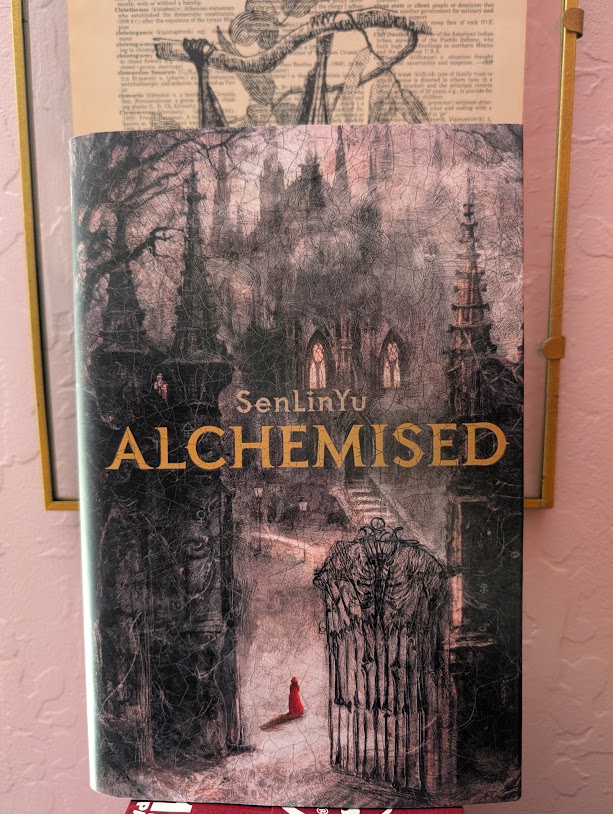
Now, the details.
Fantasy novelists love inventing new magical systems and societies, and this book is no exception. Alchemized is based on, unsurprisingly, alchemy. Historically, alchemy was a blend of art, science, and occult religion, and in Paladia it’s the same. In Paladia, though, a person’s alchemy ability depends on resonance, a sort of natural energetic affinity to various natural substances. If you have a resonance with iron or copper, for instance, you can learn to manipulate it and transmute it into other substances. If your resonance is especially strong, you might be able to affect quite a number of metals and natural elements, including human bodies and souls.
Paladia is the worlds’ main source of Lumithium, an element that amplifies resonance in humans and can enhance alchemical effects, and the key to scaling up alchemical processes to industrial levels. Paladia was founded and is still ruled by the Holdfast family; they’re both political and religious rulers, and they also run an elite alchemy school to train the best and brightest students with the strongest resonance, and to further the study of alchemy. The Holdfasts are in constant tension with various Guild families, mostly talented alchemists of various metals who perfected ways to industrialize the process and grow rich.
When we enter the story, however, everything has gone horribly wrong and the whole country is now ruled by the horrifyingly immortal High Necromancer and his terrifyingly ruthless right hand man, Kaine Ferron. The Necromancer rules through a combination of cruelty to everyone and the promise of immortality to his faithful followers–only he has the alchemical secret to becoming Undying, and once you accept his “gift” you’re bound to the Necromancer forever. Everyone in this new reality is either miserably oppressed or trying desperately to impress the High Necromancer, mostly to avoid being miserably oppressed. Our hero, Helena, is the last living member of the Resistance. Newly discovered in a forgotten prison tank and missing a good chunk of her memories, it’s Ferron’s job to extract whatever secrets are hidden in that brain of hers. The Necromancer’s minions lock Helena’s wrists into manacles lined with “nullium” that deaden her natural resonance, then she’s packed up and sent to Ferron’s country estate for interrogation. Ferron one of those powerful alchemists who can manipulate all sorts of materials. He’s also a vivimancer, meaning he can manipulate people’s bodies and brains, so Helena’s interrogation less torture and questioning, more direct attempts to magically invade Helena’s brain and unlock the information the Necromancer wants.
The entire story is told through Helena’s eyes, first as she tries to figure out what the hell happened to her and what Ferron’s deal is, and later as her memories come rushing back and we see the war’s last year through her eyes. In part one, we see Helena fierce and almost pathologically self-sacrificing, still willing to do anything to protect a Resistance that no longer exists. She’s repelled by Kaine and his cold vicious ways, but also confused. As far as she can tell he’s a remorseless killer, always seething with barely suppressed rage and totally devoted to the High Necromancer’s every whim. But he’s also got some weird moral code; he seems almost protective of his prisoner’s welfare and he carefully holds himself apart from the casual sadism of his fellow Undying. He’s definitely a monster but not the kind of monster Helena expected. She also suspects he knows her, but whatever their history is, it’s clearly in the locked part of her brain.
The brain unlocking is proceeding pretty slowly when the Necromancer suddenly decides Helena should be part of a program to breed new baby necromancers. One of the few things Helena does remember from the war is being sterilized so she couldn’t pass on her own talent for vivimancy, so she’s pretty shocked to find herself part of a breeding program. One of the Necromancer’s creepy doctors have fixes for everything, it seems, and sure enough she’s “fixed” Helena’s fertility. Yikes.
Unlike the resistance, the Necromancer actually wants vivimancers to breed, and he decides Ferron would be the perfect match for this experiment. Ferron seems utterly horrified (but not totally surprised) by such an order but he has little choice but to make a baby with his prisoner. If he doesn’t do it, the Necromancer’s next choice will probably be worse and Ferron will completely lose control of Helena. This new project is awkward and horrible for them both, and Ferron’s handling of it furthers our suspicion that he’s got more going on than just blind devotion to his leader.
As Helena’s pregnancy takes root, Helena’s stress levels spiral out of control and, ironically, all this stress loosens the locks on those hidden memories and causes them to come flooding back. Part two takes us back into these memories, and one of the first things we find is that Kaine Ferron was actually spying for the Resistance before they fell. That’s how he knows Helena.
The war between the Resistance and the Undying had been going on for a few years before Ferron offered his help, claiming he wanted to avenge his mother’s death at the Necromancer’s hands. Exactly zero people believed this (even though it’s completely true) so he randomly asked for Helena to be his contact, implying some vague romantic obsession with her. This, the Resistance believed. A couple of Resistance leaders, Jan Crowther and Ilva Holdfast, essentially tell Helena to seduce him and encourage his obsession so Ferron will be pliable.
Let’s just say none of this turns out the way any of them planned, and over the course of their alliance the two form a complicated relationship that eventually becomes a fierce love. They both become a bit obsessed with each other and we learn two important things. First, Kaine Ferron is much more a victim of torture and blackmail than anything else, which gives me great sympathy for him and the impossible choices he has to make. Second, the Resistance is a giant bag of dicks. Many of them are either intolerable snobs or self-righteous religious zealots, and almost none of them give the tiniest shit about Helena or what happens to her. She’s both a foreigner and a vivimancer so nearly everyone in the Resistance considers her vaguely distasteful and suspect, but all of them are happy to use her for healing their soldiers and seducing Ferron and literally anything else they need without giving her an ounce of sympathy or credit. Don’t get me wrong, the Undying are way worse than the Resistance, but the Resistance also sucks. They’re convinced with a literally religious fervor that they’re locked in an epic battle of good versus evil, and if only they have enough faith and optimism there’s no way they can lose. As the story progresses, even Helena begins to understand just how far their heads are up their self-righteous asses. It adds a lot of moral nuance to the story when you realize the only person to ever actually hurt the Necromancer is Kaine; even though he’s only doing it for personal vengeance, he’s the secret hero of the war.
Okay, no more spoilers. This review is long enough already. The romance between Draco and Hermione Kaine and Helena gets a little repetitive and overwrought at times; as the war drags on for months in a stalemate, so does their tortured path to love. Eventually the action picks up again, though, and the story does a pretty decent job of balancing their intensely personal drama with the epic events unfolding around them. Helena remains almost obnoxiously self-sacrificing, but also clever and brave and often pretty interesting. Kaine remains morally complex in a way that I really enjoyed–he becomes more and more a sympathetic character as he tirelessly works to bring down the High Necromancer without being suspected, but never entirely stops being a villain. I love complicated characters like that, and I thought Kaine was well done.
This is a very long and very dark book that I devoured as fast as I could. It was tense and compelling, pulling me along nearly the whole time, and it balanced the intense relationship with some great world-building and political drama. I highly recommend it.
New reviews every Friday. Embrace the darkness and read more books!
 Darker Books