Ancient Sorceries

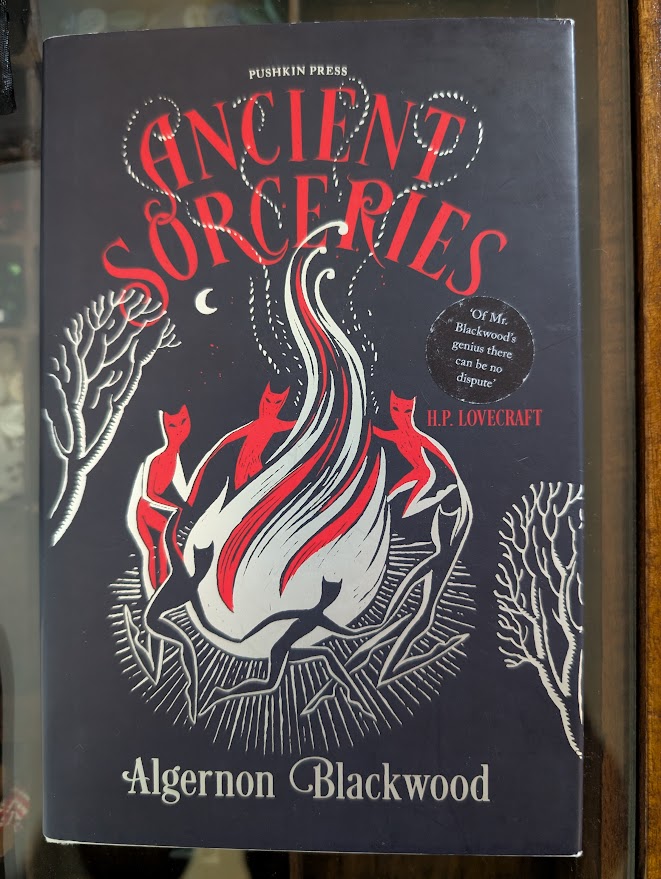
Let’s talk about Algernon Blackwood. Specifically, let’s talk about this cute little modern collection I picked up by Pushkin Press of four Blackwood tales. I think I got it at Barnes & Noble, maybe in Amarillo. It’s a hardback with a lovely cover all done in black and white and red. I love the font they used. As I mentioned, this collection has four of Blackwood’s stories–Ancient Sorceries, The Listener, The Sea Fit, and his most famous story The Willows

This book’s cover features an H. P. Lovecraft quote praising Blackwood. Lovecraft is arguably the more famous of the two, but Blackwood was a big influence on Lovecraft and honestly, Blackwood seems like a super cool person. Horror fans generally know by now that Lovecraft was kind of an unsuccessful shut-in during his life, and deeply racist even by the standards of his time. He wrote some amazing stories and his Cthulhu mythos has inspired some amazing fiction but he doesn’t seem like a guy most of us would enjoy knowing. Algernon Blackwood, on the other hand, travelled the world and had cool hobbies like ghost hunting and backpacking. He delved deeply into  buddhism and occult societies and people said he was pleasant company. He also has an excellent name; Lovecraft was not cool enough to be buddies with a guy like this and, to be honest, I’m probably not cool enough either. 

Blackwood wrote over a dozen novels and an untold number of short stories. I’ve only read a handful of his stories so far but I should probably dive deeper into his work. He’s a giant of weird fiction, writing not just horror and ghost stories but also many stories focused on awe and mysticism. These particular four inhabit a space that’s part horror and part cosmic awe.

The first story, Ancient Sorceries, follows Arthur Vezin, who visits a quaint little French town with mysterious goings-on. As he jumps off the train a fellow passenger shouts an urgent warning, but not knowing much French all Arthur can decipher is “because of the dreams and the cats.” It makes no sense until he falls deep into the mystery of this town and its witchy denizens. It’s quite a long story, verging on a novella, slow-paced and atmospheric. The whole town’s catlike quiet draws you in just as Arthur is drawn in. Well, he’s also drawn in by the innkeeper’s attractive and friendly daughter, who eventually insists that she knew him in a previous life . . .

The Listener is a ghost story. Much of the tension comes from wondering how much of the narrator’s problem is ghosts and how much is his delicate mental health. The tension and mystery build slowly up to some quite dramatic scenes near the end. There’s a dramatic reveal at the end I want to discuss so skip the rest of this paragraph if you want to be surprised. After a great build-up that this man is being truly persecuted by a malevolent ghost, the big reveal is that in life this ghost had leprosy. This explains a lot but I’m not sure this news has quite the punch these days that it once had. Finding this out was supposed to be horrifying, I think, but it mostly made me feel sad for this guy who died alone and friendless because of his disfiguring disease. Still, I suppose having leprosy doesn’t entitle your ghost to persecute others.

The next story, The Sea Fit, is a great example of Blackwood’s mixing of horror and awe. “Big Ericsson” is a sea captain with Norse blood in him, and sometimes when the sea and sky are just so, he feels the old gods calling him to join them in the storm. This is the story of one such perfect moment and by the end it’s hard to know whether to be horrified at nature’s attempt to claim Ericsson or to cheer on his glorious union with the sea. This story is quite short and simple compared to the others and quite satisfying.

The last story in this collection, The Willows, is probably Blackwood’s most famous. You’ll find it in anthologies of horror and weird tales and I think at some point I had to read it for school. This is my third time reading it, I think, and I enjoy it more each time. It’s much more about atmosphere and awe than surprise, so it keeps its power as you read it over and notice new details.

It’s a simple story about two men canoeing down the Danube River and running into something otherworldly. The first time I read this, I had to look up the Danube. I’d heard of it, I’m not totally ignorant of geography, but I’d always associated the Danube with all the cities it flows through. Once I read about the wetlands of the Danube Delta and looked up pictures of it, the isolation and otherworldly feel of the story made a lot more sense. 

The otherworldly forces these men encounter are fascinating, seeming to exist on another plane while only pushing on the edges of our reality, causing an eerie hum and making the willow bushes seem to shift in odd ways. They also seem to cause an eerie amount of bad luck for our travelers, almost as if they’re trying to trap them on this tiny sandbar they’re camping on. Trap them, or maybe worse. Ordinary things, like missing food stores and a worn spot in the boat they could swear wasn’t there last night; it all takes on ominous overtones on this shifting island with its maddening hum.

It’s quite suspenseful watching these two men try to hide, escape, and understand these mysterious beings and what they want. It’s quite a good piece of cosmic horror and has a quiet realism that makes it all the more effective. Every time I read a Blackwood story I’m convinced I should read more of them. If you’re not familiar with Blackwood this is a great place to start, and if you are familiar please tell me what else of his I should read next. I would love to dive deeper into Blackwood’s awestruck world.

As always, you can and should follow my sister and me either here or on Substack. And as always, you can and should read all the books you can lay hands on.

A Botanical Daughter

Halloween is here! Hopefully you’re all busy this weekend honoring the dead, having parties, handing out candy, watching horror movies, or however you celebrate this spookiest of days. Instead of finding the bloodiest thing I can, I’m presenting you a refreshing twist on classic Frankenstein tropes. For your holiday enjoyment, I present A Botanical Daugher by Noah Medlock.

Picture a twee fantasy version of Victorian England. Somewhere in its rolling hills live Simon and Gegor. The two are lifelong bachelors (ie. a closeted gay couple) who live together in a giant greenhouse, surrounded by exotic plants. The greenhouse is Gregor’s, on his family’s estate. He raises exotic plants for select clients and does botany experiments while Simon works in the much cooler basement creating whimsical taxidermy tableaus. When Gregor discovers a fungus with some semblance of sentience he conceives his grandest experiment yet–create a humanlike structure and implant the fungus inside. If the fungus can rise to the occasion, running its new body’s functions, Gregor will have created something like a conscious creature with this fungus for a brain. It will be the discovery of the century. It will be a triumph in the horticultural world. It will also be, in some important sense, his and Simon’s child.

It sounds sweet and it is sweet, and Simon and Gregor are a charming couple. If we just focus on this–the creation and nurturing of their botanical daughter–this is a sweet little fantasy. Of course, the humanlike structure they create is primarily a fresh human corpse, the body of a local girl who just happened to be best friends (and more?) with Jennifer, their laundress/housekeeper. It’s probably best if Simon and Gregor keep that fact from her . . .

Simon and Gregor are also both confused about their botanical creation’s intelligence and sentience, sometimes treating her like a cherished daughter and sometimes seeing her as a terrifying experiment grown out of control. In the process, they have to face some dark truths about themselves and each other. While the whimsical tone of the book doesn’t encourage too deep a look at the characters, Simon, Gregor, and Jennifer are all three well drawn and have their own satisfying character arcs.

This is a fun bit of horror with plot twists I don’t want to spoil. Most of the novel is a lighthearted mad scientist story with a romantic twist but there are a handful of gruesome murders that give this botanical fantasy a dark substrate. This book is honestly pretty weird. It’s the most quaint and charming little fantasy I’ve read in some time, but often that light and charming vibe only makes the horrific parts more horrific.

I liked those layers. I enjoyed being charmed and horrified by turns and I enjoyed watching these exaggerated characters take on more life and nuance as the book progressed. It was well done. It was exciting and unique. If you like books that give you nightmares or have really intense gore, this probably won’t be hardcore enough for you, but if you don’t mind the lighter side of dark and enjoy new twists on old tropes I highly recommend this one.

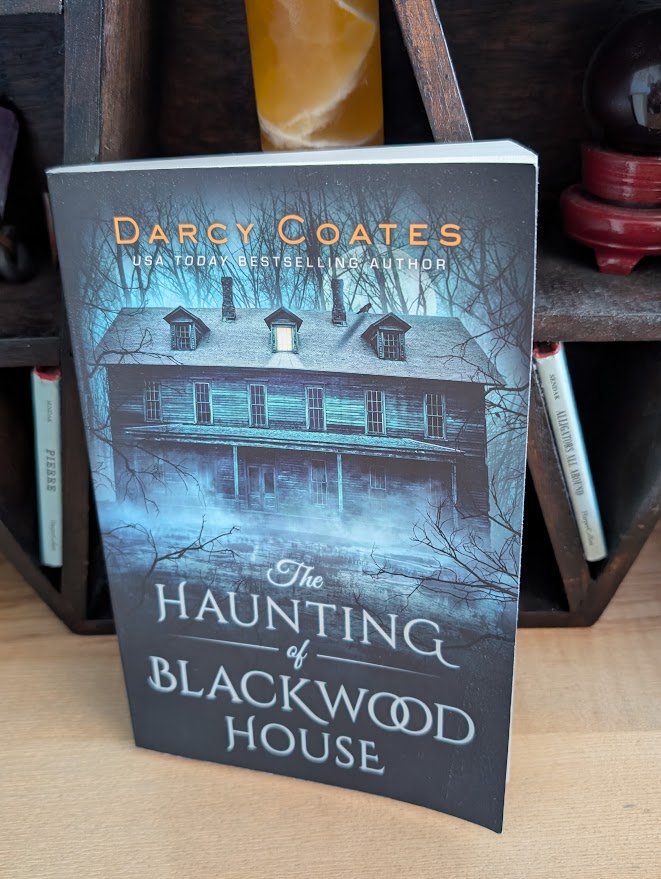
The Haunting of Blackwood House

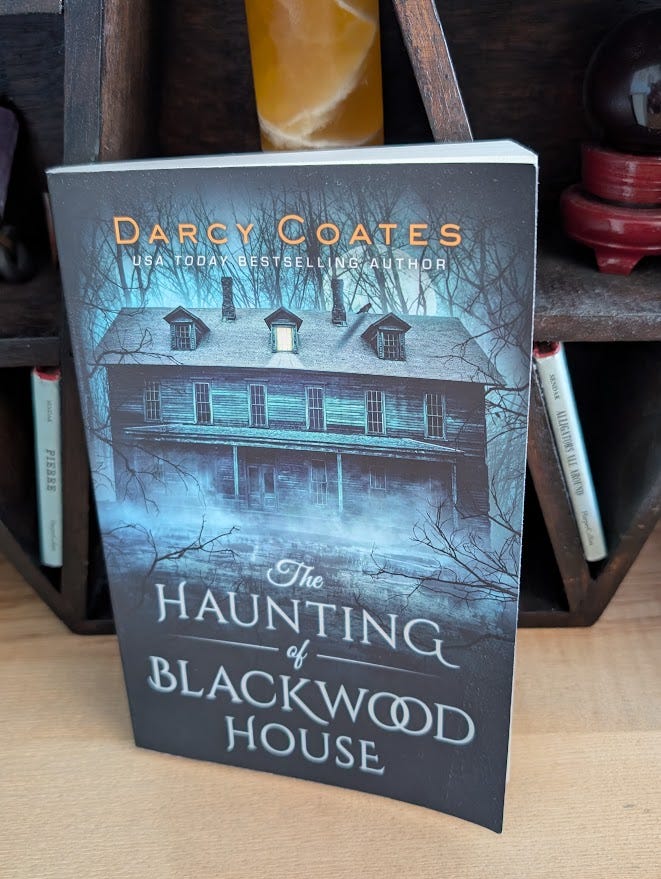
Let’s talk about The Haunting of Blackwood House by Darcy Coates.

This book is popcorn reading, light and fun and undemanding. The main character, Mara, was raised by avid spiritualists and turned her back on it all the second she was old enough to live on her own. Of course she’ll land in a truly haunted house, forced to reassess her skepticism and realize her parents were onto something after all.

Her only other defining features are being stubborn and hating vegetables.

Her boyfriend Neil’s defining features are being ridiculously nice and cute. His only flaw is being kinda religious and believing maybe ghosts might be a little bit real.

They’re pleasant to read about but fairly forgettable. Everyone in the book is pretty much that. So is the plot, really. Straightforward, no real surprises.

The actual haunted house and its various ghosts, though, are awesome. I’m guessing the vivid and fascinating ghosts are the reason Darcy Coates takes up half a shelf at Barnes & Noble. We spend a lot of time learning about these ghosts and watching them haunt Blackwood House, endlessly repeating their most traumatic moments. We learn a bit about their pre-ghost lives and personalities, which are much more varied and interesting than Neil’s and Mara’s.

Subscribe now

And in this book, the ghosts can actually hurt you. At least one of these ghosts has an agenda, one beyond just driving people out of the house or scaring them to death, and that agenda powers some pretty terrifying violence. I liked this aspect a lot. I love a good haunted house story but they can feel a bit tame and silly once you realize the ghosts can’t do much besides bang around and make life inconvenient for the living. Sure, I wouldn’t want to live with a ghost that constantly hid my car keys or put spooky graffiti on my walls, but it’s more creepy than terrifying. These ghosts are a lot more powerful than that. They can manipulate your emotions and, when they really want to, literally push you around. This raises the stakes for Mara as she tries to cleanse her house of horrors and it leads to some genuinely deadly moments. I enjoyed that immensely.

This book is great for what it is. It’ll provide chills and thrills on a stormy night or help you while away the hours on a long trip without being too demanding, and it has just the right amount of blood and danger. The characters are easy and likeable, the action suitably suspenseful, and in the end the world is put right again. If there is such a thing, it’s kind of a cozy horror novel.

I’m a sucker for a good haunted house and if you are, too, this is a solid choice. It’s great for some cozy fall reading this spooky season. Also, if you read a lot of Darcy Coates, tell me if they’re all like this or if she’s also famous for something more?

As always, you can follow us here or on Substack for free. The first ten paid Substack subscribers can choose a book for us to review.

Home Movies

We had so much fun last week writing about hauntings in our home states, Trex and I decided to continue the theme. This time we bring you horror movies set in both Maryland and New Mexico, with minor detours to Texas (where Trex spent several years before Maryland) and Utah (where I lived for frickin’ decades before New Mexico). I’m gonna be up front, though. If this were a contest, Trex would win. Maryland and Texas both have impressive lists of classic horror to their names, while New Mexico and Utah really don’t. Still, I’m gonna work with what I’ve got.

Let’s start with Maryland, since this state is the obvious winner. Not that it’s a contest, but Maryland wins. First, it gave us The Exorcist, one of the all time classics of horror. If you somehow haven’t seen The Exorcist, or read the book it’s inspired by, or listened to any podcasts talking about it, the movie is about an exorcism. I grew up during the Satanic Panic and distinctly remember my parents gossiping on occasion about various teens being attacked by Satan and such, so I used to be terrified of possession and demonic horror. The first time I “watched” this movie at a friend’s house, my eyes were closed maybe 70% of the time. As I got older and my terror turned into fascination, the movie still held up. Even decades later, this movie evokes a deep atmosphere of dread that’s hard to beat.

As if that classic wasn’t enough, Maryland also brought us The Blair Witch Project, one of the classic “found footage” films. In a fun Utah connection, this Maryland-set movie first premiered at Utah’s Sundance Festival. When the movie first premiered, all the promos were still pretending this was a documentary. I lived in Utah at the time but I had no money and no car so I did not see the premier. I saw it much later at a local theater like everybody else. By that time, word was out that the Blair Witch was fiction and the “missing” actors were alive and well and giving interviews about the film.

And last but not least, Maryland gets a bonus point because famous cannibal Hannibal Lecter (from Silence of the Lambs and such) was part of Baltimore’s elite before he was caught and imprisoned (also in Baltimore) for killing and eating people.

New Mexico, meanwhile, is not the home of any horror classics. It is the home of remakes of horror classics. (And of Breaking Bad, which isn’t really horror even though it features a lot of murders.) New Mexico brings us Let Me In, the American remake of Sweden’s Let the Right One In. Both of them are vampire/coming of age films and they’re really really similar. Let Me In is set in 1980s Los Alamos, though that has pretty much nothing to do with anything. I’ve seen both the original and the remake and they both have their merits. Let Me In is a Hammer Film and has their signature stylish, almost poetic moments of horror. As far as the plot goes, both movies end exactly the same, but the New Mexico remake is shot better and has more drama and poignancy.

New Mexico also brings us the remake of Wes Craven’s classic The Hills Have Eyes, and with it a complaint I just can’t shake. Both movies are largely about a family lost in the desert being stalked by murderous mutants. Craven’s original was set in California and Alexandre Aja, the remake’s director, moved it to New Mexico so he could change the film’s backstory. In the remake, the villainous mutants are the result of nuclear testing and part of the film’s action takes place in one of those creepy fake towns full of mannequins built to test the damage done by bombs. It’s a good idea and adds some interest and some cool creepy visuals to Aja’s remake. My complaint is that Aja, like a lot of people, seems to have New Mexico and Nevada confused. I get it, they’re both mostly desert and they’re both famous for aliens and nuclear weapons. New Mexico is famous for inventing the atom bomb and the first test was here, but most of the above ground testing was done in Nevada, so they should have the murderous mutants. New Mexico has a bad enough reputation already. We don’t need mutants on top of it.

Okay, enough of New Mexico. It has no honorable mentions. Instead I’ll move on to Utah, where Ari Aster’s Hereditary is set. I saw Hereditary but completely forgot it was set in Utah. This one is partly a disturbing look at grief and death, and partly a disturbing look at ceremonial magic and Victorian-style occult societies. It’s a great film, a modern classic. One point for me! But it’s not a contest.

If it were a contest, Trex would reach back to her time in Texas and fire back with The Texas Chainsaw Massacre. It’s even got Texas in the name so you can’t forget where the massacre is set. Another classic, this time featuring young people finding a seemingly deserted farmhouse only to be chased and killed by the creepy chainsaw-wielding family within. One of the first big slasher films, the Chainsaw Massacre has a slew of sequels and remakes with Texas in their titles.

I’m really glad this isn’t a contest because my desolate little western states just don’t have a comeback to that one. There might not be any states as terrifying as Texas and Maryland. Trex is clearly a badass afraid of nothing to live in such places. I’ll stay out here with the sand and the nuclear mutants, thank you very much.

As always, you can follow and subscribe here or on Substack for free

The Human Vampire and The Haunted Chamber

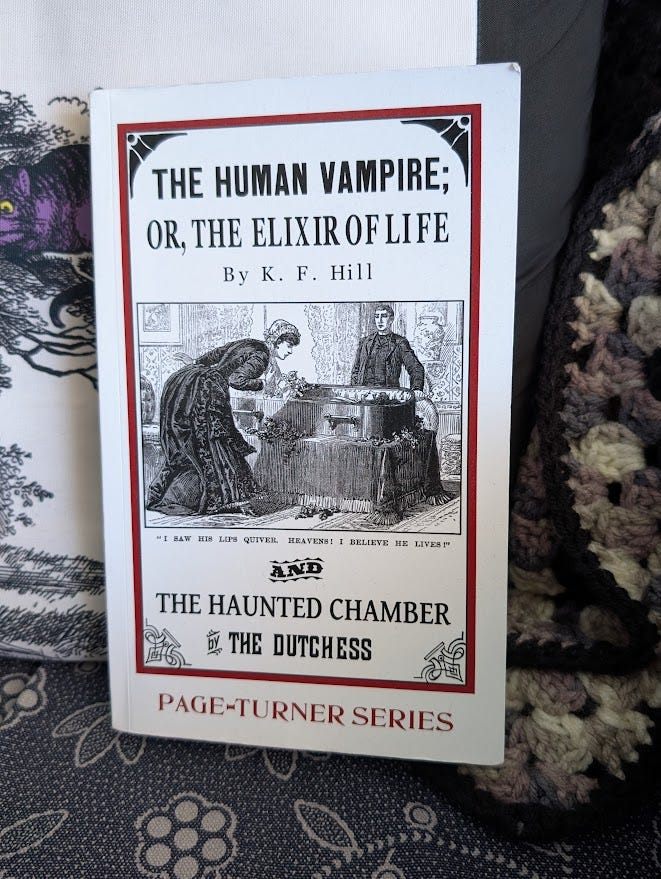
I got this book from an oddities shop in El Paso. Tooth and Veil is more about gothy jewelry and decor than books so this was a lucky find, this duo of obscure tales from the 1800s. Instead of a teaser or summary, the back of this book has a warning that these stories are “products of their time” and have “social norms, prejudices, stereotypes, and attitudes of the era that do not represent today’s society or values.” The introduction is a fascinating little tale in itself about the joys and hardships of preserving old stories like this. This feels like the smallest of small publishing, an amazing little passion project.But enough about the publisher/reviver; on to the stories themselves.

The Human Vampire; or, the Elixir of Life is is credited to K. F. Hill, the pen name of Lucy A Baer. Almost nothing is known about her, which is a shame because this story is pretty fun.

This is the story of a man who discovers a way to prolong his life and youth. He uses this discovery, of course, to scam women out of money. He sweeps through Southern society using his youthful good looks and suave British accent to woo young heiresses. Once he’s blown through his current heiress’s money he conveniently “dies,” only to pop up somewhere else with his youth restored, ready to scam someone else. Unfortunately, Southern society is small enough that eventually one widowed heiress runs into another and a handful of people get suspicious. The ages don’t make any sense but the resemblance between their various husbands is just too great to be ignored.

The story follows both our villain, who goes by various names as he continually reinvents himself, and his victims as they try to investigate this elusive scam artist. Despite our buttoned up stereotype of the 1800s, I find their horror can be surprisingly graphic and tragic. As we follow our heroes’ investigations we uncover the villain’s horrifying experiments in pursuit of perfecting his elixir of life, and though he does come to a suitably tragic end, his latest wife and children are caught in the crossfire and their lives end tragically as well.

The Human Vampire is also, I think, the main reason for the warning on the back of the book. The late 1800s were a pretty racist time in American history and this book reflects that. The Irish characters are not put in a flattering light and are written in horrendous vernacular. The few black characters are treated more sympathetically, especially the black families who fall victim to the villains’ experiments, but there’s nothing like a modern understanding or nuance here. I’ve read a lot of stories from this era and found this less uncomfortable than most, but the old-timey attitudes might still grind your gears.

Still, I loved this story. It was exciting, the characters were fun to read, and the ending was surprising and dark and morally messy. It truly feels like a hidden gem and makes me hope we discover more of Lucy Baer’s lost work someday.

The second story, The Haunted Chamber, is a bit more known and available online. It’s written by Margaret Wolfe Hungerford under the pen name “The Duchess.” It’s a much more straightforward story of love and betrayal, written in a calm and knowing style that highlights the drama of the story, while also having a subtle sense of humor throughout.

Sir Adrian Dynecourt has come home to settle in his family’s castle and invited several friends to stay with him, including the lovely Miss Florence Delmaine and her chaperone, Mrs. Talbot. Unfortunately, Adrian’s jealous cousin Arthur also crashes the party. Social maneuvering and miscommunication turn to betrayal as Arthur tries to secure Miss Delmaine (and her sizable fortune) for himself. If he can somehow also get his cousin’s castle, his triumph will be complete.

This castle, like many, has been rebuilt and added to over the centuries. One tower of the original building still stands, though it’s mostly abandoned now in favor of newer more comfortable areas of the castle. Now it’s the subject of ghost stories and family lore and one very real chamber near the top that locks itself if you let the door close. I think you can imagine where Arthur is tempted to trap his cousin.

There aren’t many surprises in this story. The pleasure is in watching events play out to their inevitable end, and in the elegant feel of the writing. And there is pleasure in it. I enjoy a solid classic tale and this delivers.

Both of these tales, especially the nearly forgotten Human Vampire, brought home to me just how long pulp horror has been around. Stories like these from the 19th century are becoming quite rare as the paper they’re printed on literally disintigrates and it makes me wonder just how many spooky treasures are lost forever. Now that’s a truly horrifying thought. Let’s find them and read them while we still can.

Follow us here or on Substack

It Was a Dark and Stormy Night

Back in June my sister and I started a Substack to review books. We both love to read and I, in particular, love the dark and spooky side of life. We write about horror novels new and old, mysteries, pulp fiction from decades past, and occasionally other dark and spooky things. We’ve been doing the Substack for a while and it still doesn’t feel like home. Substack is where all the pundits are and anybody who’s anybody is writing there but it’s really hard to find and follow anyone who isn’t already a popular pundit. I miss the community and hobby-supporting feel of WordPress so I’m going to post our stuff here as well as there.

Starting on Friday I’ll try to set things up to post more or less simultaneously on both sites but today I’m linking our original introductions by way of hello. My sister is Trex and I’m Spooky Jo. Yes, we have goofy internet handles because I guess we’re both stuck in the 1990s. Whatever, I enjoy it. If you find us amusing and/or like our book suggestions you can follow and comment here or subscribe on Substack to have us delivered straight to you every Friday (and every Wednesday in October as well).

https://trex6666.substack.com/p/it-was-a-dark-and-stormy-night

https://trex6666.substack.com/p/introducing-trex

I’m content to labor in obscurity if I must because I love to read and blog that much, but I hope to find other avid readers and kindred spooky spirits to share suggestions and opinions with. If that sounds like you, please join us and leave us a comment.