I Read Some P. D. James Mysteries

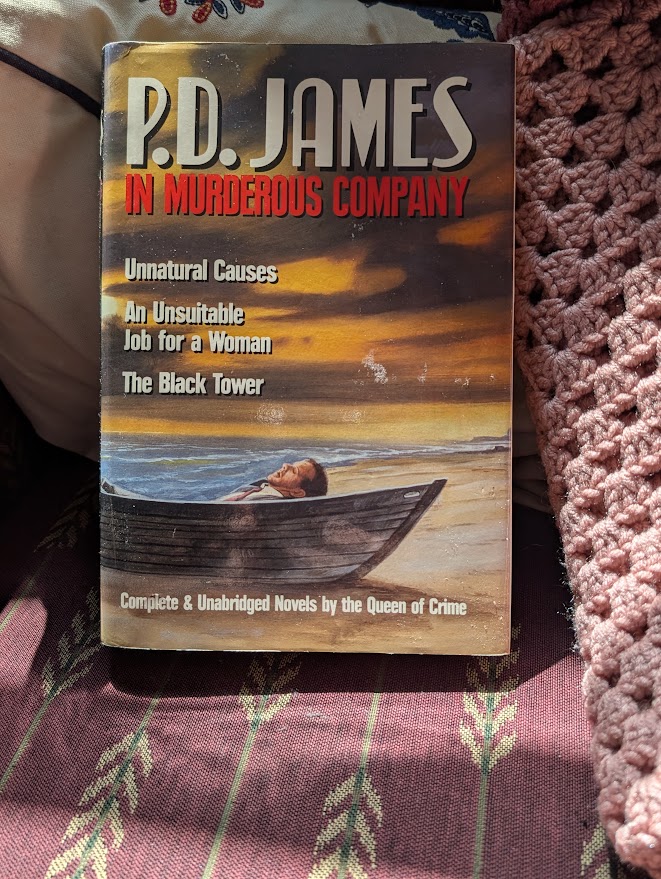
I picked up this P D James omnibus at Brave Books in El Paso. I’m pretty sure. Or maybe I got it at Second Story Books in Durango. One of the two, for sure. 

The omnibus is three novels: Unnatural Causes, An Unsuitable Job for a Woman, and The Black Tower. I read them all one right after the other and that was probably too much P. D. James at once. She seems to specialize in unpleasant characters and though I have a high tolerance for jerks and villains in literature, by the middle of the third book I was getting tired of how much everyone sucked. Most of the characters just suck in minor annoying ways like being kind of snobby or gossipy or referring to themselves as “one” all the time instead of “I” or “me”. Even the villains turn out to be kind of petty and annoying, which is probably pretty true to life but not that epic or interesting. They were exciting mysteries, though, and well written.

Also, by way of warning, James’s main detective, Adam Dalgleish, is weirdly ableist. Since I’ve only read these three books by James I don’t know how much this comes up in general but both Dalgleish books in this set have characters with disabilities or chronic illnesses and Dalgleish is very skeeved out by this. He’s very polite and keeps it to himself, and I understand these books were written in an earlier (and much meaner) time, but reading his insulting inner dialogue was kind of hard. If you’re sensitive about the topic these probably aren’t the mysteries for you. 

Unnatural Causes was my least favorite, I think. In this one, our detective Adam Dalgleish is visiting his aunt Jane out in the tiny village of Monksmere, looking for some peace and quiet. Of course, he finds murder and mystery instead. When neighbor Maurice Seton’s body washes ashore with its hands missing, Dalgleish tries to stay out of the mess but the whole neighborhood is in an uproar. This one was my least favorite because most of the characters were purposely exaggerated for effect. Monksmere is an unofficial writer’s colony of sorts–all the neighbors involved are writers of varying degrees of success and they all seem to be cultivating various writerly personas. Sometimes this is funny and sometimes it’s kind of annoying and reminds us how farfetched and “writerly” the actual murder and surrounding mystery are. Honestly, James might be purposely parodying herself a bit with this one because the other two novels were more down to earth and realistic. If you’re interested in that kind of humor and playing with the genre you might like this one better than I did. 

An Unsuitable Job for a Woman was next. This one actually stars Cordelia Gray instead of Adam Dalgleish. The novel begins with Cordelia inheriting her boss’s failing private detective agency under fairly tragic circumstances. We follow Cordelia as she takes her first case, investigating the apparent suicide of Mark Callender, a university student and son of a famous scientist. As she investigates, Cordelia immediately realizes this isn’t a simple case. Things get dangerous and though she’s in over her head, Cordelia is determined to succeed in her first solo case and keep her business alive. There are sharp twists and turns in this one and several tense moments and surprises. I enjoyed this story and I enjoyed Cordelia, who has a complicated backstory and an interesting personality. It’s a shame James only wrote a couple of books starring Cordelia because this character has a lot of potential. 

The Black Tower once again stars Adam Dalgleish. This time he’s recovering from a near fatal illness and thinking of quitting detective work altogether. During his illness, an old priest from his childhood days writes requesting Dalgleish’s help with something, but by the time Dalgleish has recovered enough to make the trip it’s already too late. The old priest has died, apparently of heart failure. Dalgleish stays on to sort through the man’s effects and quickly realizes there’s something odd going on at the hospice next door. More mysterious deaths ensue and Dalgleish himself is in great danger as he tries to solve this mystery. This was an interesting book but as I mentioned at the beginning, Dalgleish is pretty skeeved out by all the sick people at the hospice. I mean, he wants to solve the mystery and prevent any further murders but he’d prefer to do it without touching or looking at the people in wheelchairs too much. It was awkward to read. 

So. To sum up. P. D. James is famous and wrote a lot of books and a lot of those books were made into movies and tv series. My opinion of her work matters very little in the face of all that. I can see why these books were a great success, with their inventive murders and suspenseful plots and interesting characters. I probably won’t be diving deep into the career of Adam Dalgleish, though. He and his phobia of sick people are not for me. I might read the second Cordelia Gray novel, though. She was cool.

As always, embrace the darkness here or on Substack.

Ancient Sorceries

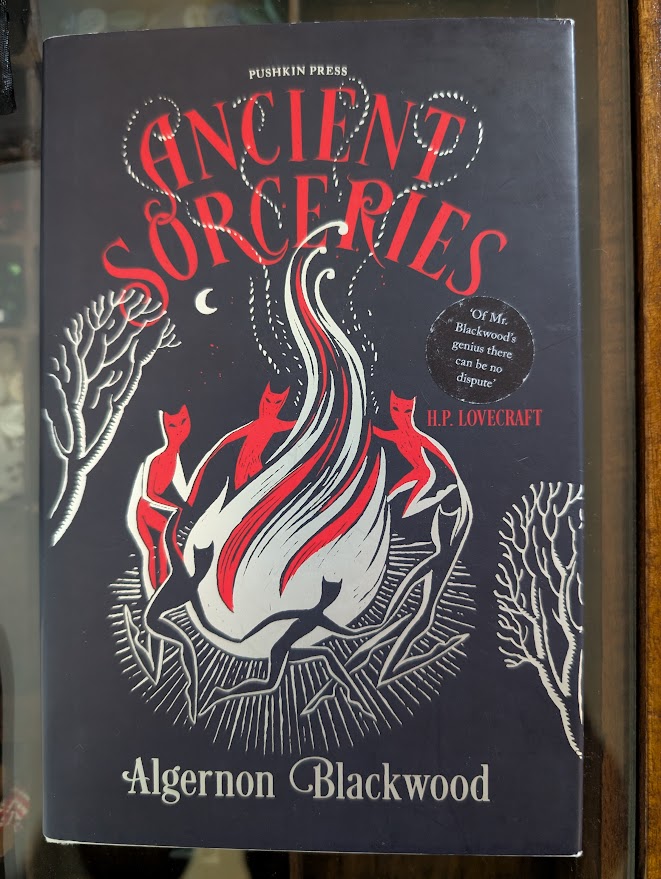
Let’s talk about Algernon Blackwood. Specifically, let’s talk about this cute little modern collection I picked up by Pushkin Press of four Blackwood tales. I think I got it at Barnes & Noble, maybe in Amarillo. It’s a hardback with a lovely cover all done in black and white and red. I love the font they used. As I mentioned, this collection has four of Blackwood’s stories–Ancient Sorceries, The Listener, The Sea Fit, and his most famous story The Willows

This book’s cover features an H. P. Lovecraft quote praising Blackwood. Lovecraft is arguably the more famous of the two, but Blackwood was a big influence on Lovecraft and honestly, Blackwood seems like a super cool person. Horror fans generally know by now that Lovecraft was kind of an unsuccessful shut-in during his life, and deeply racist even by the standards of his time. He wrote some amazing stories and his Cthulhu mythos has inspired some amazing fiction but he doesn’t seem like a guy most of us would enjoy knowing. Algernon Blackwood, on the other hand, travelled the world and had cool hobbies like ghost hunting and backpacking. He delved deeply into  buddhism and occult societies and people said he was pleasant company. He also has an excellent name; Lovecraft was not cool enough to be buddies with a guy like this and, to be honest, I’m probably not cool enough either. 

Blackwood wrote over a dozen novels and an untold number of short stories. I’ve only read a handful of his stories so far but I should probably dive deeper into his work. He’s a giant of weird fiction, writing not just horror and ghost stories but also many stories focused on awe and mysticism. These particular four inhabit a space that’s part horror and part cosmic awe.

The first story, Ancient Sorceries, follows Arthur Vezin, who visits a quaint little French town with mysterious goings-on. As he jumps off the train a fellow passenger shouts an urgent warning, but not knowing much French all Arthur can decipher is “because of the dreams and the cats.” It makes no sense until he falls deep into the mystery of this town and its witchy denizens. It’s quite a long story, verging on a novella, slow-paced and atmospheric. The whole town’s catlike quiet draws you in just as Arthur is drawn in. Well, he’s also drawn in by the innkeeper’s attractive and friendly daughter, who eventually insists that she knew him in a previous life . . .

The Listener is a ghost story. Much of the tension comes from wondering how much of the narrator’s problem is ghosts and how much is his delicate mental health. The tension and mystery build slowly up to some quite dramatic scenes near the end. There’s a dramatic reveal at the end I want to discuss so skip the rest of this paragraph if you want to be surprised. After a great build-up that this man is being truly persecuted by a malevolent ghost, the big reveal is that in life this ghost had leprosy. This explains a lot but I’m not sure this news has quite the punch these days that it once had. Finding this out was supposed to be horrifying, I think, but it mostly made me feel sad for this guy who died alone and friendless because of his disfiguring disease. Still, I suppose having leprosy doesn’t entitle your ghost to persecute others.

The next story, The Sea Fit, is a great example of Blackwood’s mixing of horror and awe. “Big Ericsson” is a sea captain with Norse blood in him, and sometimes when the sea and sky are just so, he feels the old gods calling him to join them in the storm. This is the story of one such perfect moment and by the end it’s hard to know whether to be horrified at nature’s attempt to claim Ericsson or to cheer on his glorious union with the sea. This story is quite short and simple compared to the others and quite satisfying.

The last story in this collection, The Willows, is probably Blackwood’s most famous. You’ll find it in anthologies of horror and weird tales and I think at some point I had to read it for school. This is my third time reading it, I think, and I enjoy it more each time. It’s much more about atmosphere and awe than surprise, so it keeps its power as you read it over and notice new details.

It’s a simple story about two men canoeing down the Danube River and running into something otherworldly. The first time I read this, I had to look up the Danube. I’d heard of it, I’m not totally ignorant of geography, but I’d always associated the Danube with all the cities it flows through. Once I read about the wetlands of the Danube Delta and looked up pictures of it, the isolation and otherworldly feel of the story made a lot more sense. 

The otherworldly forces these men encounter are fascinating, seeming to exist on another plane while only pushing on the edges of our reality, causing an eerie hum and making the willow bushes seem to shift in odd ways. They also seem to cause an eerie amount of bad luck for our travelers, almost as if they’re trying to trap them on this tiny sandbar they’re camping on. Trap them, or maybe worse. Ordinary things, like missing food stores and a worn spot in the boat they could swear wasn’t there last night; it all takes on ominous overtones on this shifting island with its maddening hum.

It’s quite suspenseful watching these two men try to hide, escape, and understand these mysterious beings and what they want. It’s quite a good piece of cosmic horror and has a quiet realism that makes it all the more effective. Every time I read a Blackwood story I’m convinced I should read more of them. If you’re not familiar with Blackwood this is a great place to start, and if you are familiar please tell me what else of his I should read next. I would love to dive deeper into Blackwood’s awestruck world.

As always, you can and should follow my sister and me either here or on Substack. And as always, you can and should read all the books you can lay hands on.

The Human Vampire and The Haunted Chamber

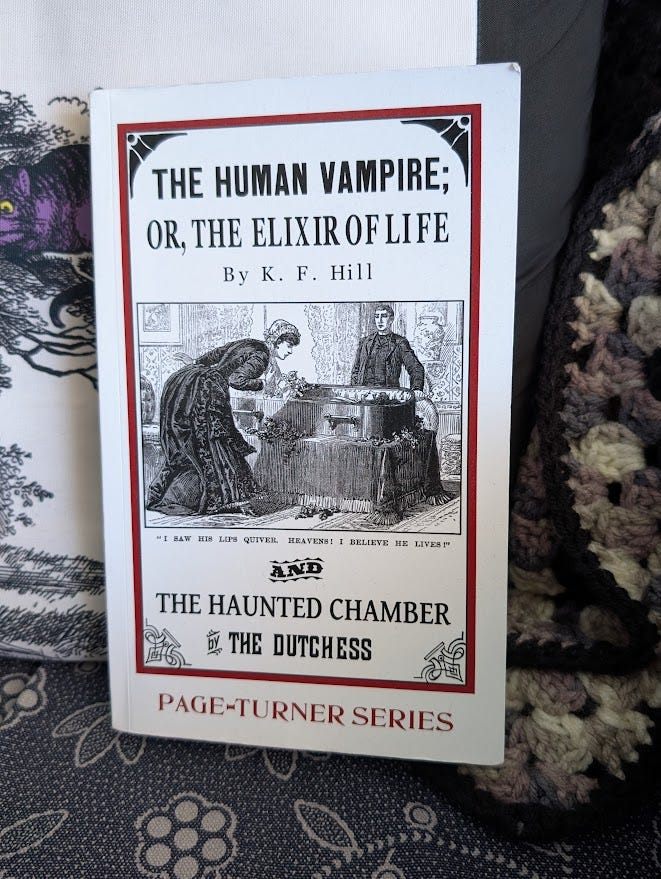
I got this book from an oddities shop in El Paso. Tooth and Veil is more about gothy jewelry and decor than books so this was a lucky find, this duo of obscure tales from the 1800s. Instead of a teaser or summary, the back of this book has a warning that these stories are “products of their time” and have “social norms, prejudices, stereotypes, and attitudes of the era that do not represent today’s society or values.” The introduction is a fascinating little tale in itself about the joys and hardships of preserving old stories like this. This feels like the smallest of small publishing, an amazing little passion project.But enough about the publisher/reviver; on to the stories themselves.

The Human Vampire; or, the Elixir of Life is is credited to K. F. Hill, the pen name of Lucy A Baer. Almost nothing is known about her, which is a shame because this story is pretty fun.

This is the story of a man who discovers a way to prolong his life and youth. He uses this discovery, of course, to scam women out of money. He sweeps through Southern society using his youthful good looks and suave British accent to woo young heiresses. Once he’s blown through his current heiress’s money he conveniently “dies,” only to pop up somewhere else with his youth restored, ready to scam someone else. Unfortunately, Southern society is small enough that eventually one widowed heiress runs into another and a handful of people get suspicious. The ages don’t make any sense but the resemblance between their various husbands is just too great to be ignored.

The story follows both our villain, who goes by various names as he continually reinvents himself, and his victims as they try to investigate this elusive scam artist. Despite our buttoned up stereotype of the 1800s, I find their horror can be surprisingly graphic and tragic. As we follow our heroes’ investigations we uncover the villain’s horrifying experiments in pursuit of perfecting his elixir of life, and though he does come to a suitably tragic end, his latest wife and children are caught in the crossfire and their lives end tragically as well.

The Human Vampire is also, I think, the main reason for the warning on the back of the book. The late 1800s were a pretty racist time in American history and this book reflects that. The Irish characters are not put in a flattering light and are written in horrendous vernacular. The few black characters are treated more sympathetically, especially the black families who fall victim to the villains’ experiments, but there’s nothing like a modern understanding or nuance here. I’ve read a lot of stories from this era and found this less uncomfortable than most, but the old-timey attitudes might still grind your gears.

Still, I loved this story. It was exciting, the characters were fun to read, and the ending was surprising and dark and morally messy. It truly feels like a hidden gem and makes me hope we discover more of Lucy Baer’s lost work someday.

The second story, The Haunted Chamber, is a bit more known and available online. It’s written by Margaret Wolfe Hungerford under the pen name “The Duchess.” It’s a much more straightforward story of love and betrayal, written in a calm and knowing style that highlights the drama of the story, while also having a subtle sense of humor throughout.

Sir Adrian Dynecourt has come home to settle in his family’s castle and invited several friends to stay with him, including the lovely Miss Florence Delmaine and her chaperone, Mrs. Talbot. Unfortunately, Adrian’s jealous cousin Arthur also crashes the party. Social maneuvering and miscommunication turn to betrayal as Arthur tries to secure Miss Delmaine (and her sizable fortune) for himself. If he can somehow also get his cousin’s castle, his triumph will be complete.

This castle, like many, has been rebuilt and added to over the centuries. One tower of the original building still stands, though it’s mostly abandoned now in favor of newer more comfortable areas of the castle. Now it’s the subject of ghost stories and family lore and one very real chamber near the top that locks itself if you let the door close. I think you can imagine where Arthur is tempted to trap his cousin.

There aren’t many surprises in this story. The pleasure is in watching events play out to their inevitable end, and in the elegant feel of the writing. And there is pleasure in it. I enjoy a solid classic tale and this delivers.

Both of these tales, especially the nearly forgotten Human Vampire, brought home to me just how long pulp horror has been around. Stories like these from the 19th century are becoming quite rare as the paper they’re printed on literally disintigrates and it makes me wonder just how many spooky treasures are lost forever. Now that’s a truly horrifying thought. Let’s find them and read them while we still can.

Follow us here or on Substack