
What’s the book? Whack Job: a History of Axe Murder by Rachel McCarthy James
How dark is it? Blood red, I suppose. Is that too on the nose?
How good is it? 2/10 hatchets
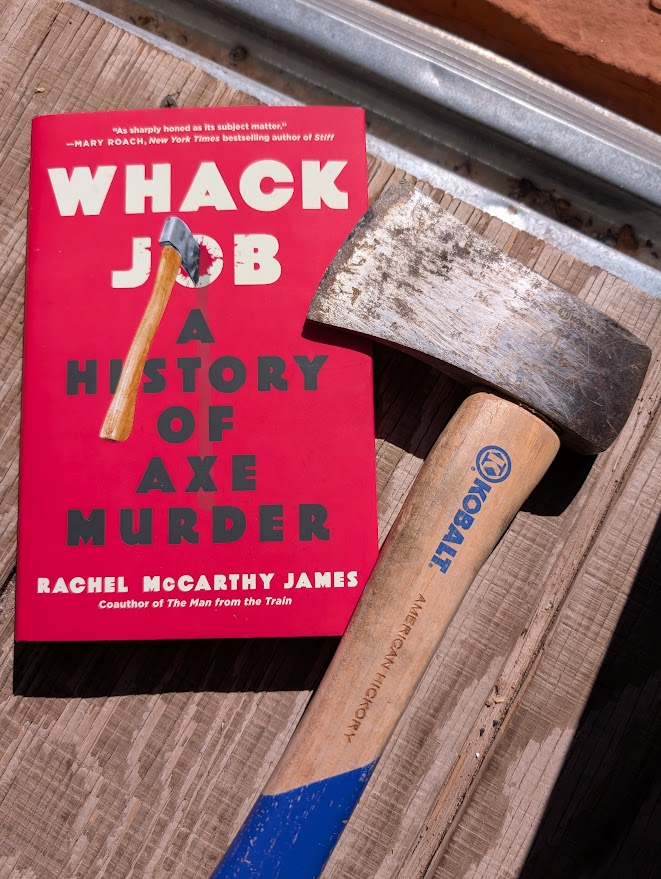
This book is less than 250 pages long. I don’t expect a thorough history of anything in that few pages, much less a history of both axes and murder. The first chapter introduces the far tighter exploration of how axe murder became a cultural meme, almost a joke. Okay, yeah, you could maybe do justice to that in 250 pages. Then we jump way back into prehistory and I know we’re in trouble.
In trying to tell stories all the way from prehistory to the 21st century, the author has to settle for bare sketches and snippets. It would require heroic summarizing skill to do any of these stories justice in just a few pages, and this author does not have heroic summarizing skills. In describing the tragedy at Taliesin, for example, so much time is spent explaining Frank Lloyd Wright’s complicated love life that we barely have descriptions of the actual murderer or most of his victims. Confusion or meandering in the oldest cases might be excused by the lack of details and evidence handed down through the ages, but the modern well-documented cases are also summarized in unsatisfying ways and I was sometimes baffled by her choices of what to dwell on and what to leave out.
All this makes the book feel incoherent, more like sketches of vaguely axe-related moments in time than an actual history of any kind. This feeling of incoherence is compounded by the political lessons the author forces onto many of the stories, often with very little explanation or argument. The story of Stesagoras’s murder (an ancient one) seems chosen mostly as a dig at fascism and Trump’s infamous border wall, and many of the early American stories seem chosen primarily to remind us that slavery is bad and the U.S. did not (does not) treat Native Americans very well. All these things are true and important to talk about, but they’re not very axe-related and honestly, shoehorning these messages into such a light book doesn’t do them justice.
And speaking of American history, fully half of this book is devoted to U.S. axe murders. Again, they seem chosen not with an eye to explaining how axe murder became a pop culture thing, but to make various other points. If they were chosen with an eye to cultural significance, she might have included the Axe Man of New Orleans or the Villisca axe murders or highlighted some modern axe murders from beyond the United States. Some of the cases she chose were interesting but again, there was no sense of a coherent throughline. Just before the end, the author devotes a chapter to The Shining and So I Married an Axe Murderer as an attempt to tie everything back to pop culture but with no throughline to the previous chapters, this movie chapter felt jarring and out of place. It was especially jarring to jump from So I Married an Axe Murderer right into the grisly and sad murders of two Missouri men in 2019. That combo gave me emotional whiplash.
This book tries to weave together a whole lot of threads–axes, political history, true crime, pop culture–and it doesn’t do any of them justice. This book disappointed me greatly. That said, there were interesting tidbits here and there and I actually enjoyed the tiny interlude chapters explaining various historical axe types. I learned a bit about different axe designs and their various pros and cons. Turns out a history of actual axe design might be a real page-turner for me. This book, however, was not.
 Darker Books