
What’s the book? Still Life with Bones by Alexa Hagerty
How dark is it? It’s about real atrocities so . . . it’s pretty depressing
How good is it? 6/10
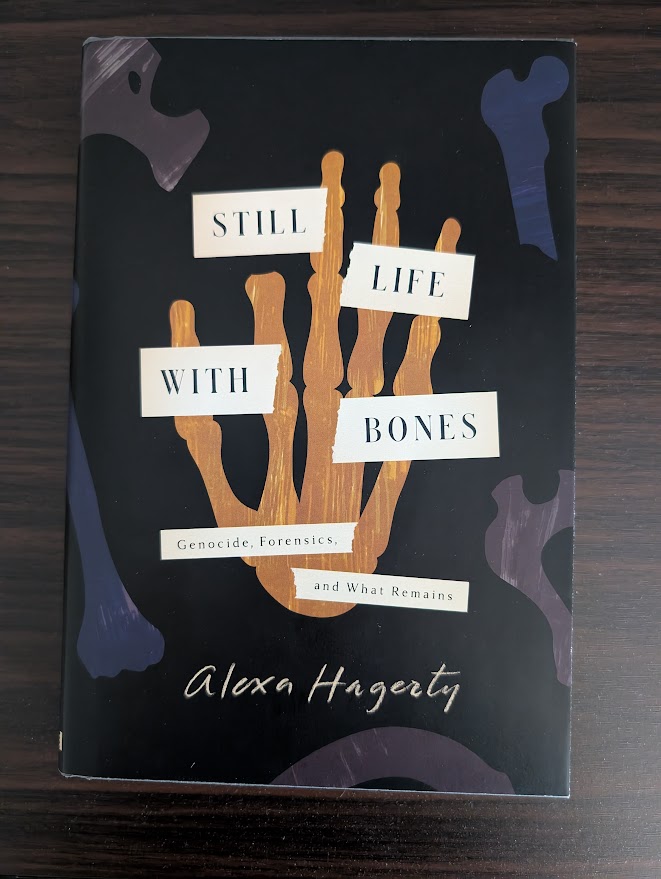
This was the Morbidly Curious Book Club‘s latest selection so I didn’t come into this book with any particular expectations. I read it because they sent it to me. Turns out it’s mostly about the author’s experience exhuming mass graves in Guatemala and Argentina as part of her anthropology studies. It’s a little bit about bones and the stories they tell, a little bit about exhumation and the various ways it’s viewed, and a lot about the atrocities perpetrated in both countries during certain periods of time.
The last part was the most interesting and informative to me. I grew up in the 1980s and ’90s, vaguely aware that shit was going down in South America and President Reagan was somehow very involved, but I was way too young to understand any of the details. I remember U2 mentioning El Salvador in their songs and stuff but I didn’t really know what they were talking about. In fact, somewhere in the middle of this book, reading about the Madres de la Plaza de Mayo, I realized they’re who that song “Mothers of the Disappeared” was about. I feel a little dumb now because I always thought that song was a metaphor. (To be fair, I was in middle school when that song came out.)
In parts of this book, Hagerty explains La Violencia in Guatamala and the Argentinian junta that kidnapped thousands of supposed dissidents, tortured them extensively, and dumped their bodies when they were done. These chapters were sad and horrifying and enlightening. They made me want to know more about the history and politics behind it all. These chapters were also the hardest chapters to read, by a long stretch, because they detail some of the horrific crimes behind the mass graves being investigated now. The discussion of Argentinian torture especially got to me, mostly because it was so perversely creative in its cruelty. It feels important to witness and condemn such things but it’s also hard to read over breakfast.
The rest of the book was more personal and poetic, more centered on Hagerty’s own experience and musings. In many ways, she becomes a stand in for the reader, giving us a single human perspective to guage these enormous events by. Her focus on her own emotions and thoughts gives us suggestions on how to shape our own emotions and thoughts about the subject. Sometimes this filtering makes the whole subject easier to handle but it also puts us a step farther from the action that makes it a little too easy at times. Instead of relating to these survivors and witnesses directly, we’re relating to Hagerty as she relates to them. At times, she becomes the subject in a way that feels a bit self-involved. Once in a while I got a whiff of that pampered American ‘their tragedy is so sad for me‘ rot.
But it was only the occasional whiff; for the most part I appreciated this book and the attempt it made to condense a huge and difficult topic into a relatable story for a mass audience. As such, it was a good introduction that made me want to do some more serious research some day.

