
What’s the book? Madness: Race and Insanity in a Jim Crow Asylum by Antonia Hylton
How dark is it? Dark like a hospital without enough windows
How good is it? 8/10 emotionally, 5/10 as a history
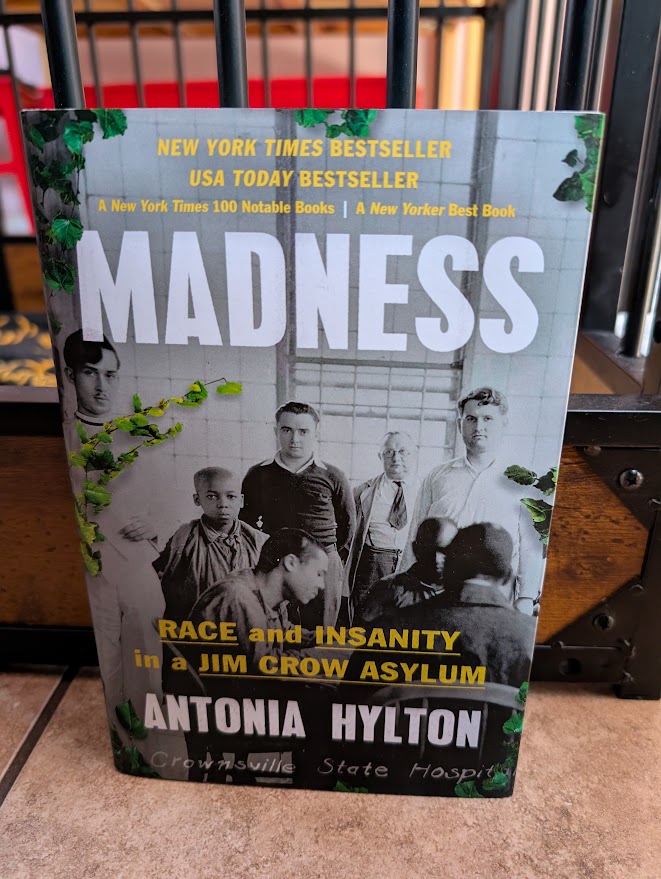
This month’s Morbidly Curious Book Club selection was Madness: Race and Insanity in a Jim Crow Asylum. It’s centered on the Crownsville hospital, built as a mental institution for Maryland’s black residents back in the days when the state was still segregated. It is an astounding coincidence that I spent part of my childhood in a town not far from this hospital and never knew it was there. Google maps tells me it’s a fifteen minute drive from the house I grew up in. I have clear memories of a few of the places talked about in this book. I haven’t lived in Maryland since last century but I have siblings in and around Baltimore. As I said, this is all just a big coincidence and I didn’t choose this book myself but knowing the area gave me an added layer of interest and an emotional connection I hadn’t expected. On top of that connection, I also spent several years doing housekeeping for a mental hospital when I was younger. Ever since then I’ve had a small personal interest in the history of mental health treatment and the thorny issues of institutionalization. Because of all that, I’m not sure I can be objective about this book. I found it fascinating and emotionally compelling, but how could I not?
This book is a history of the Crownsville State Hospital in Maryland, built in 1911 as the only mental health facility serving black people back when the state was still segregated. It’s a history of that hospital but it also uses Crownsville’s history as the starting point for a larger discussion about race and the mental health system in the U.S., focused on how it serves (and too often fails to serve) black Americans. It relies heavily on interviews with former patients and staff, oral history, and personal interactions the author’s family has had with the mental health system.
As a history, it’s not the best. Crownsville’s records are spotty for various reasons so putting together a thorough history is already a tall order, and Hylton hits a lot of major themes in the history of mental health care but she isn’t even trying to be thorough with that. She jumps around a bit between places and time periods, which made it hard to form an orderly timeline or historical picture as I read. Hylton also comes at this history without any special understanding of mental health so she sensibly avoids deep discussion about treatment philosophies and challenges, especially in the time before drug treatments became common. I find that kind of discussion fascinating and I felt the lack of it, but it’s fair that Hylton’s interest lies elsewhere.
Hylton’s interest centers more around broad historical and political trends and personal experiences. Most of the stories, especially as she talks about the sweep of history beyond Crownsville, are chosen more for theme and emotional resonance than historical completeness.
This book absolutely excels on the ‘theme and emotional resonance’ front, though. Hylton clearly wants to open our eyes to two facts: one, that the larger background of racial tension and discrimination can complicate and contribute to mental health struggles for individual black folks and two, that those struggles are made worse by the very good reasons those black folks have to distrust the mental health care system. By focusing deeply on personal stories of former patients of the Crownsville hospital and of many caring but under-resourced employees, Hylton really drives those facts home in a compelling way.
Now that I’ve highly recommended this specific book, I’d like to say a few words about my general book club experience so far. This is the third pick I’ve received from this book club and I’m beginning to worry that it’s actually the Very Important Issues book club that wants to justify its darkness by making sure each book I receive teaches me deep and important lessons. I don’t need my totally voluntary book club to apologize for liking morbid topics or make up for its darkness by acting very very virtuous. I enjoyed this book and I do think it’s very very virtuous and very very important, but I do hope this club sends the occasional book that’s just darkly historical and entertaining.

