
What’s the book? Spiritualism’s Place: Reformers, Seekers, and Seances in Lily Dale by Averill Earls, Sarah Handley-Cousins, Marissa C. Rhodes, and Elizabeth Garner Masarik
What kind of dark is it? Not really dark at all. Technically it’s about contacting ghosts but this book is not even a little spooky.
How good is it? 4/10 fake ghosts
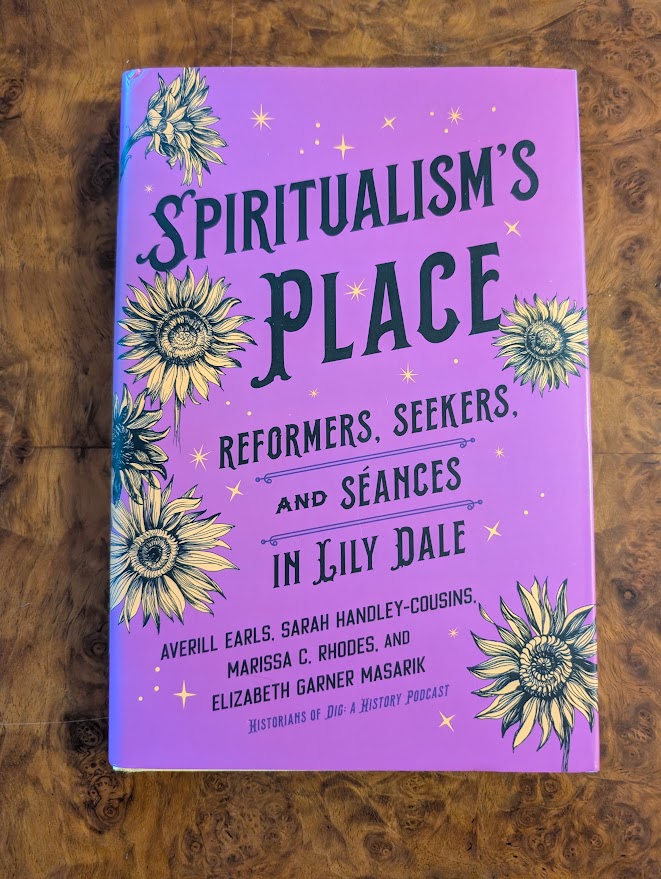
This is October’s selection for the Morbidly Curious Book Club and I was excited to read it. I’ve never listened to one second of these authors’ podcast but the subject sounded interesting and even though I’ve read bits and bobs about Spiritualism I knew almost nothing about Lily Dale, the Spiritualist movement’s home base.
Unfortunately, after reading this entire book I still feel like I know almost nothing about Spiritualism or its home in Lily Dale. The authors seem focused on connecting Lily Dale to a larger historical context rather than explaining what the place or the movement really meant to the people involved in it. There are chapters connecting Lily Dale to the fight for women’s suffrage, to the temperance movement, to the spate of new religions that came out of 19th century New England, to the cringey “connection” to Native American spirituality Lily Dale sometimes leans on. There’s some talk of the Fox sisters, considered the founders of the Spiritualist movement, and of other early leaders and famous mediums, but most of the talk is about their various drinking problems and whether they were frauds or not.
I was hoping for more focus on how people came to the movement, what Spiritualist believes were beyond the flashy seances and how they might have changed as Spiritualism aligned itself with the New Age movement (as it seems to have done). I was hoping for a deeper exploration of the ideals and conventions of the community. I wasn’t expecting Lily Dale to be just a jumping off point for a series of History 101 lectures; it was disappointing.
When the book does focus on Lily Dale and the Spiritualist churches, it focuses more on the dry details of which church split from which and who led what meeting; without a good introduction to the movement as a whole or the way Lily Dale’s founders were hoping the community would work, the sea of acronyms and obscure names didn’t hold my attention very well.
To their credit, each of these authors writes clearly and the book was a pretty easy read. They’re clearly excited about history and about Lily Dale. They take turns writing chapters, which means the writing style and focus changes slightly chapter by chapter, but they do a good job keeping the book coherent and focused the way they want it. It’s just that what they want to focus on is not what I wanted to know.
The authors also spend a lot of time discussing fraud in the seance world. It’s fair and right both that they discuss accusations of fraud (especially in the early days of Spiritualism when many mediums were caught using pretty blatant trickery) and that they keep an open mind about contacting the dead. But they don’t just sit down and wrestle with it for a chapter; instead it keeps coming up tangentially as they focus on other things, which is a very unsatisfying way of dealing with it. I would have loved a chapter focused on the history of seances at Lily Dale and how they’ve changed over the years, how they personally answer accusations of fraud and questions about authenticity.
If you love the nitty gritty details of history or are excited about the social movements of the late 19th and early 20th century, this is a nice little book for you to try. If you’re looking to dive into what Spiritualism was all about or a neat history of Lily Dale as a community, this book will come up short.

