Cinderwich: a Review

I guess Cherie Priest is known for steampunk but I haven’t read any of those books. This is the second horror novel of hers I’ve read, though, and I enjoyed both of them quite a bit. (I’ve read Cinderwich and The Toll. I read The Toll before I started this blog but maybe someday I’ll tell you about it.) Priest is great at creating quirky and engaging characters and setting them in delightfully haunted spots in the swamps and hollers of the American south. Cinderwich is very gothic and also very southern gothic, which I like.

Cinderwich is a short one, almost a novella at around 160 pages, and the story it tells is pretty straightforward. Ellen Thrush is named after her aunt Ellen, who disappeared before she was even born. It’s kind of awkward being constantly compared (both favorably and not) to an aunt she never knew, so she usually goes by her middle name, Kate. 

Aunt Ellen’s disappearance was quite the mystery and no one was affected more than Ellen’s girlfriend at the time, Dr. Judith Kane. Decades after the disappearance, when Kate ended up in grad school where Judith worked, they bonded for a while over Ellen’s life and possible death. Judith would share memories and Kate got to know a different side of her namesake. Eventually Kate left grad school and the two drifted apart, but Judith never entirely quit trying to solve the mystery of Ellen’s disappearance. 

Years later, Judith invites Kate to visit Cinderwich, Tennessee, where for years someone has been writing “Who put Ellen in the blackgum tree?” on walls and such. The name is right, the timing sort of fits, and Judith wants to follow this one last lead before giving up the search for good. Kate isn’t hoping for much but she agrees to meet in Cinderwich and help Judith investigate.

Ghostly things happen almost immediately, and they keep happening until the story’s dramatic ending. They meet probably most of the people left in this tiny ghost of a town, including three of the girls who originally found “Ellen” in the tree. The girls have since grown up into a kickass trio of very spooky, very gothy ladies who all seem to be kind of psychic. They and their house are awesome and Kate secretly wishes she could move in with them. So do I, frankly. They seem cool and they stock a wide variety of loose leaf tea at all times, it seems. It sounds lovely.

You might notice this story is chock full of women. It’s not a story about women exploring their womanhood, it’s not part of the town’s mystery or anything, but almost every single character is a woman of some kind. It’s just a cool ghost story centered around a bunch of women and their various lives and goals and perspectives. It gives the book a particular flavor I enjoyed.

This book isn’t gory at all, in spite of the dead body in the tree, and it’s not particularly frightening. It is, however, very spooky and magical and this town is haunted by mysterious (and sometimes malevolent) forces. I love a gothic tale with a really pervasive atmosphere and this delivers. The atmosphere is great and the mystery is satisfying, while Kate and Judith feel real and I’m rooting for them to solve Ellen’s mystery and get home safe. I highly recommend this as a quick cozy read. It’s a perfect ghost story for a long winter night.

As always, embrace the darkness with us here or on Substack.

I Read Some P. D. James Mysteries

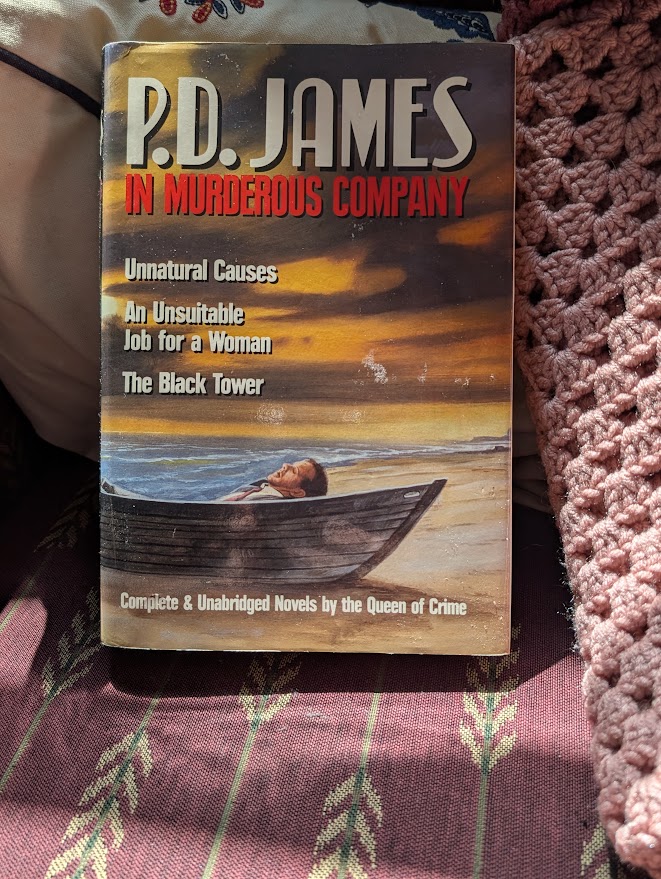
I picked up this P D James omnibus at Brave Books in El Paso. I’m pretty sure. Or maybe I got it at Second Story Books in Durango. One of the two, for sure. 

The omnibus is three novels: Unnatural Causes, An Unsuitable Job for a Woman, and The Black Tower. I read them all one right after the other and that was probably too much P. D. James at once. She seems to specialize in unpleasant characters and though I have a high tolerance for jerks and villains in literature, by the middle of the third book I was getting tired of how much everyone sucked. Most of the characters just suck in minor annoying ways like being kind of snobby or gossipy or referring to themselves as “one” all the time instead of “I” or “me”. Even the villains turn out to be kind of petty and annoying, which is probably pretty true to life but not that epic or interesting. They were exciting mysteries, though, and well written.

Also, by way of warning, James’s main detective, Adam Dalgleish, is weirdly ableist. Since I’ve only read these three books by James I don’t know how much this comes up in general but both Dalgleish books in this set have characters with disabilities or chronic illnesses and Dalgleish is very skeeved out by this. He’s very polite and keeps it to himself, and I understand these books were written in an earlier (and much meaner) time, but reading his insulting inner dialogue was kind of hard. If you’re sensitive about the topic these probably aren’t the mysteries for you. 

Unnatural Causes was my least favorite, I think. In this one, our detective Adam Dalgleish is visiting his aunt Jane out in the tiny village of Monksmere, looking for some peace and quiet. Of course, he finds murder and mystery instead. When neighbor Maurice Seton’s body washes ashore with its hands missing, Dalgleish tries to stay out of the mess but the whole neighborhood is in an uproar. This one was my least favorite because most of the characters were purposely exaggerated for effect. Monksmere is an unofficial writer’s colony of sorts–all the neighbors involved are writers of varying degrees of success and they all seem to be cultivating various writerly personas. Sometimes this is funny and sometimes it’s kind of annoying and reminds us how farfetched and “writerly” the actual murder and surrounding mystery are. Honestly, James might be purposely parodying herself a bit with this one because the other two novels were more down to earth and realistic. If you’re interested in that kind of humor and playing with the genre you might like this one better than I did. 

An Unsuitable Job for a Woman was next. This one actually stars Cordelia Gray instead of Adam Dalgleish. The novel begins with Cordelia inheriting her boss’s failing private detective agency under fairly tragic circumstances. We follow Cordelia as she takes her first case, investigating the apparent suicide of Mark Callender, a university student and son of a famous scientist. As she investigates, Cordelia immediately realizes this isn’t a simple case. Things get dangerous and though she’s in over her head, Cordelia is determined to succeed in her first solo case and keep her business alive. There are sharp twists and turns in this one and several tense moments and surprises. I enjoyed this story and I enjoyed Cordelia, who has a complicated backstory and an interesting personality. It’s a shame James only wrote a couple of books starring Cordelia because this character has a lot of potential. 

The Black Tower once again stars Adam Dalgleish. This time he’s recovering from a near fatal illness and thinking of quitting detective work altogether. During his illness, an old priest from his childhood days writes requesting Dalgleish’s help with something, but by the time Dalgleish has recovered enough to make the trip it’s already too late. The old priest has died, apparently of heart failure. Dalgleish stays on to sort through the man’s effects and quickly realizes there’s something odd going on at the hospice next door. More mysterious deaths ensue and Dalgleish himself is in great danger as he tries to solve this mystery. This was an interesting book but as I mentioned at the beginning, Dalgleish is pretty skeeved out by all the sick people at the hospice. I mean, he wants to solve the mystery and prevent any further murders but he’d prefer to do it without touching or looking at the people in wheelchairs too much. It was awkward to read. 

So. To sum up. P. D. James is famous and wrote a lot of books and a lot of those books were made into movies and tv series. My opinion of her work matters very little in the face of all that. I can see why these books were a great success, with their inventive murders and suspenseful plots and interesting characters. I probably won’t be diving deep into the career of Adam Dalgleish, though. He and his phobia of sick people are not for me. I might read the second Cordelia Gray novel, though. She was cool.

As always, embrace the darkness here or on Substack.

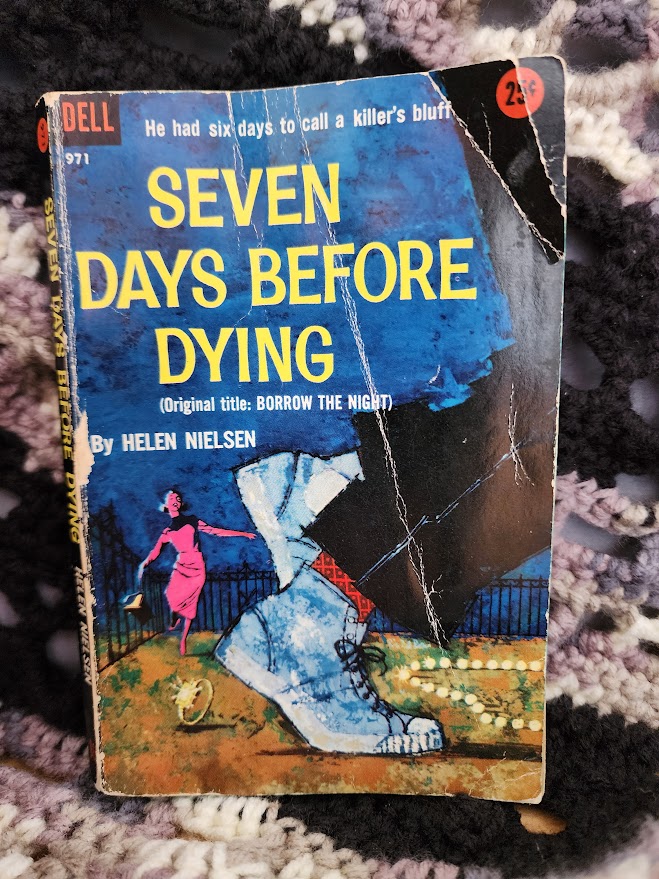
Seven Days Before Dying

Let’s talk about “Seven Days Before Dying” by Helen Nielsen. It’s also called “Borrow the Night” but I don’t really know why. A lot of these old pulp novels have multiple titles for mysterious marketing reasons.

This one is dark in that pulp fiction/film noir/mystery sort of way. I picked it up at Brave Books in El Paso, more or less at random off a table full of pulp novels. Like most of the books I picked up that day, this was a lucky find. But enough of bookstores. On to the plot:

Judge Ralph Addison has been getting death threats for the last six days. Seven months ago he judged and sentenced a young drug addict for the Christmas Eve murder of a woman up on Mulholland Drive, and he’s about to be executed for the crime. One day before the execution, the letter writer steps up the threats, calling Addison on the private line of his home office. Finally spooked enough to take this to the District Attorney, he finds another guy already there. The arresting officer in the case, Matt Coleman, has been getting similar letters all week. According to the letters (and now phone calls), when this kid is executed tomorrow morning, Addison and Coleman will die, too.

With a choice between tracking down the “Mr. Justice” of the letters or waiting anxiously at home, Coleman goes on the hunt and Addison follows. As their last day wears into night, the search becomes less about Mr. Justice and more about finding out who the real Christmas Eve killer might be. 

I don’t want to give too much away so I’ll leave my summary there. This story has some exciting twists and turns and the characters learn a bit about themselves as they follow the clues. This is a well-constructed mystery and I enjoyed watching it unfold. Nielsen takes stock characters–aging cop with nagging doubts about that one case, shady lawyer, self-righteous judge, wayward rich girl–and gives them depth and life. Aside from a few classics I really haven’t read many pulp mysteries, and reading this one makes me feel like I’ve been missing out on some solid reading pleasure. 

Turns out Helen Nielsen was a prolific author, writing eighteen novels and dozens of short stories, as well as episodes for Alfred Hitchcock Presents and Perry Mason. The TV writing makes sense–I can picture this novel being a great TV or movie mystery in that ’50’s and ’60’s style. Sounds like there’s plenty of Nielsen out there to read and, in spite of her tiny stub of a Wikipedia entry, she’s famous enough to have made it into the internet age. Publisher Simon & Schuster’s Prologue line seems to have tons of old pulp available as ebooks for fairly reasonable prices. This is great news because a whole lot of the original paperbacks are crumbling to dust these days. The paperback of Seven Days I bought is in pretty good shape, but that only means less than ten pages actively ripped when I turned them. 

Also, this isn’t important but this is the second time I’ve searched for a pulp author on Barnes & Noble’s website and found German editions for sale. The first time I was searching for an author (Evelyn Berckman) whose books were sometimes set in Europe so I thought that was the reason for German editions. Nielsen mostly set her books in California, though, so now I’m wondering if Germans are just super into pulp fiction. Anyone know the answer to this? I’m dying to know. 

As always, follow my sister and me on here or Substack as we read and review the dark side of life and literature.

Arctic Chill

You’ve probably heard about the new Frankenstein movie coming out. This one’s by Guillermo del Toro so I expect it to be visually moody and memorable. Judging from the cover art, it looks like this will include the dramatic scenes of Frankenstein following his creation to the arctic. That bit gets cut from a lot of adaptations. I imagine it’s hard to film but it’s a poignant and dramatic part of the book.

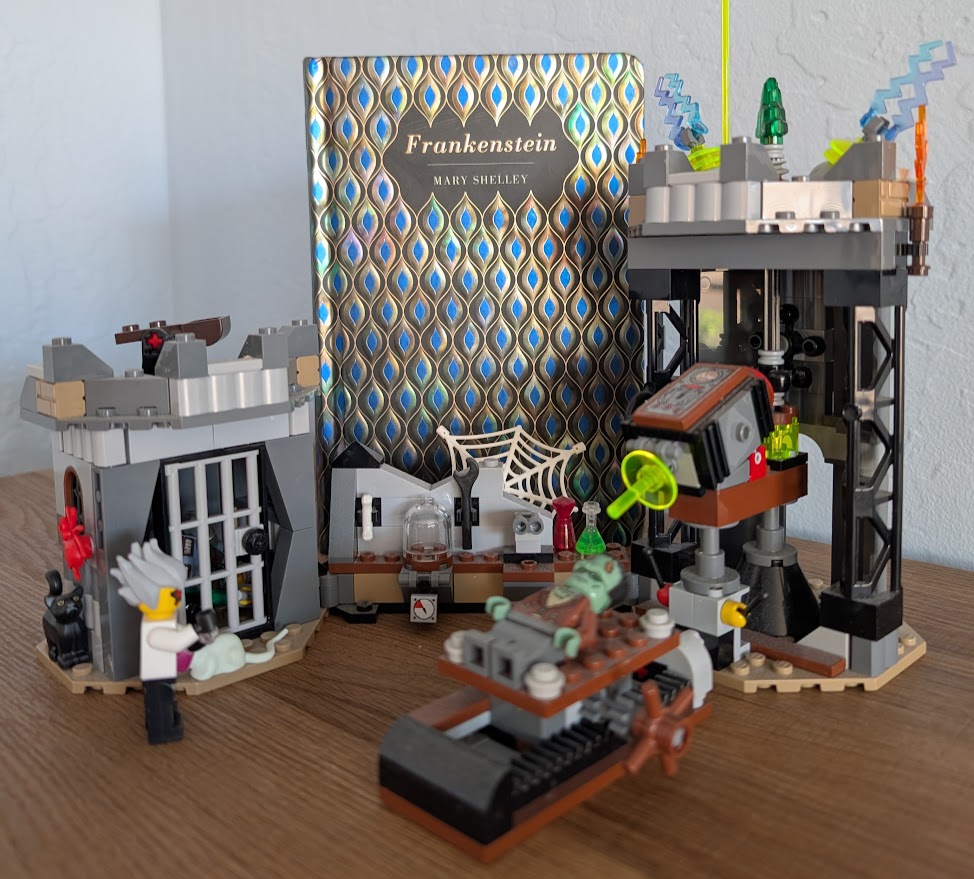
I’ve read Frankenstein a couple of times. I’ve watched a handful of adaptations. I own the Lego set (you may not remember their “monster fighters” collection but I was briefly obsessed with it). I’ll be giving this new adaptation a look when it comes out. I’m not, however, going to bother reviewing Frankenstein because every goth on the internet talks about Frankenstein. It feels overdone and I have nothing useful to add to those recommendations.

I’ve had those arctic scenes playing in my head lately, which got me thinking about how many real live dramatic stories have happened in frozen wastelands. So instead of writing yet another recommendation to read Shelley’s most famous novel I’m going to share a few real life tales of people boldly venturing into the far north and south of the globe. Only some of them end in tragedy.

  1. Ernest Shackleton’s Trans-Arctic ExpeditionThis expedition was trying to cross Antarctica by land. It completely failed in that mission, instead becoming one of the most dramatic survival stories in history. Before even beginning their overland trek, two different ships had to deliver men and supplies to opposite sides of Antarctica. Both ships ran into serious trouble, leaving men stranded and starving. The supply ship Aurora blew off course and stranded its crew. Amazingly, they lost only three men before being rescued. Shackleton’s ship, the Endurance, was trapped by the ice of the Weddell Sea and eventually was completely crushed and sunk. Nigh miraculously, Shackleton lost none of the ship’s 28 men as they walked and sailed hundreds of miles in hope of rescue. Finding the wreck of the Endurance (accomplished in 2022) was an ordeal in itself; even with modern ships and technology the antarctic is a cruel place.
  2. The Lost Franklin ExpeditionWhile Shackleton’s harrowing expedition ended in rescue, Franklin’s quest for the elusive Northwest Passage, a fabled sea lane across the north of Canada, ended in death and enduring mystery. Franklin’s ships became trapped in ice. After a year trapped with the ships (and several deaths) the remaining party tried to reach rescue in an overland journey but never made it. Rescue missions found clues and records but no definitive answer to the fate of the expedition’s many lost crew members.
  3. The Dyatlov Pass IncidentThe “incident” is that nine young people set out to climb a mountain and died. More specifically, in February 1959 these Soviet kids set out with their cross country skies to complete a mountaineering challenge and never came home. Their bodies were found at varying distances from their still intact (and presumably safe and cozy) campsite and no one could figure out why they all wandered away to die in the night. It’s still a mystery and the subject of some pretty wild Cold War conspiracy theories. I read a book about it once called Dead Mountain but it looks like I gave it away at some point. It’s a pretty thorough look at the mystery and does make some interesting guesses about the case. It also taught me that Soviet youths used to trade music using records made of old x-rays. I also bought the book about that, which I still own.
  4. Badass Ada Blackjack Ada Blackjack was the only Alaska native and only woman on a small expedition to Wrangell Island. This time it wasn’t their own ship stuck in the ice, but a supply ship. When it failed to arrive, three men of the expedition set out to find help and disappeared, leaving Ada to care for the last man until he died of scurvy months later. When someone finally came by to pick her up she did not become famous for surviving alone all that time. She didn’t even get her full paycheck for her work on the expedition. But Wikipedia has a lot of cool pictures of her and some of the dudes she set out with.
  5. The Death of Rodney MarksThis Antarctic death had nothing to do with ice or snow. Marks died of methanol poisoning at the Amundsen-Scott South Pole Station. Methanol was used to clean equipment and with plenty of alcohol available at the station it seems unlikely Marks would be chugging cleaning fluid for kicks. The whole thing seems fishy but since Antarctic legal jurisdictions are weird and murky, the death was never properly investigated. That, and the various science agencies (mostly American) in charge of research there seemed to really want this to not be murder and weren’t interested in helping police figure out what really happened.
  6. Against the IceThis one’s a bit of a two-fer. First we had the Denmark Expedition to Greenland’s northeast coast from 1906 to 1908, which was kind of successful but also involved some tragic deaths. Then in 1909 Ejnar Mikkelsen launched an expedition to recover the bodies of some of the lost men and hopefully also the records of their findings. This he did, but his ship got trapped in ice (this seems to happen more often than not) near Shannon Island. While he and his engineer Iver Iversen were off exploring, most of Mikkelsen’s crew hitched a ride home on a whaler. He and Iversen were not so lucky, having to build a cabin and survive in it for two more winters before another whaling ship picked them up in 1912. The cabin they built still exists. He wrote a book about his survival called Against the Ice, which was made into the movie Against the Ice, which was pretty good.

And that’s the last of the frozen death (and survival) stories I have for you today. As winter approaches, may they makes us all appreciate our warm homes and grocery stores.