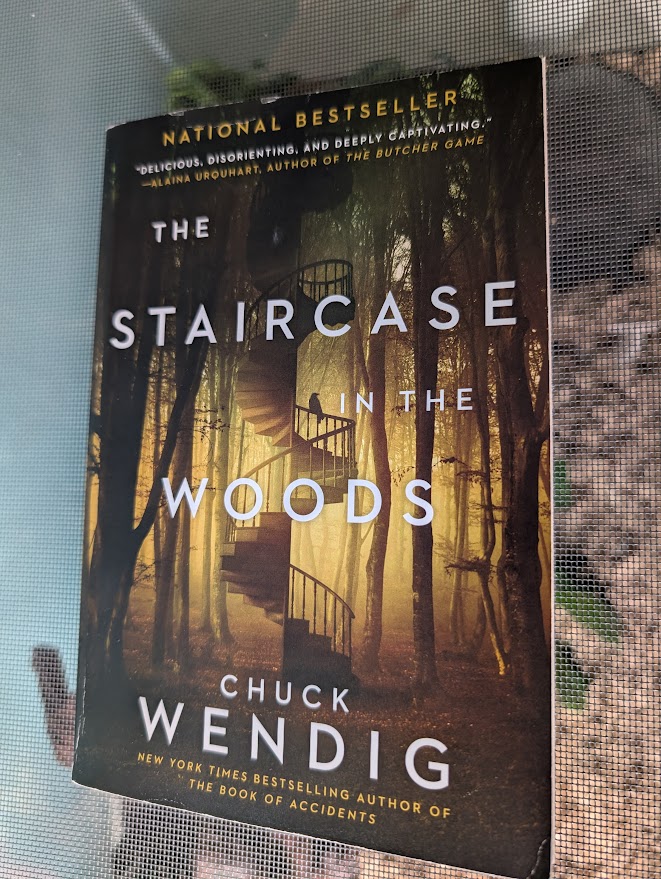
The Staircase in the Woods: a Review

What’s the book? The Staircase in the Woods by Chuck Wendig

How dark is it? Not too gory but kind of existentially dark

How good is it? I give it 6/10 decaying fish

This book was pretty surreal. I saw it on a display and thought, “yeah, I remember pictures of woodland staircases going around the internet a while back. Makes sense they would inspire a horror story.” This book was, indeed, inspired by those pictures.

Mostly, this book is devoted to the kind of otherworldly house those stairs might lead to.  

Way back in high school, Owen and his friends hiked out to a local camping spot to get wrecked in peace and anjoy the wonders of nature. On the way they discovered this random staircase that had never been there before. Just a staircase, all by itself, with no sign of a house around it. That was weird and terrifying, so they ignored the hell out of it and hiked on. But they were high schoolers so eventually drama happened and one of them decided to climb it. Matty, the most popular and well-adjusted of the friends, wanted everyone to climb the staircase with him but no one else was into it. They were all fighting with each other or too high to understand the request or dealing with their own shit. When everyone refused to join him, Matty climbed the ladder by himself and when he got to the top he just . . . vanished.

All his friends had to go home and just live with that confusion, as well as the suspicion of the whole town because there was no trace of Matty and no convincing explanation of his disappearance. Because the staircase vanished, too. The remaining friends, Owen, Lore (known as Lauren back in high school), Nick, and Hamish try to move on with their lives and . . . it doesn’t go that well. Owen and Nick are largely consumed by various mental health issues and Lore and Hamish, while outwardly successful, are emotionally far from okay. They spend decades like this, ignoring each other and nursing their various wounds, until Nick finds another staircase and convinces everyone to climb it. For Matty. This time they all vanish.

At the top of the stairs is a nightmare realm, literally. They’re trapped in a house where room after room is the scene of decay and tragedy; some rooms are the scenes of murders or suicides, some are the scenes of low points in the friends’ own lives. This dreamworld isn’t out to kill them, exactly, but it’s definitely trying to beat them down until they maybe kill themselves or each other in despair. It’s definitely trying to catch each one alone and vulnerable.

Most of the book takes place in this nightmare series of rooms, which makes it kind of a surreal book that runs on dream logic. While there’s plenty of gore and tragedy to be seen in the rooms, we’re really here for the emotional journey each character is taking as they attempt to rescue themselves and each other. We learn about each of the friends and the various pains they carry, both secret and not so secret. They’re all interesting and relatable enough that I was invested in their journey and whether they (and their friendships) survived this ordeal. It felt a little “after school special” in parts, trying too hard to teach me emotional lessons, but I do have a sappy side so I still enjoyed the book overall. 

When I was little I was really weirded out by stories that ran on dream logic; Alice in Wonderland freaked me right out more than anything actually meant to scare me. I’m way more tough and grown up now but dream logic still sucks me in pretty well, disorienting me in a way that makes the horror scenes much more effective. The book starts to lose me near the end as the dream logic devolves into a backstory that doesn’t make a lot of sense but by then I really did care about the characters and whether they’d make it out alive (and of sound mind). I don’t know that I’m itching to read Wendig’s entire oeuvre but I didn’t hate this.

The Black Hunger: a Review

This review first appeared on our Substack in 2025. This is a repost.

Let’s talk about The Black Hunger by Nicholas Pullen. This is a new title, published last year, with a quote on the cover calling it a “gothic masterpiece.” The quote is from Sunyi Dean, author of The Book Eaters, which I read sometime last year. Honestly, I should not have taken this as a ringing endorsement.

I liked The Book Eaters okay, it had a cool premise and decent action, but the flat characters left me cold. How did I expect this new book, recommended by the author of flatness, to have anything but flat characters that also left me cold? These two books are very different but they have the exact same positives and negatives. Great concepts and interesting world building but characters so flat they felt like afterthoughts.

The Black Hunger is set in the British empire of the early 1900s, following John Sackville and his faithful manservant/lover Garret Benson from the hallowed halls of Oxford all the way to India and then into Tibet and Mongolia as they try to foil the plot of an evil Buddhist cult. This alternate mythology, where the future of the world hinges on the various sects of Tibetan Buddhism fighting the unholy Dhaumri Karoti, is great. It’s interesting and original and exciting. This feels like the dream Pullen just had to put into words–he’s clearly put a lot of thought into creating a rich world surrounding this alternate Buddhist history. Whenever the book centers on this–when we see the cultists’ dark rituals, when we follow John and Garrett to meet the Dalai Lama, when we read flashback sections of previous encounters with this cult–the book comes alive. It all feels real and electric. Really, I can’t say enough good about these parts.

When we’re not directly following the cult’s action, though, the story falls flat. All the characters feel fairly wooden, heroes and villains alike, and nothing is told with the same vibrancy and detail as the culty bits. I didn’t find John or Garrett very interesting and their great love affair felt a bit like a convenience. They grew up together and remained unfailingly loyal to each other to the end of the story. If they’d been more deeply written, this would have been a great love affair tinged with the sadness of having to hide themselves from a prejudiced world. It’s clear that’s what their love was supposed to be, but I was unconvinced. They just didn’t feel very real or deeply motivated by anything; maybe this is true love or maybe it’s just too hard to meet other gay men in that cultural climate. John and Garret felt more like a step on the way to the cult action than anything else.

The villains are even more flatly written. Flat villains aren’t always a problem but the deep world building around the Dhaumri Karoti suffered a bit from the cartoonish villainry of the bad guys. The cult is based around the idea that one way to end suffering is to follow the traditional Buddhist teachings of detachment and right action, and another way is to just kill everyone. There can be no suffering if there are no beings alive to suffer. This is an interestingly scary alternative with great potential but it also makes us wonder what would lead someone to choose the dark second option. What despair would make that seem the right choice? That’s what I wonder, anyway. Apparently no one in the book wonders this at all–the Dhaumri Karoti all seem to do this purely for evil and bloodlust. Officially, they’re trying to end all suffering but they take pure delight in causing as much death and suffering as they can along the way. They don’t even try to justify it. It sometimes feels implied that they’re like this because they’re colonizers or because they’re serf-holding Russian lords, and that’s just how those guys roll. Even this could be interesting but the lack of character development just left a lot of thematic implications totally unexplored. I found that really unsatisfying.

Still, that whole Buddhist apocalypse cult thing was a really exciting idea. I’m fascinated by cults and apocalypses and the Dhaumri Karoti delivered on both counts. This is Pullen’s first novel, I’m pretty sure, so he has room to grow. If he can get as excited about his characters as he is about his alternate religious history, we could see great things from him in the future.

The Bog Wife: a Review

review written by Trex

The Bog Wife by Kay Chronister is part Gothic horror and part Magical Realism. The Haddesley family has always lived in their crumbling West Virginia mansion, on the edge of their cranberry bog. The bog gives them everything they need. It even provides a wife for each generation’s patriarch: a woman made from the bog is magically provided for the new patriarch when the old patriarch’s body has been returned to the bog. It’s a covenant kept for generations.

The book opens with Wenna Haddesley returning home to help with the ritual of their father dying. Wenna has been estranged from her father and siblings for years and plans on leaving West Virginia again as soon as possible. Plans change as she sees the sorry state her family has been living in and as old family drama and dynamics suck her back in like the peat bog itself. 

This book reminded me of a lot of other stories but felt original nonetheless. There are certainly elements of “The Fall of the House of Usher” with part-mad siblings rattling around decrepit rooms. The isolation of the Haddesleys and their sense of being chained to a legacy they never chose made me think of 100 Years of Solitude. The Haddesleys live in the disgraced present circumstances of their glorious family who previously enjoyed wealth and abundance. Or at least, this is what they were always told. The magical realism of the story is all in the bog – how they interact with it and vice versa is more an expression of how the siblings evolve as characters and less about the magic itself. 

The Bog Wife was less horrifying or scary and more quietly disturbing. Whereas I thought I’d feel the most connected to Wenna, Charlie ultimately became the character I found myself hoping for. The creeping decay and macabre events ultimately tell a really poignant story about siblings living in the ruins of their own lives. Witnessing the choices they make with the sorry tools life provided them is what kept me reading. 

Within these Walls: a Review

What’s the book? Within These Walls by Ania Ahlborn

How dark is it? Medium grey, like a drab prison wall.

How good is it? 4/10 ghosts

Lucas Graham is a true crime writer who really needs a good story. Good thing one drops right in his lap; mysterious cult leader Jeffrey Halcomb is finally ready to talk about his crimes and he wants none other than Lucas Graham to write his story. The catch is that Halcomb will only tell all if Graham comes out to interview him right now. And if he agrees to rent Halcomb’s old house. The one where Halcomb killed all those people . . . 

Thus begins Within these Walls, a haunted house story with some cult killings thrown in for extra spice. The spooky weirdness starts pretty much the moment Lucas and his 12-year-old daughter arrive at the house. His daughter knows Lucas is here to interview some murderer in prison for his next novel, but he definitely did not tell her the history of their current abode. Which is dumb, because this is the twenty-first century and she knows how to Google. This is eventually pointed out in the novel. Lucas really didn’t think that one through. 

We follow Lucas’s investigation into Halcomb and his cult, interspersed with flashback chapters detailing the months leading up to the famous murders. I would tell you more about both, but it’s all explained in excruciating detail in the book. We’ll read a chapter from the point of view of Audra Snow, the cult member who originally lived in the house. Then we’ll read about Lucas finding clues about the same event in the present. Then we’ll read a short police report or news article from the past detailing the same info. If Ahlborn wants us to know what it’s like to be a writer struggling to make a story out of nothing, she does a great job. If she’s trying to build suspense or connect us to the characters, this over-explaining thing isn’t helping. 

That’s too bad, because the actual haunting bits are pretty exciting. Lucas’s daughter quickly becomes obsessed with Halcomb and the cult, convinced that she can find a way to contact them and free the spirits haunting her new home. She sees spirits, experiences time slips, she feels terrifyingly drawn toward this cult leader she’s only seen on the internet. Lucas is also having some weird experiences but he mostly deals with them by burying himself deeper in his work. 

It all builds up to a nicely creepy ending, but even with all the tedious exposition there are parts that aren’t explained nearly enough. We never get to know what Halcomb’s deal is, where his power comes from or why people are so attracted to him. In the flashback chapters, Audra Snow pretty much goes from “who are these people?” to “I will literally do anything for Halcomb, including sex with his entire cult” in a week or two. In the present, Lucas’s daughter sees Halcomb’s picture on the internet, and in spite of knowing his history (and in spite of being only 12), immediately becomes obsessed with how great he is. I need to know how this works and it is never explained. I’m irritated. 

So . . . my feelings are mixed. I love a good haunting and those scenes are well done. I love a dark ending and this book definitely has one. But the good parts make the repetitiveness and unanswered questions all the more annoying, like Ahlborn was dwelling on all the wrong things between jump scares. The book was flawed to the point that I couldn’t really immerse myself in the suspense. Too bad, too. With a proper buildup the ending would have really gotten to me.

A Short Stay in Hell

This review first appeared on our Substack in October 2025, written by my sister TRex.

Let me tell you about A Short Stay in Hell by Steven L. Peck.

What drew me to this particular novella is that the protagonist, Soren, is Mormon. As an ex-Mormon myself, I’m generally fascinated by portrayals of Mormons in the media. As it turns out, the fact that Soren is a Mormon is pretty much irrelevant. That’s the point, actually. The book opens in the office of a demon who is processing new arrivals into hell. Why are any of them there? Because they weren’t Zoroastrians in life. Yep. During processing, hell-bound souls are sorted into hells that will be appropriately torturous to them specifically based on their tastes, life, and personality. Soren was a reader so his hell is a vast library comprised of every possible book. Think about that briefly. Think about what that really means. Every. Possible. Book. Among every possible book is a book that tells Soren’s life story and he has to find the right book to leave hell.

I really enjoyed this book. It was a genuinely upsetting look at the idea of an afterlife. As someone raised with a really strict and structured concept of life after death who then rejected that concept, I really identified with the author’s commentary on the arbitrariness of who gets what kind of afterlife. Not a Zoroastrian? Hell. Never heard of Zoroastrianism? Them’s the breaks, kid. The hell described in the book initially sounds really not bad at all and Soren doesn’t understand the real profundity of his sentence for a long long time. The author draws on feelings and ideas we can all identify with to flesh out the punishment: monotony, futility, overwhelm.

This isn’t horror in the same way The Shining is horror but I’d call it horror nonetheless. Peck makes you imagine what it would be like in this endless library hell. He makes you inhabit the feeling of waking up every day with a perfect memory of every day preceding it stretching back eons, knowing it’ll continue just like that for a forever longer. That’s the horror.

The Haunting of Room 904: a Review

What’s the Book? The Haunting of Room 904 by Erika T. Wurth

How dark is it? Maroon, maybe? Not a ton of gore but the plot revolves around a massacre and a suicide, so . . . dark themes abound.

How good is it? 7/10 haunted houses. Good thrills, a lot of humor.

In this novel, Erika Wurth creates a compelling ghost story by weaving together fact and fiction. She makes clear from the beginning that the Massacre at the heart of the story was a real event, a tragedy in Colorado history. The mysterious Sacred 36 was a real club, though I think the reality was much more tame than the Sacred 36 in this novel. The Brown Palace hotel our hero, Olivia, investigates is also a real place you can stay. It’s also supposed to be actually haunted. One of the prominent ghosts in this story, Luella Stillwell, is partially based on Louisa Hill, who really did finish out her life in room 409 of the Brown Palace

I bring all that up because it’s cool, but I also bring it up because with this novel Wurth has created cool characters and a fun story while also bringing our attention to real historical tragedy and generational trauma. Her first book was a similar blending of exciting fiction with heavy themes of complex identity and generational trauma, and I feel this second effort is even more successful. It’s both more fun and more weighty and coherent in its themes.

Anyway, on to the actual story. Olivia Becente is a paranormal investigator. She actually set out to be a professor and almost made it, got her PhD and everything, when her sister’s death awakened Olivia to the world beyond. Her life definitely took a sharp turn at that point but Olivia has come to accept it. She likes being a paranormal investigator. It’s a good living, she’s good at it, it helps people. 

On an average day, she seems to spend a lot of time investigating “haunted” stuff people buy on eBay for funsies. Lately, though, a surprising number of these objects turn out to not only be haunted but haunted by related entities. They all seem to trace back in some way to the Massacre. Before she can figure out what that’s all about, the Brown Hotel asks her to investigate room 904. The room her sister died in. A room that also has distant ties to the Massacre. The universe is clearly trying to tell her something, yes?

It’s exciting watching these mysteries unfold and interconnect, and as Olivia investigates room 904 she has to confront some truths and memories she’s been avoiding pretty hard. She does this while dodging her stalkery ex-boyfriend and a local reporter bent on debunking the hell out of Olivia. She also spends time with the modern version of Denver’s storied Sacred 36, who have also been investigating room 904 for the past several years.

I don’t want to give away the mystery but it’s a fun haunting story that, among other things, teaches Olivia that amid all the sorrow and complexity what she really needs is to open herself to love and connection. It was surprisingly uplifting for a horror novel. 

Despite the heavy subject matter and the dark history at its heart, this is a warm and engaging novel with a lot of fun, likeable characters. I was thoroughly entertained. It serves up a fair amount of (pretty deserved) white guilt, but instead of feeling hamfisted or preachy it felt like the book was inviting me to be part of the solution. It felt like a great balance that could speak to a lot of different readers.

Incidents Around the House: a Review

What’s the book? Incidents Around the House by Josh Malerman

How dark is it? Light grey. Like, so light it’s almost just plain white. 

How good is it? I give it 1/10 hauntings. Did not enjoy.

The book is narrated by Bela, a young child being haunted by a mysterious entity calling itself her “other mother.” The entity wants Bela to let it “into her heart” so it can use Bela’s body to reincarnate. If Bela agrees to this plan, her own soul will go . . . somewhere else. The entity is pretty vague about where. The entire book revolves around Bela and this haunting, so connecting with this character is key to enjoying the book. 

I did not connect to Bela at all. I’m guessing Josh Malerman doesn’t spend much time around kids because Bela doesn’t sound like any kid I’ve ever known. She sounds like random bits and pieces of lots of kids I’ve known, of lots of different ages. Supposedly she’s eight years old but she talks with the unreflective simplicity of a 5-year-old and she still calls the toilet a “potty” like she’s even younger than that. Then, when it’s convenient to the plot, Bela suddenly has the understanding and reactions of a young teenager. She also has no personality beyond being a good dancer  and having a demonic imaginary friend. Bela didn’t feel like a real person to me, and since she didn’t feel real I couldn’t care less what happened to her. Without that, nothing about the book is scary or even particularly interesting. 

Bela’s parents, who carry forth most of the book’s actual action as they try to get help for Bela, are almost as flat as Bela herself. Daddo is almost pathologically positive and easygoing and Mommy’s only personality traits are being super high strung and cheating on Daddo with anyone she can find. Also, they both drink way too much. Also, their marriage is slowly disintegrating, probably because of all the drinking and cheating. If Bela were an interesting character, I’d be interested in how she deals with these pieces of human wreckage. But I don’t care about her so it’s hard to care how her parents’ poor decisions affect her. 

Mommy and Daddo’s emotional issues and relationship build up to a climactic reveal, which comes in the form of a huge monologue dumped on Bela herself, who seems to understand it and react on a teenage level but narrates it with her typical kindergartener flatness. Not to spoil too much, but I was underwhelmed when the big reveal was that (SPOILER ALERT!) Mommy was married before and Daddo is actually Bela’s stepdad. The monologue is very emotional for Mommy bacause it involves even more cheating and drinking than she currently does, but I don’t see an 8-year-old having any idea what to make of this at all. It’s presented in a very adult way in an attempt to “destroy Bela’s innocence” but just knowing a bunch of adult stories doesn’t really do that; part of being an innocent is being too young to get what any of that means even when you are told about it. So the whole reveal felt shoehorned in to bring the parents’ issues to some sort of climax.

If I squint really hard I can see this book trying to be the sensitive study of a troubled marriage and an emotionally neglected child, framed by the haunting story. It didn’t work for me, but I think this is what some people enjoyed about the book. For me, these parts felt too repetitive and underdeveloped to have much impact. This is the real down side of choosing a child as the narrator–we get a lot of faithful reports of conversations Bela overhears, but no real introspection or exploration of, say, why Bela has no friends or why Mommy feels so compelled to explore her dark side to its limits. Without that exploration, this feels more like a hamfisted moral lesson than a deep look at, well, anything. There’s no depth here for me.

The actual entity was pretty well done and suitably creepy, I’ll give it that. Its size and shape are constantly shifting in an unsettling way. it also mimics Bela’s loved ones as it tries to manipulate her into giving up her body; some of those scenes build nicely as some trusted person slips into disturbing territory and you realize this is not who you thought it was. I think some people read Bela and just mentally insert some actually endearing child in her place, and if you can do that I think the horror elements are much more effective. 

After I finished this book I looked up reviews, and this seems to be a polarizing book. A whole lot of people where just as bored as I was, but a whole lot of people got deeply invested and started checking their closets for monsters. I do think the cartoonishly flat characters are the key to both reactions: some of us just can’t bring ourselves to care about these people as written and some people are able to replace them in their imaginations with much better characters they actually can care about. Of maybe fans of this book have just never met a child and don’t know any better. Yeah, maybe that’s it.

No Child of Mine

This review first appeared on our Substack in October 2025. For the next few weeks I’m using alternate Tuesdays to reprint a few months worth of reviews we published there before starting up over here.

Let’s talk about No Child of Mine by Nichelle Giraldes. I picked this up in Denver, at the tiny Tattered Cover in Denver’s Union Station. It was within walking distance of my daughter’s volleyball tournament and I wanted to unwind and look at books. I picked it, as I pick a lot of books, by scanning the shelves for titles and covers that seemed cool.

This is two stories intertwined, alternating chapter by chapter. It starts in the present with Essie and Jay moving into their dream house, an old house they plan to remodel together. They’ve been together since high school; Essie supported Sanjay through his architecture degree and now he’s supporting her through law school. She’s in her third year and couldn’t be more excited to graduate and really dive into her career. Then we flash back to the vague and distant past to meet Isabel and Ana, best friends just reaching adulthood, preparing to be married off. Neither is exactly thrilled at this but in this distant past there’s really no other option. No one’s life, present or past, goes the way they hope it will.

Essie’s trouble begins with an unexpected pregnancy. Always adamantly childfree, she decides to keep the baby but has deep misgivings about the whole motherhood thing. Aside from the terrible timing and extra difficult pregnancy, already reasons to worry, Essie’s family might also be cursed. For more generations than they can remember, it’s gone the same way. Meet the love of your life, eventually get pregnant, give birth to a healthy girl, lose the love of your life in some tragic accident. Maybe it’s a curse, maybe not, but it’s frighteningly consistent. As Essie’s pregnancy progresses and her fears about motherhood increase, she also becomes desperately worried about Sanjay’s seeming fatigue and unusual behavior. And then there are the odd whispers she hears in the house, the oddly palpable darkness, and her increasingly vivid nightmares . . .

As this story unfolds, we’re also following Isabel and Ana. Ana is married off first, and we soon discover her husband has a dark side. Isabel’s marriage is much happier but even so, it’s painfully clear that Ana is the real love of Isabel’s life and she can’t possibly find peace knowing Ana is suffering. Isabel lies awake at night trying to think up ways to rescue Ana from her brute of a husband. Then Isabel becomes pregnant and has to put her plans on hold. Still desperate to help her true love Ana, Isabel strikes a bargain with dark forces . . .

Subscribe now

I had mixed feelings about this book. I found Isabel and Ana’s story compelling, like a great myth or fairy tale. I found parts of Essie and Sanjay’s story touching and exciting–the nightmares were quite frightening, their relationship is touching, and I was worried for Sanjay as he tried valiantly to support his unhappy wife while falling into darkness himself. I had a hard time connecting with Essie herself, though. I sympathized with her fears and with her frustration at being endlessly sick and on bedrest when she just wanted to power through her last year of law school. I felt for her but I also felt she played the victim to a weird degree. Essie is described as ambitious, a planner, a fierce woman who lives for a challenge, but the second she finds out she’s pregnant she kind of throws her problem solving skills out the window.

It seems like everyone around her offered to support any choice she made about this baby–everyone knew she didn’t want kids and no one pressured her to keep the pregnancy. In fact, I’m betting Sanjay would have got a vasectomy for her if she’d asked him to. She’s solely keeping this baby because she decided she wants it but for most of the book she acts kind of helpless about it in a way I found off putting. She spends most of her time repetitively worrying that this baby—the one she insists on having solely because she wants it—is going to completely ruin her life. Fair enough, she’s anxious and rumination happens. But rumination is not the same as character development and Essie is pretty boring to read about.

Still, Essie did start to find herself again near the end and I enjoyed that. I enjoyed the book overall and I thought the connections of the past with the present were mostly well done. I love a good haunted house (or haunted person) and this book satisfied on that score. I wouldn’t put it in my top ten but I’d recommend it for anyone who enjoys dark stories focused on women, especially if you like a bit of a love story mixed in.

The Works of Vermin: a Review

What’s the book? The Works of Vermin by Hiron Ennes

How dark is it? Um, it’s hard to say. On the one hand, people are dying in droves and every character’s life is a horrorshow. On the other hand, none of this is told in a dark way at all so . . . maybe that makes it even darker? Technically, darkest of dark. Drenched in blood and sap. But I was personally more fascinated than horrified.

How good is it? On a scale of 1 to 10 pests. 9/10 pests. But it’s also very weird and not for everyone. Read a few pages in the store before you decide.

This book is a glorious chaos. From beginning to end, I was just barely hanging on as I followed the various characters on their adventures through this splendidly horrific fantasy city. I’m still not sure I understood it all because no one ever explains anything in this book, but I think I loved it. Yeah, I’m pretty sure I loved it.

Tiliard is a city tunneled into an impossibly large tree stump straddling a river. At the top of the stump are the rich, obsessive about their opera and perfumes and fashions. They’re also, it seems, always caught up in deadly political drama. We’re following the Laurel Chancellor and his right hand man, the Marshall Revenant, as they attempt to defend their positions against any and all upstarts. We’re also following the Marshall’s head perfumer, Aster, as she befriends an exciting newcomer to town. Who is this new guy, this Mallory vant Passand? Is he part of the latest group of starving artists trying to overthrow the Chancellor? Is he angling to meet Olaf Aufhocker, the reclusive author of this era’s most popular operas? Is he just really into Aster? Who knows?

While that drama unfolds, we’re also following denizens of the city’s underbelly, who literally live on catwalks and bungalows hanging from the giant stump’s underside. Guylag is a humble exterminator, doing his best to look out for his little sister Tyro and willing to do literally anything to give her a better life than he has. Since this entire city is built in a rotting stump, there are always new and exciting vermin to smoke out and extermination is a booming but dangerous business to be in. Guylag (Guy for short) and his partner Dawn answer a particularly tricky call that results in a nasty sting for Guy and a whole new species of pest for his team to hunt down. Pretty soon the hunt for this particular pest becomes all-out war between the various extermination companies of the undercity, and Guy and Dawn are on the front lines.

It’s clear that the rulers on top of the city must somehow connect with our plucky undercity exterminators, but it’s not at all clear why or when or how. Since the book hurtles ahead at full speed and never explains anything ever, I was utterly surprised when these questions were answered. I can’t remember exactly what page it was, but I was well over halfway through and still confused (though increasingly delighted) when everything snapped into focus. Suddenly it all made sense. Or, well, nothing in this book quite makes sense but it all came together in the most satisfying way. I read a whole lot of books and it’s become hard to surprise me, but I did not see this twist coming. That made me love this book all the more.

This book is part horror, part fantasy, part I-don’t-know-what. You need a strong vocabulary and a high tolerance for confusing experimental vibes to enjoy this book, but if you can get past that it’s a unique brand of excitement and fun. It’s always on the verge of becoming nonsense but Hiron Ennes manages to keep it just barely together, and amid the chaos I found myself really attached to most of the characters, hero and villain alike. 

Now for a slight spoiler.

Stop here if you hate spoilers.

Okay.

Ready?

Mallory vant Passand is a trans gentleman. Or possibly genderfluid. Or nonbinary? Mallory is beyond labels. This is clear from very early on and seems of zero importance to any of the characters, including Mallory. Tilliard is a very accepting tree stump city, possibly because everyone’s so distracted by all the operas and murder. Eventually, as Mallory’s history is revealed, it becomes key to the plot in a way I should have caught onto sooner. In my defense, I was distracted by the many assassination attempts and the exterminator war unfolding. I mention it at all because I was thoroughly excited by Mallory as a bold adventuring character. As the book progresses Mallory’s loose relationship with gender becomes a very cool part of the adventure and I can’t review this book without mentioning how much I love how it plays out. It felt like an inspiring call to transcend our hang-ups around gender and sex and just live freely, without ever actually saying anything like this at all. Because, as I’ve said before, this book never explains anything ever. It doesn’t have time; it’s too busy living its best life.

An Education in Malice: a Review

What’s the Book? An Education in Malice by S. T. Gibson

How dark is it? Eh, not that dark. Lot of sex, very little murder.

Is it good? On a scale from 1 to 10 vampire kisses. 2/10 vampire kisses. Did not love.

Man, I wanted to like this way better than I did. I love the vibes of Dark Academia and I was excited to read this mashup of Carmilla (lesbian vampire classic) and The Secret History (elite New England college, charismatic professor teaching a hypercompetitive literature class). I’d seen this in all the stores and heard a lot of good buzz, but I was deeply bored and disappointed once I actually got to reading. The book felt like a rough draft that was rushed to publication way before it was ready. 

Laura is a shy Southern girl away from home for the first time. She wants to become a priest, but also secretly longs to be a dominatrix. Carmilla is a rich jaded Austrian whose parents gave her everything but love, who came to this school specifically to study with their charismatic poetry professor, Doctor Delafontaine. Delafontaine is a vampire searching for her lost lover while grooming Carmilla to be her . . . her thrall? Acolyte? Replacement lover? Probably all of the above. 

Laura and Carmilla totally get together, of course, but not before Delafontaine turns Carmilla into a vampire. This happens as Delafontaine reawakens her own sire, Isis, hoping they can get back together. (Delafontaine clearly has her own dramatic relationship history that is hinted at but barely explored.) Isis, however, turns out to be more of a bloodthirsty monster than the average vampire and this causes some exciting problems for our trio. 

The bits with Isis are pretty bloody and exciting, but there aren’t many of them. This is mostly a romantasy with fairly typical tropes and moderately steamy sex scenes between Laura and Carmilla. If you’re a big fan of romance and really only care about steamy sex scenes then sure, read this book. If you want more than that–coherent characters, good pacing, and a solid storyline to your romance–this book will come up short.

Carmilla is a pretty undeveloped character, and since she’s underdeveloped the weird relationship she has with her vampire professor feels awkward and forced, especially since Delafontaine’s character is also underdeveloped. She’s a predator who has clearly groomed Carmilla in some deeply inappropriate ways, and it’s implied that Delafontaine’s sire maybe did the same to her so . . . something something generational trauma? There could be something interesting there but it’s not well explored and in the end *Spoiler Alert* Delafontaine seems to sensibly feel bad about what she’s done to Carmilla and leaves, setting up Carmilla and Laura for a happy future without her. It’s unbelievably sensible and empathetic behavior for a predator. And I mean that I literally don’t believe it would happen that way. It feels cheap and anticlimactic. 

 Laura’s character is explored more but not enough. She’s deeply religious yet unashamed of her lesbian dominatrix urges yet terrified for anyone to know yet confident enough to have public sex yet deeply insecure about her body yet . . . you get the idea. With careful handling, Laura could be a complex woman struggling with desires that don’t fit together easily, but instead of being explored and struggled with these contradictions are just thrown out there and then ignored when they become inconvenient. 

I was also a bit frustrated that despite the heavy fantasies both girls have about domination and submission, this part of the plot doesn’t really come together. There are several explicit sex scenes and some of them sort of have these overtones but they feel quite tame. I mean, the tameness would be realistic for actual new lovers who don’t have much experience but nothing else about this book is realistic or nuanced, so it’s odd that the author pulled her punches so hard here. 

Next to all that my last complaint might seem kind of petty but I’m going to add it anyway. This book is set in 1968, and to establish this the author throws in every random thing from the 1960s she can think of, along with a few things that definitely didn’t happen until the 1970s and ‘80s. My best guess is the late ’60s vibe was supposed to enhance the themes of sexual liberation but it felt so forced that it detracted instead.

Yeah, like I said. Decent for a rough draft. Lots of good ideas that just don’t come together. Needs a lot more work to become an actually good book. Honestly, I expect this kind of sloppy writing from a cheap romance, which is why I don’t generally read them anymore. At this age I’m looking for something more. But this isn’t marketed as a cheap romance so it caught me off guard. Money wasted. Lesson learned.