Stubs: Part 1

Sometimes I read a book that inspires thoughts and feelings, but not enough thoughts and feelings to inspire a full review. (Often the book just isn’t dark in the way I was hoping it would be.) Even the way I write, with lots of asides about where I bought the book and what random thoughts I had while reading, there’s just not enough for a coherent thousand words or so. When this happens, I save them up and throw together some mini-reviews. Let’s talk about three of these books:

Ghosts of Denver: Capitol Hill by Phil Goodstein

This didn’t merit a whole review because it’s not really about ghosts. The spooky font and haunting line drawing on the cover promised me ghosts galore, so I was bitterly disappointed to find nearly six hundred pages and almost no ghosts at all. This is about 5% ghosts and lurid tales of Denver hijinks, 95% very detailed history of the Capitol Hill section of Denver focusing largely on architecture. I love history included with my ghosts stories, especially when that history involves colorful locals and either criminals or disasters. I like architecture and I’ve actually spent a few hours looking at cool buildings in the area this book is about, but this is way more detail than I ever wanted. 

I did learn a handful of interesting things, though. I learned that Denver used radium tailings in some of their roadbeds, which made them radioactive enough to require cleanup efforts in the 1990s. I learned that 1920s Denver was kind of run by the Ku Klux Klan. I learned that during the Great Depression, movie theaters used to raffle off groceries. (That’s much more wholesome than the radium roads and the Klan thing.) There are a couple strange stories of murder and a couple of interesting ghost stories, but this book felt like a bait and switch. They lured me in with the promise of ghosts and then made me learn about city planning.

Reprisal by Arthur Gordon

Funny enough, I grabbed this book in Denver’s Capitol Hill area. I’m pretty sure I got it at Kilgore Books, a few blocks down from the fittingly named Capitol Hill books, where I got the ghost book with no ghosts in it. I was pressed for time on this book-finding trip so I grabbed several books based on hunches and cool titles, and this was one of them. 

Turns out Reprisal is trying to show us the complexities of race in the Jim Crow south. It was written in 1950 by a rich white dude from Savannah, Georgia so . . . he nails it, obviously. Deep and rich understanding of the grievances and injustices that led to the Civil Rights movement soon to gain momentum and sweep through the south.

Just kidding. He doesn’t nail it at all. It’s awkward and unsatisfying to read. The center of the story is Nathan, whose wife was lynched along with three friends. Several of the men involved were eventually brought to trial only to be acquitted by a jury of their white small town peers. When Nathan hears of the acquittal, he returns to Georgia to take justice into his own hands. This part is interesting and Nathan is a sympathetic character. Unfortunately, our author spends most of the novel following various characters who aren’t Nathan, trying to present a wide range of views on the lynching in particular and race in general. (Of course, most of these characters are white.)

There are so many characters that none of them are particularly deeply drawn and following them all bogs down the story’s pace while not saying anything particularly enlightening about race or segregation. In the story’s first few pages, a reporter wants to cover the trial and its aftermath and his editor warns him that “if you’re going to tackle the race problem–which has been hammered almost to death lately–try to write about the negroes as people, will you? Not symbols of suffering humanity or shuffling clowns. If you can make ‘em people, with fairly coherent thoughts and reactions and emotions, you’ll have done something no other feature writer has done yet . . .” This feels like the author’s mission statement and honestly, I’m not sure he succeeded. Maybe by 1950 standards . . . . 

To be fair, I don’t know what book from the pre-Civil Rights era south would meet a modern reader’s standards. It does seem like Gordon was trying to fight racism in some way with his book, which is more than most authors were doing. This book kinda sucked on both a technical and a moral level but I found the attempt weirdly interesting to think about. 

The Broken Gun by Louis L’amour

I picked this up at a used book shop purely because I wanted to try out Louis L’amour. I was booked to stay at the historic Strater Hotel for a weekend and Louis L’amour apparently stayed and wrote there often, preferring room 222. There’s a little brass plaque on the door now commemorating him. I thought it would cool to read L’amour in the hotel where he stayed. For the record, it was cool and this is a good book. It’s not my usual dark vibe, though, so an entire post on this fun L’amour book I read for goofy reasons felt like too much.

This isn’t one of L’amour’s most famous books, it’s just the one I happened to find the day I went looking. This one is set in the 1960s (and also written in the 1960s), following a writer of Westerns, Dan Sheridan, as he researches an old mystery and ends up in deep trouble. He visits the remote ranch of Colin Wells for research and immediately starts to realize Wells means trouble. Stuck in the Arizona wilderness, miles from help, Sheridan looks for a way to escape while trying desperately to figure out why Wells would want him dead at all. 

It’s a tight mystery with exciting action and interesting wilderness survival scenes. L’amour is more famous for writing what his character Sheridan writes, historical frontier fiction, but if all his books are as tense and tightly written as this I can understand his fame. Used bookshops here in the southwest are usually well stocked with L’amour so I’ll probably grab more eventually. Maybe he’ll show up in the next Stubs post I put up. Who knows?

As always, embrace the darkness here or on Substack. Read more (and darker) books! Happy New Year!

Cinderwich: a Review

I guess Cherie Priest is known for steampunk but I haven’t read any of those books. This is the second horror novel of hers I’ve read, though, and I enjoyed both of them quite a bit. (I’ve read Cinderwich and The Toll. I read The Toll before I started this blog but maybe someday I’ll tell you about it.) Priest is great at creating quirky and engaging characters and setting them in delightfully haunted spots in the swamps and hollers of the American south. Cinderwich is very gothic and also very southern gothic, which I like.

Cinderwich is a short one, almost a novella at around 160 pages, and the story it tells is pretty straightforward. Ellen Thrush is named after her aunt Ellen, who disappeared before she was even born. It’s kind of awkward being constantly compared (both favorably and not) to an aunt she never knew, so she usually goes by her middle name, Kate. 

Aunt Ellen’s disappearance was quite the mystery and no one was affected more than Ellen’s girlfriend at the time, Dr. Judith Kane. Decades after the disappearance, when Kate ended up in grad school where Judith worked, they bonded for a while over Ellen’s life and possible death. Judith would share memories and Kate got to know a different side of her namesake. Eventually Kate left grad school and the two drifted apart, but Judith never entirely quit trying to solve the mystery of Ellen’s disappearance. 

Years later, Judith invites Kate to visit Cinderwich, Tennessee, where for years someone has been writing “Who put Ellen in the blackgum tree?” on walls and such. The name is right, the timing sort of fits, and Judith wants to follow this one last lead before giving up the search for good. Kate isn’t hoping for much but she agrees to meet in Cinderwich and help Judith investigate.

Ghostly things happen almost immediately, and they keep happening until the story’s dramatic ending. They meet probably most of the people left in this tiny ghost of a town, including three of the girls who originally found “Ellen” in the tree. The girls have since grown up into a kickass trio of very spooky, very gothy ladies who all seem to be kind of psychic. They and their house are awesome and Kate secretly wishes she could move in with them. So do I, frankly. They seem cool and they stock a wide variety of loose leaf tea at all times, it seems. It sounds lovely.

You might notice this story is chock full of women. It’s not a story about women exploring their womanhood, it’s not part of the town’s mystery or anything, but almost every single character is a woman of some kind. It’s just a cool ghost story centered around a bunch of women and their various lives and goals and perspectives. It gives the book a particular flavor I enjoyed.

This book isn’t gory at all, in spite of the dead body in the tree, and it’s not particularly frightening. It is, however, very spooky and magical and this town is haunted by mysterious (and sometimes malevolent) forces. I love a gothic tale with a really pervasive atmosphere and this delivers. The atmosphere is great and the mystery is satisfying, while Kate and Judith feel real and I’m rooting for them to solve Ellen’s mystery and get home safe. I highly recommend this as a quick cozy read. It’s a perfect ghost story for a long winter night.

As always, embrace the darkness with us here or on Substack.

I Read Some P. D. James Mysteries

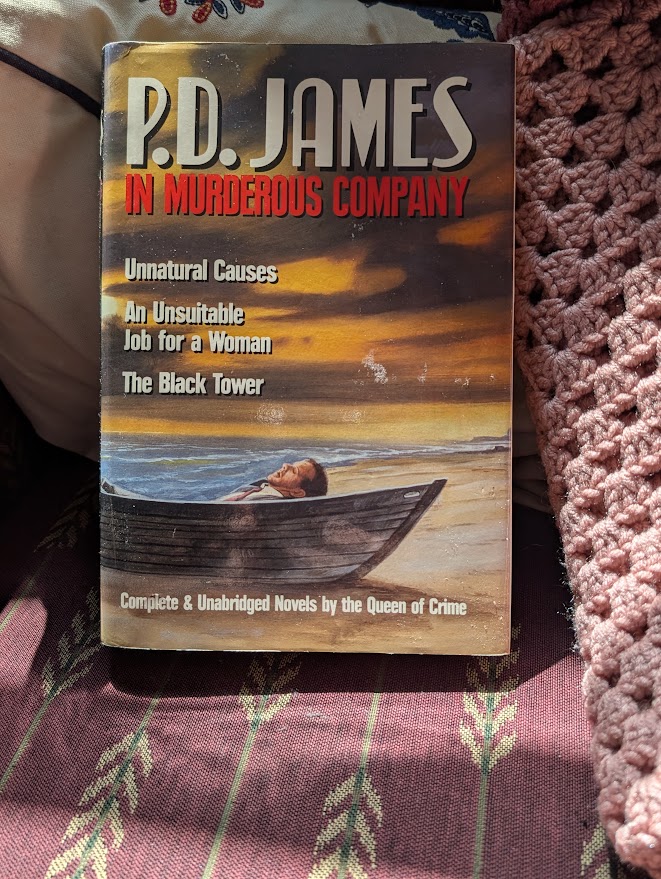
I picked up this P D James omnibus at Brave Books in El Paso. I’m pretty sure. Or maybe I got it at Second Story Books in Durango. One of the two, for sure. 

The omnibus is three novels: Unnatural Causes, An Unsuitable Job for a Woman, and The Black Tower. I read them all one right after the other and that was probably too much P. D. James at once. She seems to specialize in unpleasant characters and though I have a high tolerance for jerks and villains in literature, by the middle of the third book I was getting tired of how much everyone sucked. Most of the characters just suck in minor annoying ways like being kind of snobby or gossipy or referring to themselves as “one” all the time instead of “I” or “me”. Even the villains turn out to be kind of petty and annoying, which is probably pretty true to life but not that epic or interesting. They were exciting mysteries, though, and well written.

Also, by way of warning, James’s main detective, Adam Dalgleish, is weirdly ableist. Since I’ve only read these three books by James I don’t know how much this comes up in general but both Dalgleish books in this set have characters with disabilities or chronic illnesses and Dalgleish is very skeeved out by this. He’s very polite and keeps it to himself, and I understand these books were written in an earlier (and much meaner) time, but reading his insulting inner dialogue was kind of hard. If you’re sensitive about the topic these probably aren’t the mysteries for you. 

Unnatural Causes was my least favorite, I think. In this one, our detective Adam Dalgleish is visiting his aunt Jane out in the tiny village of Monksmere, looking for some peace and quiet. Of course, he finds murder and mystery instead. When neighbor Maurice Seton’s body washes ashore with its hands missing, Dalgleish tries to stay out of the mess but the whole neighborhood is in an uproar. This one was my least favorite because most of the characters were purposely exaggerated for effect. Monksmere is an unofficial writer’s colony of sorts–all the neighbors involved are writers of varying degrees of success and they all seem to be cultivating various writerly personas. Sometimes this is funny and sometimes it’s kind of annoying and reminds us how farfetched and “writerly” the actual murder and surrounding mystery are. Honestly, James might be purposely parodying herself a bit with this one because the other two novels were more down to earth and realistic. If you’re interested in that kind of humor and playing with the genre you might like this one better than I did. 

An Unsuitable Job for a Woman was next. This one actually stars Cordelia Gray instead of Adam Dalgleish. The novel begins with Cordelia inheriting her boss’s failing private detective agency under fairly tragic circumstances. We follow Cordelia as she takes her first case, investigating the apparent suicide of Mark Callender, a university student and son of a famous scientist. As she investigates, Cordelia immediately realizes this isn’t a simple case. Things get dangerous and though she’s in over her head, Cordelia is determined to succeed in her first solo case and keep her business alive. There are sharp twists and turns in this one and several tense moments and surprises. I enjoyed this story and I enjoyed Cordelia, who has a complicated backstory and an interesting personality. It’s a shame James only wrote a couple of books starring Cordelia because this character has a lot of potential. 

The Black Tower once again stars Adam Dalgleish. This time he’s recovering from a near fatal illness and thinking of quitting detective work altogether. During his illness, an old priest from his childhood days writes requesting Dalgleish’s help with something, but by the time Dalgleish has recovered enough to make the trip it’s already too late. The old priest has died, apparently of heart failure. Dalgleish stays on to sort through the man’s effects and quickly realizes there’s something odd going on at the hospice next door. More mysterious deaths ensue and Dalgleish himself is in great danger as he tries to solve this mystery. This was an interesting book but as I mentioned at the beginning, Dalgleish is pretty skeeved out by all the sick people at the hospice. I mean, he wants to solve the mystery and prevent any further murders but he’d prefer to do it without touching or looking at the people in wheelchairs too much. It was awkward to read. 

So. To sum up. P. D. James is famous and wrote a lot of books and a lot of those books were made into movies and tv series. My opinion of her work matters very little in the face of all that. I can see why these books were a great success, with their inventive murders and suspenseful plots and interesting characters. I probably won’t be diving deep into the career of Adam Dalgleish, though. He and his phobia of sick people are not for me. I might read the second Cordelia Gray novel, though. She was cool.

As always, embrace the darkness here or on Substack.

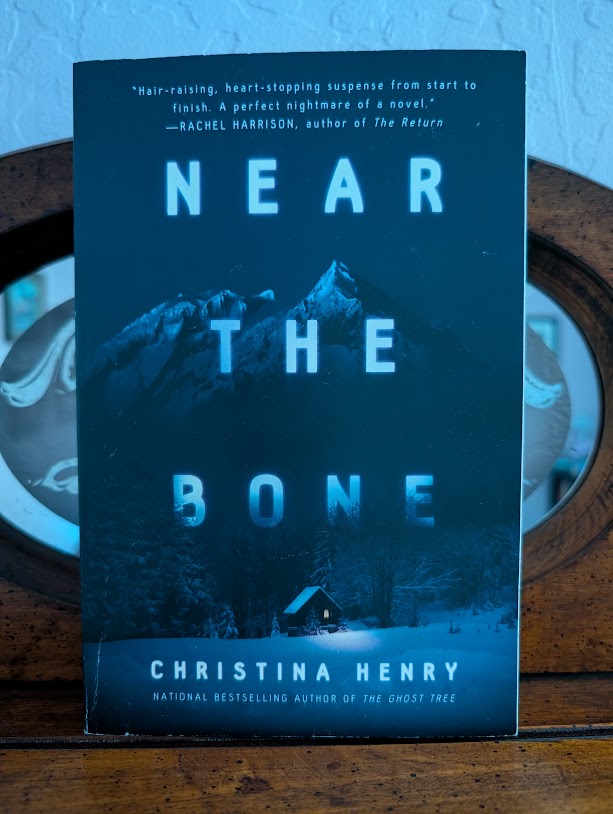
Near the Bone

I was excited to read Near the Bone because years ago I read one of Christina Henry’s other books, one of her series inspired by Alice in Wonderland. I remembered liking it; the Disney version of Alice really freaked me out as a kid with its black backgrounds and creepy dream logic, so I was intrigued by Henry’s dark take on the tale. Near the Bone, however, didn’t impress me the same way.

As a voracious and dedicated reader of novels, I can’t believe I’m about to say this but Near the Bone should have just been a movie. As a book this kind of fell flat. 

Mattie lives on the mountain with her husband, William. Her much older, extremely religious, horrendously abusive husband. They are utterly alone yet he still watches her like a hawk, dictating her every move and timing her to the minute. She has odd flashbacks and thoughts–snippets of songs she shouldn’t know, tiny memories of a sister and a mother–that William insists are dreams and nonsense. 

And now, all of a sudden, there’s something new in the woods. Something hunting the animals and leaving their mutilated corpses in the trees. First the mysterious beast violates their carefully isolated territory, then a trio of cryptid hunters violate their territory as they look for the mysterious beast. William is not happy about any of this, and when he’s not happy Mattie is generally the one to suffer. 

Great set-up, right? This would be a great movie. Mattie fighting between fear and hope as she finally connects with other humans and maybe, just maybe, a chance to escape her husband’s oppression. Everyone, hero and villain alike, stalked by the mysterious beast. It would be tight and terrifying in the right hands. 

A book, on the other hand, usually lets you live with the characters over time and really get to know them. We can see deeper into their souls and follow their inner journeys as the plot unfolds. This is where movies based on novels usually fall short. With these people, though, their inner journeys just aren’t that interesting. We never see into the minds of William or the three cryptid hunters at all, really. We never know why they do what they’re doing in any real way. We follow Mattie’s inner journey quite closely as she begins to remember her life before William and gains courage in the process but honestly, it’s not that interesting a journey. 

Spoiler alert: it’s super clear from the beginning that William must have kidnapped Mattie at a young age and brainwashed her into being his child-bride. We never know why except that he’s a fundamentalist nutcase and we never know how he managed to cozy up to Mattie’s mother without setting off all the alarm bells in the world. Mattie’s inner journey gives us zero insight and she just reads as kind of a mishmosh of stereotypes and tv tropes. Trying to follow Mattie’s inner journey actually detracted from the rest of the action, which was actually pretty exciting when we got to focus on it. 

So yeah, it should have been a movie. Just show us Mattie and three cryptid hunters running around a mountain, trying to evade a mystery monster and a psycho kidnapper with a shotgun. Maybe a few brief flashbacks of Mattie’s previous life and how she’s suffered at William’s hands, so we can feel vindicated when he suffers and loses control of her. I can fill in her inner life for myself, and probably in a more interesting way than this novel did.

The Death of Jane Lawrence

I’m not sure where I picked up The Death of Jane Lawrence by Caitlin Starling. It might have been Barnes & Noble or maybe Maria’s Bookshop in Durango, Colorado. Either way, it’s mine now. I loved this book while I was reading it. Could hardly put it down. Once I was done, though, the doubts crept in. Now that I’m sitting down to write I’m not quite sure what to say. 

Victorian England was full of people trying to do magic and contact the dead. Seances and ceremonial magic were all the rage. It was also the heyday of gothic novels full of haunted country houses and dark family secrets. The Death of Jane Lawrence combines these elements to great effect. This book is set in a fictionalized version of Victorian England where the country houses are actually haunted and magic might be real. 

Jane, herself, is a bundle of trauma. The book isn’t clear about its alternate history but it seems war came to Britain when she was little, killing her parents and partially destroying her hometown. Jane has lived with the Cunninghams in another city since then. Mr. Cunningham has been offered an important post in Jane’s old hometown, now rebuilt and thriving, and Jane can’t stomach the thought of moving back there. She’s mathematically gifted and has a good head for business, but not even in magical fictional England can she just get a job and live on her own. Her best option, it seems, is a marriage of convenience to a suitable local man. 

She sets her sights on local doctor Augustine Lawrence, who could certainly use a business manager even if he’s unsure about marrying. Still, the two get along well and Augustine is quickly convinced to sign on to Jane’s marriage scheme. He has one odd condition, though. Once they’re married, he’ll spend every night at his family’s manor house and she’s never allowed to stay over. She’ll live at the office in town. Since Jane mostly sees this as a business arrangement she’s fine with this. It’s weird, sure, but it helps keep the boundaries firm around their arrangement.

That plan, of course, immediately falls apart. On the day of their marriage, they have dinner in Augustine’s mansion and then he promptly, anxiously, ushers her into a carriage as night falls. A heavy storm has started and, sure enough, less than a mile down the road the carriage is damaged in a mudslide and Jane has to trudge back to the mansion for the night. Their arrangement didn’t even last one day. 

Believe it or not, all this background takes up very little room in the novel. It’s painted quickly, in light brush strokes, and the real meat of the story is what happens in the manor house and all the magic Jane learns in the attempt to undo what happens in the manor house. The plot rushes along at breakneck speed, with most of the events occurring in a matter of days. Immediately after her wedding, Jane figures out that Augustine’s family home is deeply haunted (and so is he) and she undertakes some expert level ceremonial magic in order to set things right and save their brand new marriage. She’s especially keen to do this because, in spite of all their careful businesslike planning, Jane and Augustine are falling in love.

Most of the book is a disorienting round of magic rituals and haunting visions, where you’re never quite sure what’s real and what’s imaginary, what’s magical and what’s mundane. I found it compelling as I was reading it, racing to the end of the novel as Jane pushed through each stage of her grand magical working. By the end I was both deeply confused and deeply invested in Jane’s goals. Things got surreal, a bit gruesome, and deeply moving in moments. The writing itself becomes more choppy and quick, jumping from scene to scene in a disorienting manner.

And then the roller coaster ended, I had time to breathe and think, and I became less satisfied. Was this an elegantly written clash of realities or a cheap string of parlor tricks? What does the ending mean? Do Jane and Augustine live happily ever after as presented, or do those little ambiguities hint at something much darker? There are a few dark possibilities and no real way to choose between them. I’m still not sure whether that’s brilliant and tantalizing or cheap and annoying. 

I actually looked for opinions on the ending and was not surprised to find wildly differing takes. Some people believe Jane has learned the secrets of magic, though she’s trying to keep that secret. Some think she’s mentally broken, trapped in her own fantasy. Some think she’s dead. Considering the book’s title, that last is a strong possibility, but there are strong arguments in favor of other interpretations. I still can’t decide if this is an intriguing mystery or a frustrating non-ending.

I’m a sucker for all the Victorian occult stuff, though, and this book really swept me up in it. I enjoyed the hell out of it as I was reading, even if it didn’t stick with me in the most satisfying way. If you’ve read it, I’d love to hear your opinion on this book. Loved it? Hated it? What do you think the ending means?

A Botanical Daughter

Halloween is here! Hopefully you’re all busy this weekend honoring the dead, having parties, handing out candy, watching horror movies, or however you celebrate this spookiest of days. Instead of finding the bloodiest thing I can, I’m presenting you a refreshing twist on classic Frankenstein tropes. For your holiday enjoyment, I present A Botanical Daugher by Noah Medlock.

Picture a twee fantasy version of Victorian England. Somewhere in its rolling hills live Simon and Gegor. The two are lifelong bachelors (ie. a closeted gay couple) who live together in a giant greenhouse, surrounded by exotic plants. The greenhouse is Gregor’s, on his family’s estate. He raises exotic plants for select clients and does botany experiments while Simon works in the much cooler basement creating whimsical taxidermy tableaus. When Gregor discovers a fungus with some semblance of sentience he conceives his grandest experiment yet–create a humanlike structure and implant the fungus inside. If the fungus can rise to the occasion, running its new body’s functions, Gregor will have created something like a conscious creature with this fungus for a brain. It will be the discovery of the century. It will be a triumph in the horticultural world. It will also be, in some important sense, his and Simon’s child.

It sounds sweet and it is sweet, and Simon and Gregor are a charming couple. If we just focus on this–the creation and nurturing of their botanical daughter–this is a sweet little fantasy. Of course, the humanlike structure they create is primarily a fresh human corpse, the body of a local girl who just happened to be best friends (and more?) with Jennifer, their laundress/housekeeper. It’s probably best if Simon and Gregor keep that fact from her . . .

Simon and Gregor are also both confused about their botanical creation’s intelligence and sentience, sometimes treating her like a cherished daughter and sometimes seeing her as a terrifying experiment grown out of control. In the process, they have to face some dark truths about themselves and each other. While the whimsical tone of the book doesn’t encourage too deep a look at the characters, Simon, Gregor, and Jennifer are all three well drawn and have their own satisfying character arcs.

This is a fun bit of horror with plot twists I don’t want to spoil. Most of the novel is a lighthearted mad scientist story with a romantic twist but there are a handful of gruesome murders that give this botanical fantasy a dark substrate. This book is honestly pretty weird. It’s the most quaint and charming little fantasy I’ve read in some time, but often that light and charming vibe only makes the horrific parts more horrific.

I liked those layers. I enjoyed being charmed and horrified by turns and I enjoyed watching these exaggerated characters take on more life and nuance as the book progressed. It was well done. It was exciting and unique. If you like books that give you nightmares or have really intense gore, this probably won’t be hardcore enough for you, but if you don’t mind the lighter side of dark and enjoy new twists on old tropes I highly recommend this one.

The Haunting of Blackwood House

Let’s talk about The Haunting of Blackwood House by Darcy Coates.

This book is popcorn reading, light and fun and undemanding. The main character, Mara, was raised by avid spiritualists and turned her back on it all the second she was old enough to live on her own. Of course she’ll land in a truly haunted house, forced to reassess her skepticism and realize her parents were onto something after all.

Her only other defining features are being stubborn and hating vegetables.

Her boyfriend Neil’s defining features are being ridiculously nice and cute. His only flaw is being kinda religious and believing maybe ghosts might be a little bit real.

They’re pleasant to read about but fairly forgettable. Everyone in the book is pretty much that. So is the plot, really. Straightforward, no real surprises.

The actual haunted house and its various ghosts, though, are awesome. I’m guessing the vivid and fascinating ghosts are the reason Darcy Coates takes up half a shelf at Barnes & Noble. We spend a lot of time learning about these ghosts and watching them haunt Blackwood House, endlessly repeating their most traumatic moments. We learn a bit about their pre-ghost lives and personalities, which are much more varied and interesting than Neil’s and Mara’s.

Subscribe now

And in this book, the ghosts can actually hurt you. At least one of these ghosts has an agenda, one beyond just driving people out of the house or scaring them to death, and that agenda powers some pretty terrifying violence. I liked this aspect a lot. I love a good haunted house story but they can feel a bit tame and silly once you realize the ghosts can’t do much besides bang around and make life inconvenient for the living. Sure, I wouldn’t want to live with a ghost that constantly hid my car keys or put spooky graffiti on my walls, but it’s more creepy than terrifying. These ghosts are a lot more powerful than that. They can manipulate your emotions and, when they really want to, literally push you around. This raises the stakes for Mara as she tries to cleanse her house of horrors and it leads to some genuinely deadly moments. I enjoyed that immensely.

This book is great for what it is. It’ll provide chills and thrills on a stormy night or help you while away the hours on a long trip without being too demanding, and it has just the right amount of blood and danger. The characters are easy and likeable, the action suitably suspenseful, and in the end the world is put right again. If there is such a thing, it’s kind of a cozy horror novel.

I’m a sucker for a good haunted house and if you are, too, this is a solid choice. It’s great for some cozy fall reading this spooky season. Also, if you read a lot of Darcy Coates, tell me if they’re all like this or if she’s also famous for something more?

As always, you can follow us here or on Substack for free. The first ten paid Substack subscribers can choose a book for us to review.