How dark is it? Super dark purply-black like a black eye
How good is it? 7/10 gut punches
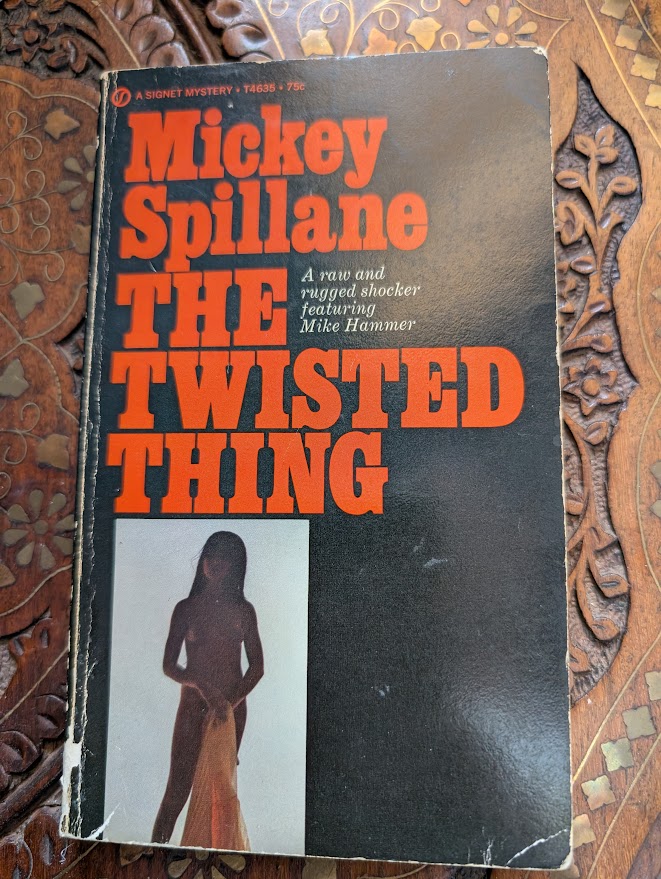
This is a Mike Hammer mystery. I had heard of Hammer and knew he was one of the classic hard-boiled detective characters. I pictured him vaguely as one of those tough talking film noir characters. Back in the day, Mike Hammer mysteries were wildly popular, maybe the most popular of hard-boiled detective stories. Which makes sense, because Hammer is the most over-the-top hard-boiled detective I’ve ever encountered. He’s completely ridiculous but also utterly awesome.
This book starts with Hammer beating up a crooked cop and only gets more violent from there. Hammer is huge and angry and kinda looking for excuses to pull out his gun. (Which he constantly calls his “rod” because he’s super hard-boiled and unbothered by metaphor.) He will punch a dude for the smallest of reasons, and this is treated as more heroic than psychotic. Hammer is also irresistible to the ladies and always lookin’ to get laid. He’s chock full of film noir slang and old school outlaw masculinity.
He’s almost an offensive caricature of a hard-boiled detective, and the whole book is full of vaguely offensive stereotypes and stock characters: the ex-con trying to make good, the former sex worker hiding her past from her employer, the murderous lesbian with masculine vibes, the boy genius who’s emotionally stunted, the cop on the take, the casino owner with mob ties . . . every character is so over the top it’s actually hard for me to be upset about it because none of it feels serious. If you think about this story for even one second it gets pretty silly.
But Mickey Spillane’s writing is so tight and gripping that I didn’t have one second to think about how ridiculous it all was. It was thoroughly fun to watch Hammer punching twits in the face, sneaking around in dumbwaiters, swimming through freezing water to find the bad guy’s escape route. This story is all plot all the time and I couldn’t help but enjoy it. I was way more excited by reading Hammer’s adventures than I was by any of the other hard-boiled classics I’ve read.
If you’re looking for something classy, I doubt Hammer’s what you’re looking for. Stick to P.D. James or Agatha Christie or, if you’re in a noir mood, maybe Raymond Chandler. If you want action and the hardest of hard-boiled insanity, this is the detective for you.
How dark is it? Dark like a hospital without enough windows
How good is it? 8/10 emotionally, 5/10 as a history
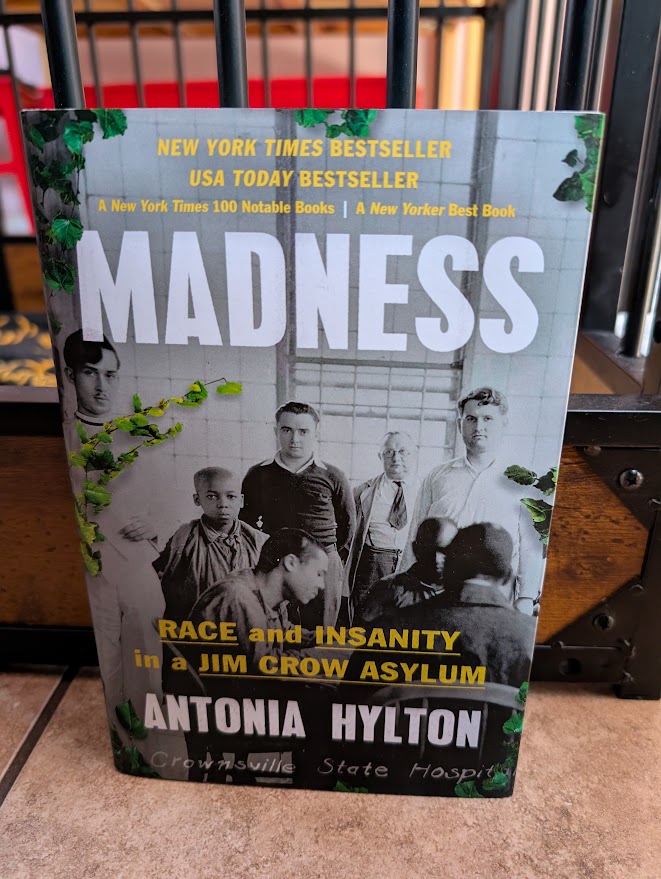
This month’s Morbidly Curious Book Club selection was Madness: Race and Insanity in a Jim Crow Asylum. It’s centered on the Crownsville hospital, built as a mental institution for Maryland’s black residents back in the days when the state was still segregated. It is an astounding coincidence that I spent part of my childhood in a town not far from this hospital and never knew it was there. Google maps tells me it’s a fifteen minute drive from the house I grew up in. I have clear memories of a few of the places talked about in this book. I haven’t lived in Maryland since last century but I have siblings in and around Baltimore. As I said, this is all just a big coincidence and I didn’t choose this book myself but knowing the area gave me an added layer of interest and an emotional connection I hadn’t expected. On top of that connection, I also spent several years doing housekeeping for a mental hospital when I was younger. Ever since then I’ve had a small personal interest in the history of mental health treatment and the thorny issues of institutionalization. Because of all that, I’m not sure I can be objective about this book. I found it fascinating and emotionally compelling, but how could I not?
This book is a history of the Crownsville State Hospital in Maryland, built in 1911 as the only mental health facility serving black people back when the state was still segregated. It’s a history of that hospital but it also uses Crownsville’s history as the starting point for a larger discussion about race and the mental health system in the U.S., focused on how it serves (and too often fails to serve) black Americans. It relies heavily on interviews with former patients and staff, oral history, and personal interactions the author’s family has had with the mental health system.
As a history, it’s not the best. Crownsville’s records are spotty for various reasons so putting together a thorough history is already a tall order, and Hylton hits a lot of major themes in the history of mental health care but she isn’t even trying to be thorough with that. She jumps around a bit between places and time periods, which made it hard to form an orderly timeline or historical picture as I read. Hylton also comes at this history without any special understanding of mental health so she sensibly avoids deep discussion about treatment philosophies and challenges, especially in the time before drug treatments became common. I find that kind of discussion fascinating and I felt the lack of it, but it’s fair that Hylton’s interest lies elsewhere.
Hylton’s interest centers more around broad historical and political trends and personal experiences. Most of the stories, especially as she talks about the sweep of history beyond Crownsville, are chosen more for theme and emotional resonance than historical completeness.
This book absolutely excels on the ‘theme and emotional resonance’ front, though. Hylton clearly wants to open our eyes to two facts: one, that the larger background of racial tension and discrimination can complicate and contribute to mental health struggles for individual black folks and two, that those struggles are made worse by the very good reasons those black folks have to distrust the mental health care system. By focusing deeply on personal stories of former patients of the Crownsville hospital and of many caring but under-resourced employees, Hylton really drives those facts home in a compelling way.
Now that I’ve highly recommended this specific book, I’d like to say a few words about my general book club experience so far. This is the third pick I’ve received from this book club and I’m beginning to worry that it’s actually the Very Important Issues book club that wants to justify its darkness by making sure each book I receive teaches me deep and important lessons. I don’t need my totally voluntary book club to apologize for liking morbid topics or make up for its darkness by acting very very virtuous. I enjoyed this book and I do think it’s very very virtuous and very very important, but I do hope this club sends the occasional book that’s just darkly historical and entertaining.
How dark is it? Dark like a cloudy day. Also very trippy.
How good is it? 4/10 ghosts from the past
Be warned right now that spoilers abound. The last fifteen pages of this book changed how I thought of everything that came before so I can’t really review it fairly without explaining a lot of the plot. That said, here we go!
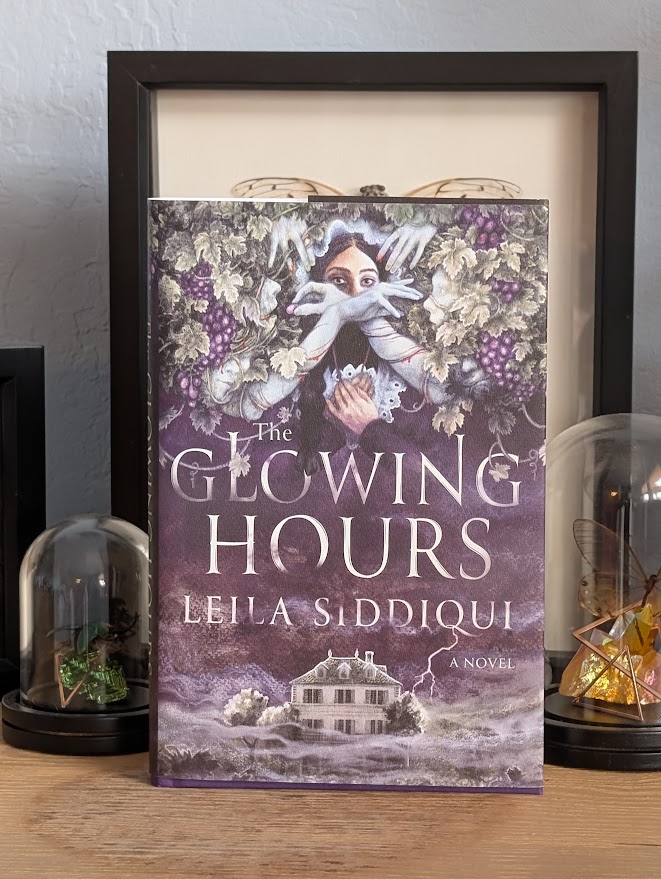
Mehrunissa Begum is the granddaughter of the Nawab of Lucknow. She’s basically a princess and she will not let us forget it. Mehrunissa Begum, Mehr for short, is also half British on her father’s side but when her British father left her mother he only took his son with him. Mehr and her mom were left in Lucknow with her uncle. They never saw him again.
Still, according to Mehr it was a wonderful life right up through her early adulthood, living in the zenana (the secluded women’s wing of her uncle’s estate) and waiting to be married off. There are a few hints that things weren’t as idyllic as Mehr remembers but we’re left to trust her story until the very end of the book. As far as we’re told, Mehr’s troubles began when her mother died and Mehr’s uncle insisted she deliver her brother’s inheritance in person, by hand. That meant a trip to England.
When she got off the ship in London, Mehr’s brother was not there to meet her. Instead, there was a lady from a ‘home for Indian women’ sent to take her in. The ‘home’ was a charity of sorts that took in Indian nursemaids out of work and found new jobs for them. After weeks and weeks with no word at all from her brother and no help from her uncle, Mehr has to train as a maid to earn money for the trip back to Lucknow. This work is beneath a princess like Mehr and she’s very very clear on that point, but she’s desperate to get home.
Who’s going to take in a maid with no experience and a huge superiority complex? Mary Shelley, that’s who. That’s right, Mehr goes to work for the famous writer of Frankenstein and her famous poet boyfriend/husband Percy Bysshe Shelley. Only Mary hasn’t written Frankenstein yet–we’re about to watch Mehr accompany them on the famous summer trip that inspires that novel.
The first half of this book is taken up by Mehr judging the hell out of the Shelleys and their friends. Mehr herself is an insufferable snob (and a terrible maid) but the Shelleys are also pretty terrible. So is Mary’s sister Claire. Lord Byron is even worse. Byron’s personal doctor, John Polidori, is only barely less terrible than the rest. This is probably pretty historically accurate; all of their terribleness is heavily based on the actual lives of all these people. They were mostly very troubled, very into free love peppered with extreme relationship drama, and probably none too mentally healthy. This book puts it in the most unflattering light possible but it’s not a completely unfair take on these authors’ personal lives.
From the beginning, Mehr takes a shine to Mary Shelley. Mary is depicted as spineless and barely there for almost the entire novel, so it’s not clear at all why Mehr likes her. They’re not really friends and Mary’s not especially nice to her or interested in her. In fact, Mary’s barely interested in anything. There’s some implication that Mehr is sexually attracted to Mary, so maybe that’s all there is to it. Percy’s a jerk and Mary’s hot, so maybe Mehr wants to sweep her away from all this? Could be, but this possibility is just barely explored and doesn’t really go anywhere.
In the second half of the book all these terrible people (including Mehr) and a handful of not-so-terrible house staff are trapped in a weird nightmare full of ghosts and possibly vampires. They’re literally trapped in a villa by the lake, unable to leave, becoming sicker and more confused as time wears on. Mehr and Polidori both have their theories about the haunting but they both think each other’s theories are stupid. Mehr thinks she’s the only one not being haunted only to find out the secret room she’s been enjoying is actually chock full of ghosts. This part is weird and full of spooky images, only everyone is so terrible it’s hard to care what happens to them. The haunting also has very little buildup, going from “maybe it was just a nightmare” to “all ghosts all the time” nearly instantly so there’s no delicious suspense building or anything like that.
So far, the entire book is watching people be terrible, then watching them be terrible and also haunted. I was irritated the whole time. I don’t know what I expected from this book but this was a painful slog I hadn’t prepared myself for.
Then it got worse. Suddenly, in the last forty pages or so, the weird haunting became a weird mystery. We suddenly find that Percy Bysshe Shelley and Lord Byron have kidnapped Mehr’s brother and hidden him in an unused room in the cellar. No, they didn’t kidnap him months ago when he was failing to reach out to Mehr. They kidnapped him a couple weeks ago in an elaborate plot to make him sign over his new inheritance. (Even though they’re not really sure what he’s inheriting or how much it’s worth.)
That’s right, the two greatest poets of the Romantic era are bumbling schemers out for a quick payday. Mehr figures this out and a stand off ensues, first with Lord Byron threatening to shoot either Mehr or her brother if he doesn’t get that money, then with Byron and Percy fighting over who deserves the stolen inheritance more. This plot twist was sudden and ridiculous and made me actively mad.
Then it got one shade more ridiculous. You might be wondering how a ridiculous kidnapping plot resulted in a horrific haunting. Turns out the answer is Mehr herself. When her mother died, she insisted Mehr deliver a taweez (kind of a talisman) directly to her absent British father. Of course, she couldn’t find him so she’s had it this whole time. Turns out the taweez is a curse, meant to torture Mehr’s dad with the memory of all that bad stuff he did but instead it’s been haunting everyone in the villa. Oopsy doopsy.
But it all has a happy ending! Turns out the inheritance Mehr thought was for her brother is actually for her. She’s rich now! She’s also not haunted because apparently once she figured out the taweez she could just . . . stop the hauntings. Easy peasy. Mehr is rich now, her brother is saved, Mary and her friends are once again free to write famous things and be awful. The book’s last fifteen pages wraps everything up in a simple little rush. It was like the whole dark novel turned into a Scooby Doo episode.
This was the most ridiculous thing I have read in a long time and suddenly, at the very end, I found it hilarious. Instead of trying to immerse myself in a moody gothic horror and failing, I stepped back and saw it all as a campy farce and I liked that much better! That’s why I’m spoiling the hell out of this book: I think I would have enjoyed it a whole lot more if I’d read it as humor from the beginning. It wasn’t quite enough to save the novel for me and I’m not at all sure the book is supposed to be funny, but reading it as a comedy bumped The Glowing Hours up at least two points on the ten point scale.
Jennifer Daniels is back in town. It’s been four years since the summer of book one and Jennifer is coming home reluctantly. This book explores what the aftermath of a slasher could look like for survivors in the real world. How would the legal system respond to a person who had to kill or be killed? How would lawyers and prosecutors deal with a huge body count and a suspicious lack of hard evidence pointing at the identity of the killer? In the time between books, Jennifer Daniels is charged with and prosecuted for a number of crimes. Her heroism in opening the dam to stop the forest fire is reduced to destruction of government property. Surviving the massacre and then being shuffled through the judicial system leaves Jennifer disconnected from the version of herself that was Jade. She wants to be Jennifer now but being on parole means moving home to the house she inherited from her dead father.
Letha Mondragon has severe facial disfigurement from her run-in with Stacy Graves and has endured multiple reconstructive surgeries to try and reattach her jaw. She’s in constant pain and her jaw is wired shut. She has married Banner Tompkins and has a baby. She processes the trauma of everything that happened in book one by making herself as much an expert on slashers as Jade ever was.
Jennifer and Letha are just two examples among many in the book that believably portray characters surviving a huge collective trauma. Nobody miraculously bounced back or conveniently moved on. Everyone in town lives with their hackles permanently up. This plus a record breaking blizzard set the stage for a new outbreak of killings. Proofrock is cut off from the outside world with a notorious serial killer on the loose. Jade, Letha, and probationary deputy Banner Tompkins are trying to keep history from repeating itself while fighting to stay alive themselves.
This book is every bit as good as the first. It just is. In fact, I think I liked it a bit better. Jennifer’s reluctant journey back to Jade is heartbreaking and thrilling at the same time. We get to see a more mature and sober version of her leading a group of fellow Proofrockers who actually grasp the stakes this time around. Jones delivered a new set of slasher tropes interwoven with stunning surprises. His characters remained nuanced and interesting. Old characters got new layers and new characters were just as developed. “Don’t Fear the Reaper” is a fantastic book and honestly the best thing you can do is to just go read it.
How dark is it? Medium dark, like a mine entrance.
How good is it? 4/10 dark spirits
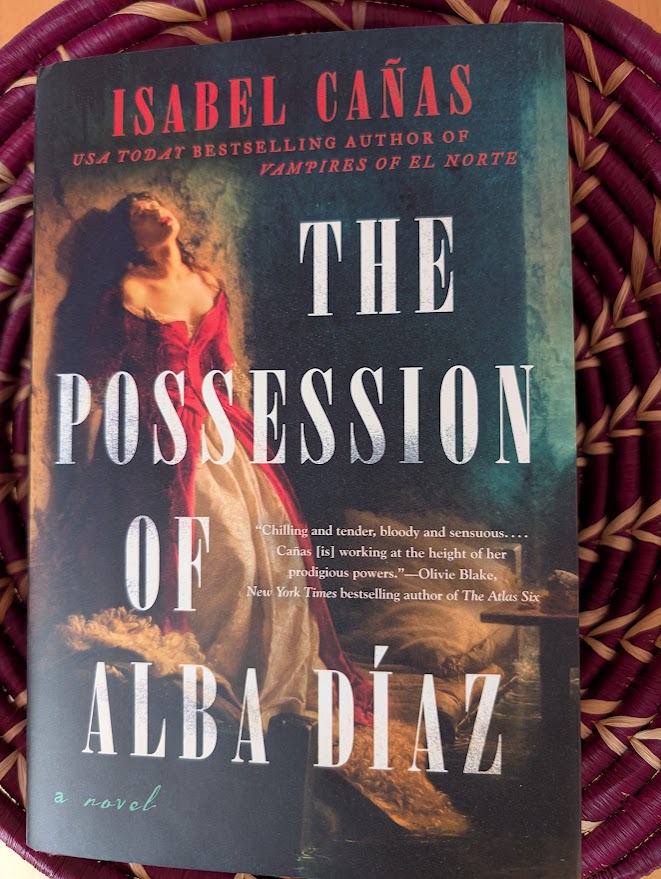
Mexico, 1765. Alba Diaz is rich and of marrying age. This is good, yes? No. This is more of a “marriage as business deal” time and place and Alba is terrified of ending up with some creepy old dude with a booming silver mine. So she makes a deal with her friend Carlos; he’s around her age, attractive, and has as little interest in marrying as Alba does. They agree to marry, forging their own business alliance before a much less pleasant one can be forced on either of them. So far, so good.
Then, two things happen. First, Alba meets Carlos’s magnetically sexy cousin Elias. Second, a plague hits. (The Matlazahuatl they describe was a real plague that swept through colonial Mexico several times in this era. It sounds terrifying.)
And here I must digress for a moment, because part of this story is told from Elias’s point of view. Elias grew up in Spain while his father worked here in Mexico at the family silver mine. While his father remarried a local and had another kid here in Mexico, Elias and his mother did not have a great time back in Spain. He’s pretty bitter about it. He has a checkered past, including a stint doing forced labor in a Spanish mine and some time in Constantinople studying alchemy and the occult. His alchemist buddies gave him a bunch of money and sent him to Spain to buy mercury for their experiments, and he does just that. But he also finds out his estranged father has died and Elias is more or less expected to take that mercury to Mexico and use his mad mercury skills to pay of his father’s debts. (They don’t explain it much, but mercury was key to refining the silver out of the ore they were mining.) He’s pretty pissed about the whole thing; the only silver lining (hah!) is the amazing gal he meets at a party cousin Carlos drags him to. The amazing gal is, of course, Alba.
Okay, back to the plague. Alba convinces her parents to move up to Carlos’s family silver mine until the plague burns itself out; they can ride out the plague safely up in the mountains while also finalizing the details of Alba’s impending marriage. The big downside is that sexy tempting Elias is coming, too, since he came to Mexico to work in that exact mine. Since he’s part of Carlos’s family, she can’t entirely avoid him. She also has to hang out with Carlos’s best friend, Bartolome, a soldier-turned-priest who wants to win Mexico for the Inquisition or something. Alba thinks he’s creepy but she’s also very religious so she feels guilty for thinking he’s creepy.
It’s here, up at the silver mine, that Alba becomes very clearly possessed by an evil entity. As her symptoms worsen, she doesn’t know who to turn to. Bartolome represents God and the church, so he’s an obvious choice, but Alba doesn’t quite trust him. Elias has some experience with the occult and Alba does trust him (turns out Elias is a pretty nice guy) but the book he’s using to help is, as far as they both can tell, evil. It’s a puzzle.
Things get worse and worse as Bartolome and Elias approach the problem from opposite angles. Eventually Bartolome involves the Inquisition and blames the whole possession on Elias’s sorcery. Things are not looking good for either Alba or Elias.
Alba is a sympathetic character, Elias is interesting, Bartolome makes a good villain, and the possessing entity itself is quite intriguing. I was excited to be along for the ride as the book got more violent and mysterious.
It chugged along and kept me interested right to thend, which is both bloody and dramatic. It’s also kind of a happy ending for Alba and Elias.
This is where the book lost me. Without giving away too many details, it felt like too much of a hand-wavey ‘deus ex machina’ situation to me. I love a good happy ending but this book set us up for a heartwrenching tragedy and just reversed it in the last few pages in a way that felt cheap. But right up until then, this was a fairly satisfying read.
This post first appeared on our Substack in September 2025.
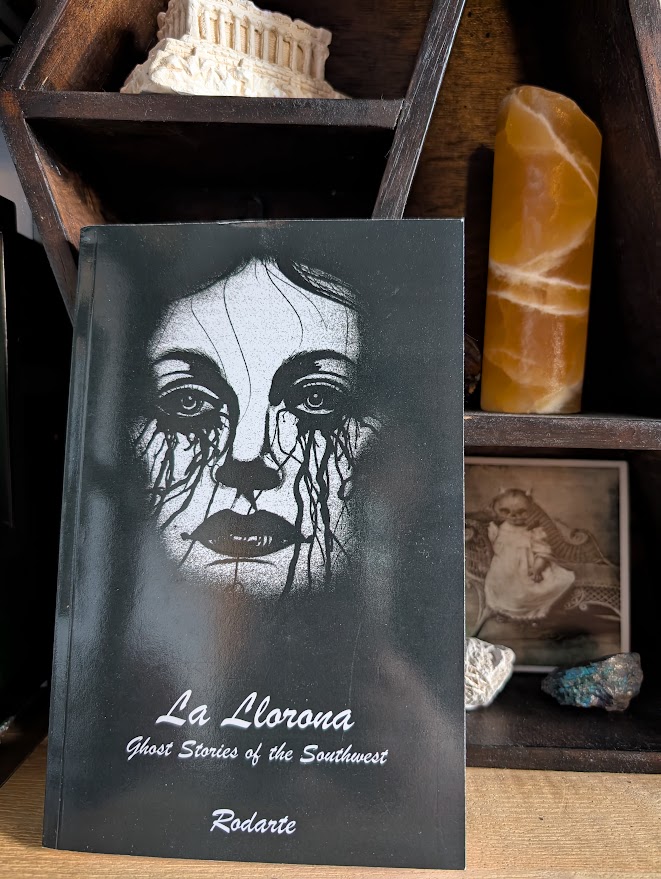
Let’s talk about La Llorona, a collection of short stories by Chris Rodarte.
I picked this one up in a gift shop. We’d first moved to Santa Fe and were still doing tourist stuff. Gift shops are a surprisingly good place to find offerings by local historians and folklorists. My copy seems to be signed by the author, who grew up in Albuquerque, but I didn’t notice that at the time. In fact, at the time I laid it on a table and promptly got distracted by other books. I remember squashing a large bug with it and though I thoroughly wiped it off the cover still feels a bit psychically tainted with bug guts. I think this is why it took me two or three years to actually start reading La Llorona. No, I’m not kidding. Yes, that’s a dumb reason to put off reading this.
Chris Rodarte’s author page says he’s a teacher, which explains his writing style. It feels a lot like a “Scary Stories to Tell in the Dark” collection. Dark and spooky tales told in a simple easy style that’s accessible to just about anyone. A great collection for young readers looking for a scare, with the same potential to either scar a kid for life or ignite a lifelong fascination with the darker side of literature. It’s a quick read with a nice variety of Llorona tales, ranging from uncanny to terrifying to tragic.
Some of the stories are inspired by real events and stories told to the author personally, but they’re not raw ghost experiences. The raw stories are recreated and blended into tight little tales fitting into various common categories–hitchhiking ghost, graveyard haunting, spirit warning, cautionary tale–and all with La Llorona as a central figure.
To be honest, I’m not convinced all the specters are actually La Llorona; some of the connections seem pretty tenuous. I’m not even sure if I believe in ghosts, but La Llorona has a pretty specific backstory and connection to drowning so if she does exist, some of these stories fall pretty far outside her usual bailiwick. Still, even if these experiences aren’t all La Llorona’s doing, they’re chilling nonetheless.
One of my favorites is “The Stick Lady”, based on a friend’s experience. As kids, the woman and her friends were caught in an arroyo when a storm hit in the distance. They began to hear loud cracks, like branches breaking, and saw a terrifying old lady walking toward them ahead of the storm. They fled from the ditch just in time to escape the stick lady and a flash flood coming their way. This was a quick and believable story, made more eerie by being unsure whether the Stick Lady was warning them of the flood or bringing it to them.
Another great story is “Two Minutes to Midnight”, a made up story set in a real building in Santa Fe. The Public Employees Retirement Administration (PERA) building was put up in the 1960s, partially over the site of a historical graveyard. It seems the builders just paved over a lot of bodies, which means every time they try to add or renovate they find old bones. I’m not surprised that ghost sightings began pretty much from the moment the building opened. (Fun fact: this building is not that far from my house. Luckily we’ve never been haunted by its ghosts.)
In this story, two friends are allowed to ghost hunt by an uncle who cleans the building at night. The building is so haunted they have a hard time keeping night workers, so the building is deserted as the uncle leads them way down into the sub-basement and leaves them there. The kids’ annoyance at this prank turns to terror as La Llorona and an army of rats chase them through the building. The PERA building’s history makes this story more intense but it’s spooky and suspenseful even without knowing about the building.
Like most local ghost story collections, this isn’t high literature or destined for the best seller lists. It’s charming, though, an easy read, and an exciting perspective on New Mexican folklore and history. If you like little hints of truth and experience in your spooky tales or have a youngster looking for a good scare, this is a fun little book to pick up.
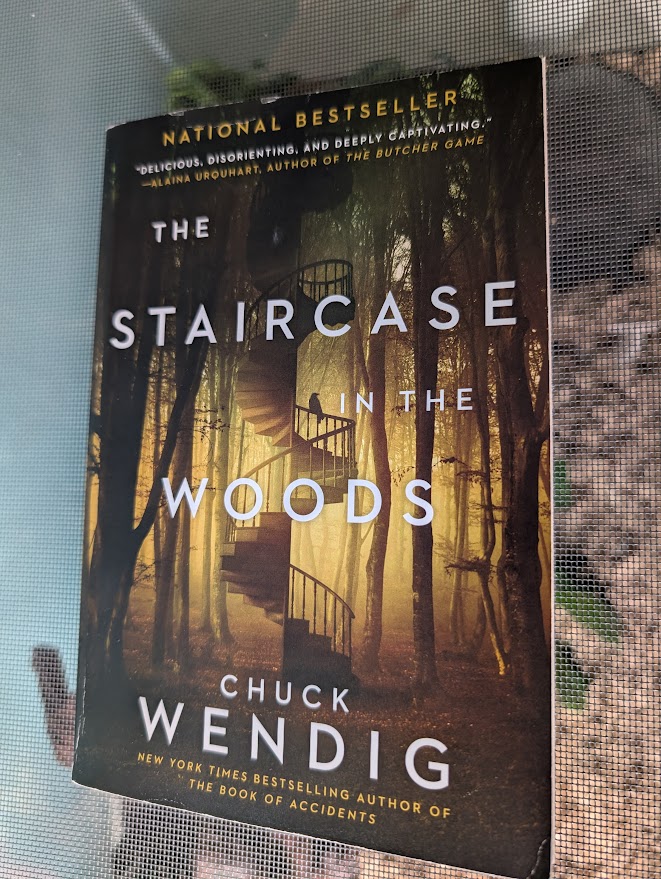
What’s the book? The Staircase in the Woods by Chuck Wendig
How dark is it? Not too gory but kind of existentially dark
How good is it? I give it 6/10 decaying fish
This book was pretty surreal. I saw it on a display and thought, “yeah, I remember pictures of woodland staircases going around the internet a while back. Makes sense they would inspire a horror story.” This book was, indeed, inspired by those pictures.
Mostly, this book is devoted to the kind of otherworldly house those stairs might lead to.
Way back in high school, Owen and his friends hiked out to a local camping spot to get wrecked in peace and anjoy the wonders of nature. On the way they discovered this random staircase that had never been there before. Just a staircase, all by itself, with no sign of a house around it. That was weird and terrifying, so they ignored the hell out of it and hiked on. But they were high schoolers so eventually drama happened and one of them decided to climb it. Matty, the most popular and well-adjusted of the friends, wanted everyone to climb the staircase with him but no one else was into it. They were all fighting with each other or too high to understand the request or dealing with their own shit. When everyone refused to join him, Matty climbed the ladder by himself and when he got to the top he just . . . vanished.
All his friends had to go home and just live with that confusion, as well as the suspicion of the whole town because there was no trace of Matty and no convincing explanation of his disappearance. Because the staircase vanished, too. The remaining friends, Owen, Lore (known as Lauren back in high school), Nick, and Hamish try to move on with their lives and . . . it doesn’t go that well. Owen and Nick are largely consumed by various mental health issues and Lore and Hamish, while outwardly successful, are emotionally far from okay. They spend decades like this, ignoring each other and nursing their various wounds, until Nick finds another staircase and convinces everyone to climb it. For Matty. This time they all vanish.
At the top of the stairs is a nightmare realm, literally. They’re trapped in a house where room after room is the scene of decay and tragedy; some rooms are the scenes of murders or suicides, some are the scenes of low points in the friends’ own lives. This dreamworld isn’t out to kill them, exactly, but it’s definitely trying to beat them down until they maybe kill themselves or each other in despair. It’s definitely trying to catch each one alone and vulnerable.
Most of the book takes place in this nightmare series of rooms, which makes it kind of a surreal book that runs on dream logic. While there’s plenty of gore and tragedy to be seen in the rooms, we’re really here for the emotional journey each character is taking as they attempt to rescue themselves and each other. We learn about each of the friends and the various pains they carry, both secret and not so secret. They’re all interesting and relatable enough that I was invested in their journey and whether they (and their friendships) survived this ordeal. It felt a little “after school special” in parts, trying too hard to teach me emotional lessons, but I do have a sappy side so I still enjoyed the book overall.
When I was little I was really weirded out by stories that ran on dream logic; Alice in Wonderland freaked me right out more than anything actually meant to scare me. I’m way more tough and grown up now but dream logic still sucks me in pretty well, disorienting me in a way that makes the horror scenes much more effective. The book starts to lose me near the end as the dream logic devolves into a backstory that doesn’t make a lot of sense but by then I really did care about the characters and whether they’d make it out alive (and of sound mind). I don’t know that I’m itching to read Wendig’s entire oeuvre but I didn’t hate this.
This review first appeared on our Substack in September of 2025.
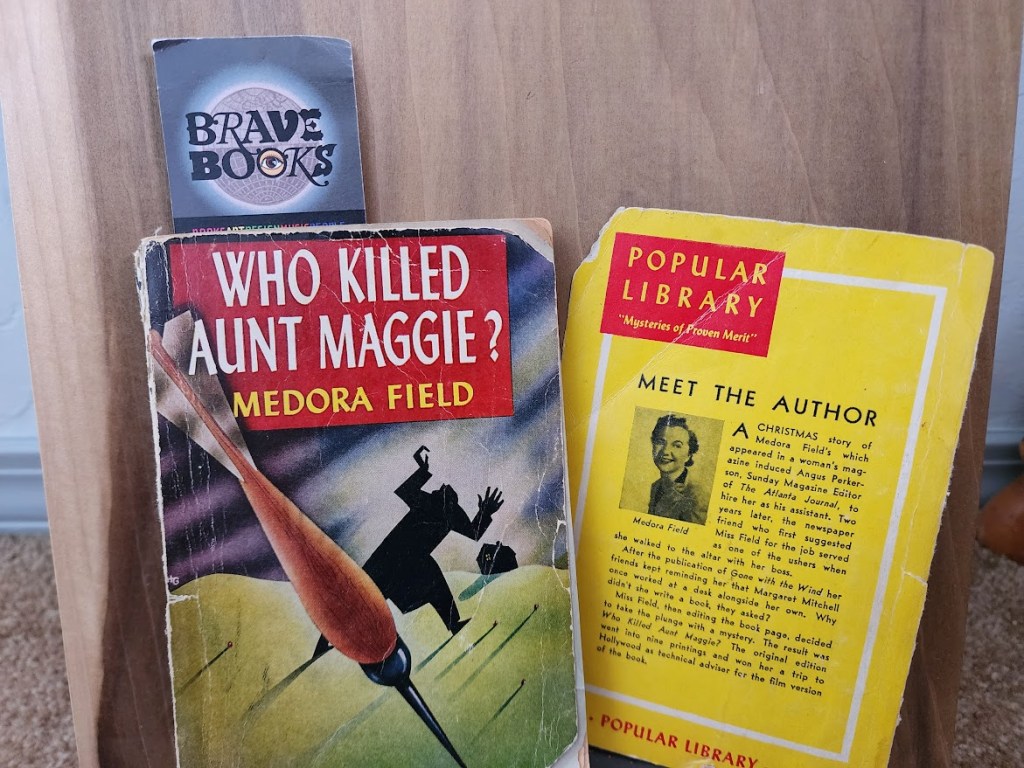
Let’s talk about Who Killed Aunt Maggie by Medora Field. This is one of a handful of pulp novels I picked up in El Paso. I basically scanned the pulp table looking for female author names and murdery titles. I knew nothing about Medora Field and I didn’t know how hard this book is to find these days. Like a lot of pulp paperbacks, my copy started falling apart the second I opened it up, so I’m not surprised they’re becoming rare.
This book is casually racist. It was published in 1939 by a well off white lady from Georgia, so it’s no surprise. The only black characters in this mystery are servants, and they’re all portrayed as kind of dumb and childlike (and extremely devoted to the rich white family who employs them). Late in the book there’s a short speech about the moral inferiority of black people. Medora Field (married name Medora Field Perkerson) was an advice columnist and historian who wrote a book about Georgia’s historical buildings and was friends with Margaret “Gone with the Wind” Mitchell, who was also racist.
Honestly, it’s the unthinking casualness of the racist bits that gets to me. I read a lot of older novels so I’ve run across a lot of racist and sexist and colonialist content. As a modern white American lady, I have the luxury of taking a detached view of most of it. A surprising number of old novels actually examine and push back against the views of their time in ways that are interesting and hopeful, even when they fall far short of modern standards. Sometimes, though, there’s just zero thought and zero pushback and the old timey awfulness just sits there stinking up an otherwise decent story. (I suppose that’s sometimes true in contemporary fiction, too.)
It’s a shame because this is an otherwise decent story. Not great, but decent. The mystery takes place in a grand old plantation house Sally Ambler has inherited from her family. She’s offered to host an impromptu engagement party for her friends Claire and Bob. Bob’s old fling, Eve, is crashing the party and Sally’s Aunt Maggie has also been staying at the house to look through the library and do some family research. Maggie has also been nosily looking at all the recent renovations and making one last search for the secret room their ancestor was rumored to have built back before the Civil War.
As soon as she arrives to get the party ready, Sally feels something isn’t right. Who was that man she saw dashing away through the backyard? Where have the servants got off to, when they were supposed to be here dusting bedrooms and preparing dinner? She’s a bit spooked, but soon all the guests arrive and those thoughts are pushed out of her head. Until bedtime, that is, when she walks out of the kitchen to find Aunt Maggie crumpled at the bottom of the back stairs. At first Sally assumes Aunt Maggie fainted or somehow tripped down the stairs but it soon becomes clear that something far more sinister is afoot . . .
We spend a lot of time watching characters bumble about the house while learning about their various tense relationships and wondering who might have motive for such a crime. Sally and her husband try to call the police but the phone line has been cut. They try to get Andrew, the butler, to drive to the nearest town for help but all the cars’ tires have been punctured. A fierce storm comes up and the electricity goes out, which leads to a night of various suspects roaming about the house with candles, finding clues and having spooky moments. This isn’t the tightest of mysteries but there are fun and intriguing moments as the night progresses.
The next day they finally get the police and coroner out to investigate but at first this only leads to more confusion and questions. The coroner, by the way, is a blind lawyer. In these forensics-heavy days of medical examiners and crime scene investigators, it’s easy to forget that coroners with no medical expertise did and still do exist. This coroner’s expertise is in ferreting out motives and secrets by listening intently to the way people talk. He’s an interesting character, but he’s also the one who gives the racist speech, so that ruins things a bit.
After a lot of worrying and conjecture and confusion, Sally literally stumbles onto the mystery’s solution, which is a lot more tense and suspenseful than it sounds. The book’s finale was pretty exciting. Not sure it was worth the racism, but it was a good ending.
And there we have it. Who Killed Aunt Maggie was an interesting experience but I’m not itching to find Field’s second novel. It might interest you to know both of her books inspired movies in the 1940s; I haven’t seen either movie and the synopsis for the Who Killed Aunt Maggie film sounds not much like the book, but if you’re into old movies you might look them up. Tell me if they’re any good. Tell me if they’re also casually racist.
It’s the Friday before Independence Day here in the USA, which means we’re all too busy loving/hating America to read full reviews. It’s also the day after my birthday and I’m probably getting a tattoo as this goes live. Yes, we all lead very full lives and today I’m just leaving some quick mini-reviews here of a few books that didn’t quite fit the normal profile for one reason or another. Enjoy.
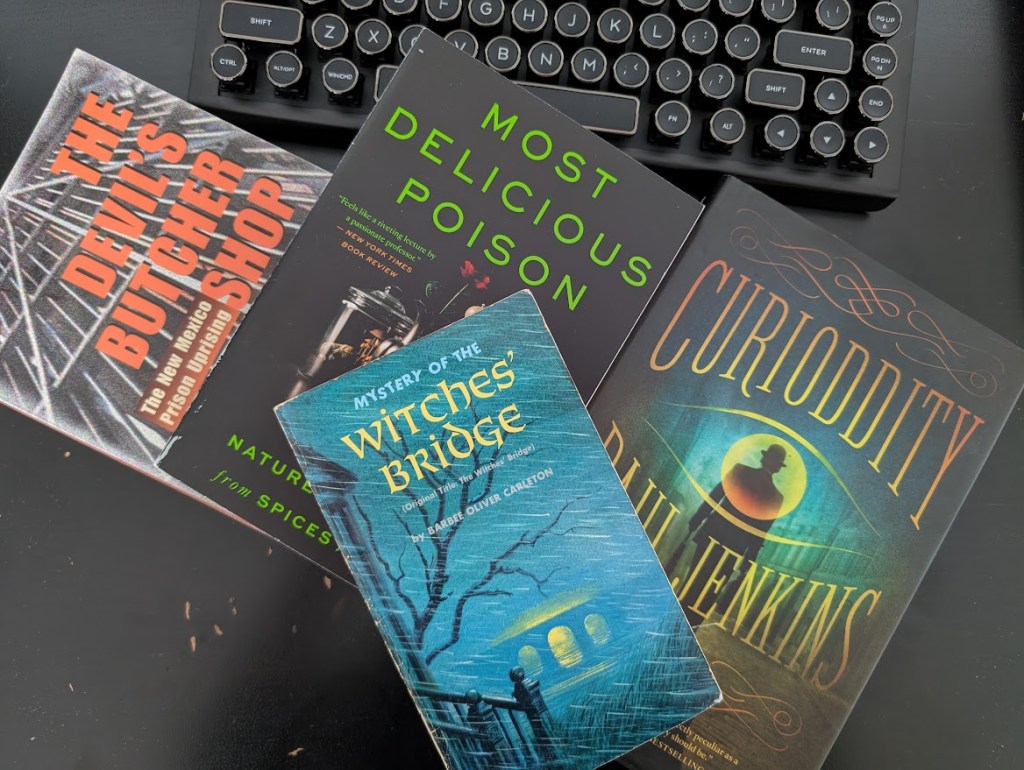
Most Delicious Poison
Written by Noah Whiteman, the title Most Delicious Poison: the Story of Nature’s Toxins from Spices to Vices pretty much sums it up. I dip into history and popular science on occasion, and this one delivers some pretty interesting info about how plants protect themselves and how humans have learned to use those defensive chemicals as flavorings, medicines, and recreational drugs. The book is inspired by Whiteman’s struggle to understand his father’s debilitating problems with alcohol, so along with exciting stories about medicine and interesting facts about flavorings, we get vulnerable discussion of the more dangerous uses of plants. It’s not exactly our usual Darker Books fare but I found it fascinating and quite moving in parts.
Last October we stayed at the McCoy Hotel in Tucson, which had a cute red desk with a pile of paperbacks on it for our reading pleasure. This was in the pile. It’s a mystery for youngsters written by Barbee Oliver Carleton; the internet has precious little about her but she apparently wrote a lot of stuff for youngsters. This book is kind of quaint and cute, with detailed and interesting descriptions of the Massachusetts wetlands where it’s set. It’s not particularly spooky or exciting but it’s fun in a Nancy Drew/Hardy Boys way.
Last Halloween I wrote a bit about the New Mexico State Penitentiary, which is probably haunted because of the deadly prison riot of 1980. Back then, I said I’d bought a book about the riot but I hadn’t read it yet. This is that book. The main reason I’m making this a stub instead of a full review is that, even for a hardened true crime enthusiast like myself, this is a hard book to get through. It’s not for everyone. Still, I was riveted by Roger Morris’s book, which details not only the riot but the appalling mismanagement leading up to it and the shocking lack of consequences afterward (both for the murders committed by rioters and for the negligent and corrupt managers of the prison). It was thorough and moving, and I appreciated the way Morris built sympathy for the prisoners while making it clear that the actions of many prisoners during the riot were also inexcusably awful. This one will stick with me a long time and I’m glad I read it, but it’s definitely one of the darkest books I’ve ever read.
This one, by Paul Jenkins, is the opposite of dark. I bought it at an occult book shop in Tucson and it’s got a mysterious cover so I thought it would be at least a little dark. Instead I got a rollicking absurdist adventure with a lot of goofy humor. The book is not set anywhere in particular but Jenkins is a British comic book writer, which explains why the book felt so much like a Douglas Adams or Terry Pratchett project. It also explains the main character, Wil Morgan, who is exceedingly straitlaced and depressed about life; he’s constantly baffled and disconcerted by the zaniness suddenly springing up around him even though it’s making his life better by leaps and bounds. This type of straight man seems common in British comedy. Anyway, the book is fairly funny and if you like British goofiness you should read it. But it isn’t dark. Not even a little bit.
This review first appeared on our Substack in 2025. This is a repost.
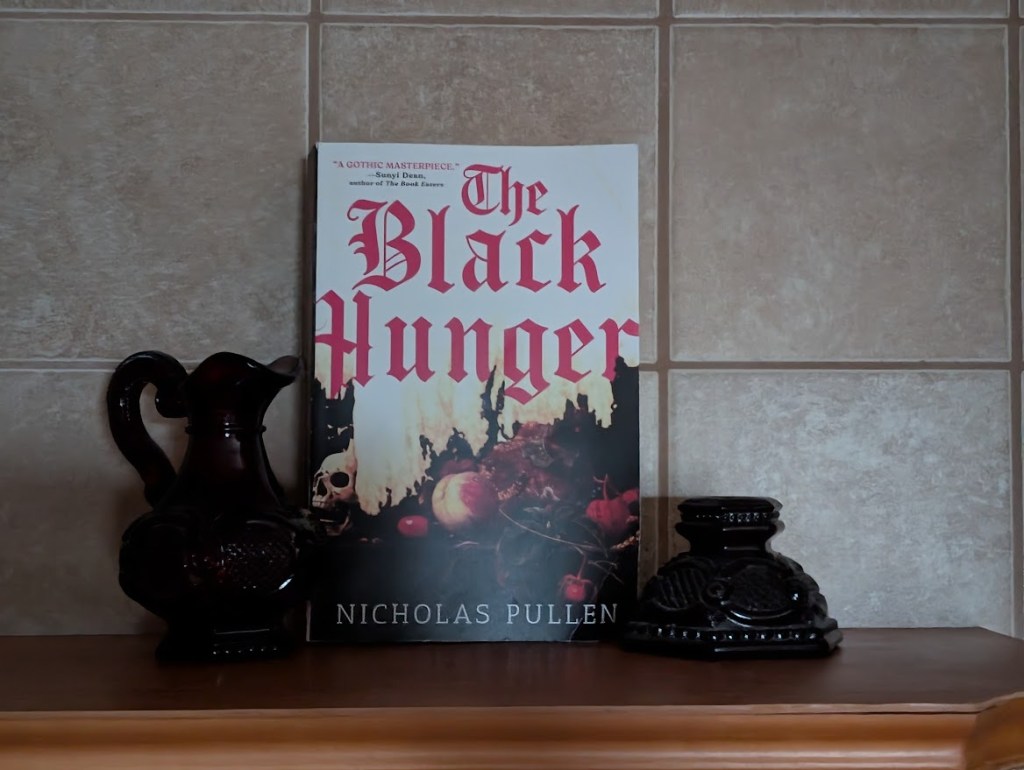
Let’s talk about The Black Hunger by Nicholas Pullen. This is a new title, published last year, with a quote on the cover calling it a “gothic masterpiece.” The quote is from Sunyi Dean, author of The Book Eaters, which I read sometime last year. Honestly, I should not have taken this as a ringing endorsement.
I liked The Book Eaters okay, it had a cool premise and decent action, but the flat characters left me cold. How did I expect this new book, recommended by the author of flatness, to have anything but flat characters that also left me cold? These two books are very different but they have the exact same positives and negatives. Great concepts and interesting world building but characters so flat they felt like afterthoughts.
The Black Hunger is set in the British empire of the early 1900s, following John Sackville and his faithful manservant/lover Garret Benson from the hallowed halls of Oxford all the way to India and then into Tibet and Mongolia as they try to foil the plot of an evil Buddhist cult. This alternate mythology, where the future of the world hinges on the various sects of Tibetan Buddhism fighting the unholy Dhaumri Karoti, is great. It’s interesting and original and exciting. This feels like the dream Pullen just had to put into words–he’s clearly put a lot of thought into creating a rich world surrounding this alternate Buddhist history. Whenever the book centers on this–when we see the cultists’ dark rituals, when we follow John and Garrett to meet the Dalai Lama, when we read flashback sections of previous encounters with this cult–the book comes alive. It all feels real and electric. Really, I can’t say enough good about these parts.
When we’re not directly following the cult’s action, though, the story falls flat. All the characters feel fairly wooden, heroes and villains alike, and nothing is told with the same vibrancy and detail as the culty bits. I didn’t find John or Garrett very interesting and their great love affair felt a bit like a convenience. They grew up together and remained unfailingly loyal to each other to the end of the story. If they’d been more deeply written, this would have been a great love affair tinged with the sadness of having to hide themselves from a prejudiced world. It’s clear that’s what their love was supposed to be, but I was unconvinced. They just didn’t feel very real or deeply motivated by anything; maybe this is true love or maybe it’s just too hard to meet other gay men in that cultural climate. John and Garret felt more like a step on the way to the cult action than anything else.
The villains are even more flatly written. Flat villains aren’t always a problem but the deep world building around the Dhaumri Karoti suffered a bit from the cartoonish villainry of the bad guys. The cult is based around the idea that one way to end suffering is to follow the traditional Buddhist teachings of detachment and right action, and another way is to just kill everyone. There can be no suffering if there are no beings alive to suffer. This is an interestingly scary alternative with great potential but it also makes us wonder what would lead someone to choose the dark second option. What despair would make that seem the right choice? That’s what I wonder, anyway. Apparently no one in the book wonders this at all–the Dhaumri Karoti all seem to do this purely for evil and bloodlust. Officially, they’re trying to end all suffering but they take pure delight in causing as much death and suffering as they can along the way. They don’t even try to justify it. It sometimes feels implied that they’re like this because they’re colonizers or because they’re serf-holding Russian lords, and that’s just how those guys roll. Even this could be interesting but the lack of character development just left a lot of thematic implications totally unexplored. I found that really unsatisfying.
Still, that whole Buddhist apocalypse cult thing was a really exciting idea. I’m fascinated by cults and apocalypses and the Dhaumri Karoti delivered on both counts. This is Pullen’s first novel, I’m pretty sure, so he has room to grow. If he can get as excited about his characters as he is about his alternate religious history, we could see great things from him in the future.